
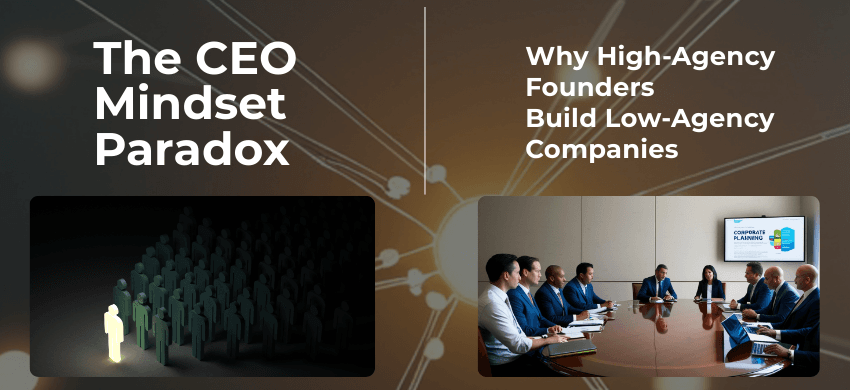
The CEO Mindset Paradox: Why High-Agency Founders Build Low-Agency Companies
A Leadership Development Framework for Scaling Without Becoming
the Bottleneck
By Andreas Pettersson | Leaders ADAPT | December 2024
Key Takeaways: The CEO Mindset Shift for Scaling Leadership
- The CEO Mindset Paradox: The same high-agency traits that build successful startups become the ceiling that prevents scaling leadership past $3-10M
- Agency Multiplication: The leadership transformation from “I can figure out anything” to “I build people and systems that figure out anything without me.”
- The Revenue Inflection Points: $1-3M (cracks appear), $3-10M (bottleneck visible), $10M+ (multiply or plateau)
- Nordic Leadership Development Model: High-trust, distributed authority, and collective capability outperform heroic-leader cultures at scale
- Beyond Vistage and YPO: Why traditional executive peer groups fail to address the CEO mindset transformation required for real scaling leadership
What Is CEO Mindset?
| CEO mindset is the mental framework that determines how a leader thinks, decides, and acts. For scaling companies, the CEO mindset must evolve from personal agency (“I solve problems”) to organizational agency (“I build systems and people that solve problems without me”). This transformation is the difference between founders who plateau at $3-10M and those who scale beyond. |
The CEO Mindset Problem Nobody Talks About Correctly
Dan Koe recently wrote something that stopped me mid-scroll: “The most important skill to learn in the next 10 years is agency.”
He’s right. And he’s also missing something critical that will cause 90% of his readers who run companies to fail anyway.
Koe writes for creators and solopreneurs. His definition of agency, the ability to iterate without permission, treat life as an experiment, and believe in the difficult, works beautifully when you’re a one-person operation. But here’s what happens when that same high-agency founder tries scaling leadership to 20, 50, or 150 employees:
Their CEO mindset becomes the very thing that prevents everyone else from developing theirs.
I call this the CEO Mindset Paradox. And after scaling a company from startup to over 150 employees before our acquisition by Canon, I can tell you it’s the most overlooked leadership development gap in business today.
I’ve watched this pattern destroy companies. Founders with the CEO mindset to “figure anything out” build teams that can’t figure out anything without the founder’s input. Leaders who pride themselves on decisive action create cultures where nobody else dares to decide. Visionaries surrounded by people waiting for instructions.
The agency that built your success becomes the ceiling that limits everyone else. This isn’t theory. It’s the reality I see in 8 out of 10 CEOs I work with who are stuck between $3M and $10M in revenue. The CEO mindset that got them there won’t get them further.
The question isn’t whether you have the right CEO mindset. If you’ve built something worth scaling, you clearly do. The question is whether your CEO mindset is building or destroying the capability of everyone around you.
The CEO Mindset for Scaling: A Complete Definition
The CEO Mindset for Scaling is the leadership transformation from exercising personal agency (“I can figure out anything”) to building organizational agency (“I build people and systems that can figure out anything without me”). This is fundamentally different from the CEO mindset required at startup.
Unlike delegation, which transfers tasks, the scaling CEO mindset transfers decision-making capability, judgment, and autonomous problem-solving throughout the organization. The test: Does your absence slow anything down? If yes, your CEO mindset hasn’t evolved for scale.
This concept sits at the intersection of adaptive leadership and leadership development. It’s the missing piece in most executive peer groups and CEO coaching programs, which focus on making leaders more capable rather than making leaders who make others more capable.
Why the CEO Mindset That Built Your Company Now Limits It
Koe describes agency as “the tendency to initiate action towards a goal without outside prompting, instruction, or permission.” That’s a perfect definition for individual success. For scaling leadership, it’s dangerously incomplete.
Here’s the brutal truth most leadership development programs won’t tell you: every behavior that made you successful as a founder becomes a liability at scale. Your CEO mindset is working against you.
- Your quick decisions train your team to wait for decisions
- Your problem-solving abilities attract problems to your desk
- Your willingness to jump in and fix things creates a culture where nobody else jumps in
I call this the Agency Hoarding Pattern. And it shows up with almost mathematical precision at specific revenue stages. Understanding these inflection points is essential for any CEO mindset shift and real leadership development.
The Revenue Stage Breakdown: When the CEO Mindset Becomes a Bottleneck
$0 to $1M: The founder CEO mindset is everything. You should be making every important decision. You should be solving problems directly. This is the stage where Koe’s framework applies perfectly. Iterate without permission. Move fast. Figure it out yourself. At this stage, your CEO mindset IS the company. No leadership development needed beyond your own growth.
$1M to $3M: The first cracks in the CEO mindset appear. You’re hiring, but you’re still the answer to every question. Employees come to you for approval on decisions they should be making themselves. You tell yourself this is because they’re new, they’re learning, they need guidance. The real reason? Your CEO mindset hasn’t evolved. You haven’t learned to transfer agency yet. According to research from the Center for Creative Leadership, 38% of new executives fail in their first 18 months, often because organizations haven’t built agency-enabling structures. The leadership development gap starts here.
$3M to $10M: The CEO mindset bottleneck becomes visible. Growth slows because everything flows through you. Your calendar is packed with meetings that shouldn’t require you. Projects stall when you’re unavailable. Your best people start leaving because they feel suffocated by your CEO mindset. You work harder and harder, but the company doesn’t grow proportionally. This is where most founders get stuck. I’ve seen talented entrepreneurs work 80-hour weeks at this stage, exhausted and frustrated, while their companies flatline. The problem isn’t effort. It’s a CEO mindset that refuses to evolve and a leadership development strategy that doesn’t exist.
$10M and beyond: Transform the CEO mindset or plateau forever. At this stage, you either learn to multiply agency through others, or you hit a ceiling that no amount of personal effort can break through. Industry research suggests that fewer than 1% of companies successfully scale past $10M in revenue. The differentiator isn’t strategy or market. It’s a leadership transformation. It’s evolving the CEO mindset from doer to multiplier.
The tragedy is that the same CEO mindset traits that created success in the early stages become the exact behaviors that prevent the next level of success. This is why so many entrepreneurs feel like they’re running an adult daycare center rather than a growth company.
[For more on breaking free from this pattern, see: From Founder to CEO: Delegation & Systems that Scale]
The Learned Helplessness Trap in Leadership Development
Koe references the learned helplessness experiment with dogs. Fascinating study. But here’s what he doesn’t mention: the CEO mindset can create learned helplessness in teams.
Every time you solve a problem your team could have solved, you’re delivering a small electric shock. Every time you make a decision they could have made, you’re teaching them that escape isn’t possible. Do this long enough, and you end up with a team of talented people who won’t even try to solve problems because they’ve been conditioned by your CEO mindset to wait for you.
I’ve sat in meetings where executives earning $200,000 a year looked at me for permission to send an email. That’s not a talent problem. That’s a CEO mindset problem. That’s a leadership development failure. That’s what agency hoarding creates.
The high-agency founder, left unchecked, systematically destroys agency in everyone around them. Not through malice. Through competence. Through the very CEO mindset traits that made them successful in the first place.
[Related reading: CEO vs Manager Mindset: 9 Differences]
Free Assessment: Is Your CEO Mindset Helping or Hurting?
DOWNLOAD: The CEO Mindset Bottleneck Diagnostic A 5-minute self-assessment that reveals whether your CEO mindset and leadership style are building or destroying organizational agency. Includes the Agency Multiplication Scorecard used in my CEO coaching programs. |
The Agency Multiplication Framework: Leadership Development for Scaling
If agency hoarding is the disease of the unexamined CEO mindset, agency multiplication is the cure. But multiplication isn’t something that happens naturally. It requires deliberate architecture and a fundamental shift in how you think about leadership development.
The CEO mindset shift is from “I can figure out anything” to “I build people and systems that can figure out anything without me.” That’s not delegation. Delegation is giving someone a task. Agency multiplication is giving someone the capability, permission, and context to make decisions you would have made, including decisions you haven’t anticipated.
The Three Levels of Agency in Scaling Leadership
Level 1: Individual Agency (You) This is Koe’s territory. Your ability to act, decide, and move without external permission. Every successful founder has this. It’s table stakes for leadership development.
Level 2: Team Agency (Your Direct Reports) The CEO mindset shift to building individual agency in others. Not just telling people what to do, but developing their capacity to figure things out themselves. This is where most leadership development programs focus, and where most founders first struggle.
Level 3: Organizational Agency (The System) Building structures, processes, and cultures that enable agency at every level without your direct involvement. This is the CEO mindset transformation that separates $10M companies from $100M companies. This is true scaling leadership.
The goal isn’t to eliminate your agency. It’s to multiply it through others. To build an organization where your CEO mindset creates the conditions for agency, rather than consuming the oxygen that others need to develop their own.
The Four Mechanisms of Agency Multiplication for CEO Mindset Development
- Context Over Directives: Instead of telling people what to do, share why things matter. The CEO mindset focused on context gives people the information they need to make decisions you haven’t anticipated. Netflix calls this “highly aligned, loosely coupled.” I call it treating adults like adults for effective leadership development.
- Boundaries Over Control: Define the edges, not the path. The CEO mindset for scaling leadership sets clear boundaries (budget limits, brand standards, timeline constraints) but doesn’t dictate how people operate within them. This is the opposite of micromanagement. It’s structured freedom for leadership development.
- Failure Tolerance: The CEO mindset that builds agency must tolerate mistakes. Not catastrophic failures, but learning failures. If people are punished for initiative that doesn’t work out, they’ll stop initiating. Period. Google’s Project Aristotle found that psychological safety, the ability to take risks without punishment, was the number one predictor of high-performing teams. Build this into your leadership development approach.
- Questions Over Answers: When someone brings you a problem, the default CEO mindset is to solve it. The agency-multiplying CEO mindset responds with questions: “What do you think we should do?” “What options have you considered?” “What would you recommend?” This forces thinking, builds judgment, and develops the leadership development capacity that enables scaling leadership.
[Related: The Resilient CEO Mindset: Emotional Regulation Under Pressure]
The ADAPT Framework: A CEO Mindset Model for Leadership Transformation
At Leaders ADAPT, we use a specific framework for developing the CEO mindset required for scaling leadership. It’s called ADAPT, and each element directly addresses a component of agency multiplication and leadership development.
Awareness: The CEO mindset transformation starts with honest self-assessment. Where is your bottleneck? Where does agency die in your organization? Most founders can’t answer these questions accurately because the same CEO mindset traits that made them successful also create blind spots. Harvard Business Review research shows that only 10-15% of leaders are truly self-aware, making this the critical starting point for leadership development.
When I work with CEOs, I often ask them to track every decision they make for a week and categorize them: decisions only they could make, decisions they should have made but could have been delegated, and decisions that never should have reached them. The results are always humbling. The average CEO mindset that comes through my programs discovers they spend over 60% of their time on decisions that should never have reached their desk. That’s a leadership development opportunity waiting to happen.
[Related: Fearless Leadership: Ten Essential Strategies for Growth]
Direction: Clarity of vision enables autonomous decision-making throughout the organization. When people understand where you’re going and why, they can make decisions aligned with that direction without checking in with you. This is the CEO mindset multiplier effect. The clearer your vision, the more agency others can exercise for true scaling leadership.
[See: CEO Mindset: The Ultimate Guide to Thinking Like a Visionary Leader]
Action: The CEO mindset must model the behaviors you want multiplied. If you want people to take initiative, you must reward initiative (even when it fails). If you want people to make decisions, you must stop making decisions they could make. Your CEO mindset, expressed through behavior, is the primary teaching tool for leadership development.
Purpose: Purpose extends beyond you as the founder with the vision for scaling leadership. When purpose is personal to you alone, every decision must flow through you to check alignment. When purpose is shared and deeply understood, it becomes a decision-making shortcut for everyone. This is the CEO mindset shift from “founder’s purpose” to “organizational purpose” that enables true leadership development.
[Related: Developing a CEO Mindset: Why Admitting Weakness is Key to Growth]
Transformation: This isn’t a one-time CEO mindset shift; it’s an ongoing evolution of your leadership development approach. The behaviors that work at $1M won’t work at $10M. The CEO mindset required at $10M won’t serve you at $50M. Continuous transformation, continuous learning, continuous evolution. That’s the CEO mindset for scaling leadership.
The Nordic Leadership Development Model: A Different CEO Mindset
I grew up in Sweden, and I’ll be direct about something: the American glorification of the heroic CEO mindset is one of the biggest obstacles to scaling leadership in U.S. companies.
In Nordic business culture, we have a fundamentally different CEO mindset about what makes great leadership. Authority is distributed by design for better leadership development. Consensus-building isn’t seen as a weakness; it’s seen as smart. The goal isn’t to be the most decisive person in the room; it’s to build rooms full of decisive people. This is the essence of adaptive leadership in the Nordic tradition.
This isn’t just a cultural preference. It’s backed by results. Nordic countries consistently rank among the highest in the world for innovation, business competitiveness, and entrepreneurship according to the World Economic Forum. Not despite their distributed CEO mindset, but because of it.
When I see American founders working 80-hour weeks while their teams wait for instructions, I think about Swedish companies where the CEO takes a 4-week summer vacation and the company doesn’t skip a beat. That’s not because Swedish CEOs care less about their companies. It’s because they’ve built organizations that don’t depend on their constant presence. That’s the CEO mindset difference for scaling leadership.
The Nordic CEO mindset operates on what I call the Trust Premium. When you invest in developing agency throughout your organization through deliberate leadership development, you get it back tenfold. When you hoard agency because you don’t trust others to exercise it well, you guarantee they never will.
[Related: Radical Candor at Work: Building an Open Feedback Culture]
Why Vistage, YPO, and Traditional Executive Peer Groups Miss the CEO Mindset Problem
If you’re a CEO exploring leadership development options, you’ve probably considered Vistage, YPO (Young Presidents’ Organization), or EO (Entrepreneurs’ Organization). These are valuable executive peer groups with long track records.
But here’s the gap: these groups rarely address the fundamental CEO mindset transformation required for scaling leadership. They help you solve problems better. They don’t help you build organizations that solve problems without you.
The Limitation of Traditional Executive Peer Groups for CEO Mindset Development
Vistage and YPO are designed around the heroic CEO model. You bring problems. The group helps you solve them. You leave with better answers. This reinforces the CEO mindset that you are the central problem-solver, not the CEO mindset needed for scaling leadership.
The group size limits depth of CEO mindset transformation. Typical Vistage groups have 12-20 members. YPO forums have 8-10, but meet only monthly. With that many members and limited time, you might get 20 minutes of focused attention per quarter on your specific CEO mindset challenges. That’s not enough for real leadership development or transformation.
They lack a systematic framework for CEO mindset development. Peer discussion is valuable, but without a structured approach to leadership transformation, you’re getting advice and support rather than systematic CEO mindset development for scaling leadership.
For a detailed comparison of options, see: Vistage vs CEO Mastermind: Complete 2025 Comparison Guide
What Effective CEO Mindset Transformation Requires for Scaling Leadership
Transforming your CEO mindset from agency hoarding to agency multiplication requires:
- Smaller group size for deeper CEO mindset work (8 members maximum, not 12-20)
- A systematic framework for leadership development (like ADAPT), not just peer discussion
- Focus on behavioral change in CEO mindset, not just problem-solving for scaling leadership
- Revenue-stage specificity for CEO mindset challenges ($3M-$30M is fundamentally different from $50M+)
- Accountability structures that drive real CEO mindset transformation, not just insights
Implementing the CEO Mindset Shift: Stage-Specific Leadership Development
Understanding the CEO mindset framework is one thing. Implementing it is another. Here’s what leadership development looks like at each stage for scaling leadership:
$1M-$3M: Building the CEO Mindset Foundation for Leadership Development
- Start documenting your decision-making process to develop CEO mindset awareness
- For every decision, ask: “Who else could have made this decision for scaling leadership?”
- Hire for agency, not just skills, as part of your leadership development strategy
- Create one “no-check-in zone” where someone has full authority to support CEO mindset evolution
$3M-$10M: Active CEO Mindset Transformation for Scaling Leadership
- Implement structured decision-making frameworks that support CEO mindset development
- Develop decision rights clarity as part of leadership development (who can decide what, without approval?)
- Create formal leadership development programs for direct reports to build CEO mindset throughout the organization
- Join a CEO mastermind focused on CEO mindset transformation for scaling leadership (not just networking)
- Schedule regular “CEO mindset absence tests” where you’re deliberately unavailable
$10M+: Full CEO Mindset Multiplication for True Scaling Leadership
- Build leadership development into organizational DNA with clear CEO mindset expectations
- Measure and reward agency-building behaviors, not just outcomes
- Create systems where CEO mindset principles scale automatically for leadership development
- Develop a leadership development pipeline that produces future leaders for scaling leadership
- Your role evolves to be about strategy, culture, and developing CEO mindset in your executive team
CEO Mindset in the AI Era: Why Scaling Leadership Matters More Now
There’s one more dimension to this CEO mindset discussion that most leadership development frameworks miss: artificial intelligence.
AI is the ultimate agency amplifier for the right CEO mindset. Tools like AI assistants, automated workflows, and intelligent systems can multiply what one person can accomplish for scaling leadership. This is transforming the economics of small teams.
But here’s the counterintuitive truth: AI makes agency multiplication more important for CEO mindset, not less.
If you’re the only one who knows how to leverage these AI tools for scaling leadership, you’ve just created another bottleneck with your CEO mindset. If you’re the only one trusted to use AI for important work, you’ve limited your organization’s capability. The CEO mindset that builds organizations where everyone can leverage AI effectively will dramatically outperform those where AI is a CEO-only tool for leadership development.
The question isn’t whether AI will change your business. It’s whether your CEO mindset is evolving fast enough to multiply AI capability throughout your organization for true scaling leadership.
[Related: Executive AI Mastermind for Innovative Leadership]
FAQ: CEO Mindset and Leadership Development for Scaling
How do I know if my CEO mindset is the bottleneck preventing scaling leadership?
Your CEO mindset is a bottleneck if decisions stall when you’re unavailable, your calendar is filled with meetings that don’t require your expertise, or your best people are leaving because they feel micromanaged. Track every decision you make for one week. If more than 40% could have been made by someone else, your CEO mindset needs work for scaling leadership. The most telling sign: do things slow down when you take time off? If yes, you’ve built dependency instead of organizational agency.
How long does CEO mindset transformation take for effective leadership development?
CEO mindset transformation typically takes 12-18 months of deliberate practice. Initial CEO mindset awareness can happen in weeks through leadership development. Behavioral changes start within 90 days. But building organizational agency that operates without you for scaling leadership takes 12-18 months of consistent work. This isn’t about learning new ideas; it’s about rewiring ingrained CEO mindset habits and building new organizational capabilities.
Can you develop CEO mindset if you’re naturally a high-control person?
Yes, but it requires deliberate practice and often external support through leadership development. High-control CEO mindset tendencies usually come from a deep sense of responsibility for outcomes. The shift isn’t abandoning that responsibility; it’s expressing it differently for scaling leadership. Instead of controlling decisions, you control the conditions that enable good decisions throughout your organization. Many of the best agency-multiplying CEOs I work with started as extreme controllers who learned through leadership development.
What’s the difference between CEO mindset and delegation for scaling leadership?
Delegation transfers tasks; CEO mindset transformation transfers decision-making capability. When you delegate, you’re saying “do this.” When you build organizational agency with the right CEO mindset for scaling leadership, you’re saying “here’s the context, boundaries, and purpose. Decide what needs to be done and do it.” Delegation still requires you for the next decision. Agency multiplication creates people and systems that make good decisions without you.
Is the CEO mindset transformation different for technical founders doing leadership development?
Technical founders often struggle more with CEO mindset transformation because their identity is tied to being the smartest person in the room. The CEO mindset shift for technical founders requires separating self-worth from technical contribution for scaling leadership. Your value becomes building organizations that solve technical problems well, not solving every technical problem yourself. This is often the hardest CEO mindset transition because it touches identity, not just behavior, in leadership development.
[Related: Overcoming Imposter Syndrome: How High-Achieving Leaders Can Own Their Brilliance]
The CEO Mindset Choice: Agency Hoarding or Agency Multiplication for Scaling Leadership
Koe is right that agency is the most important skill for the next decade. But for CEOs, the question isn’t whether you have agency with the right CEO mindset. It’s what you do with it for leadership development.
You can use your CEO mindset to solve every problem, make every decision, and drive every outcome. You’ll work harder and harder for scaling leadership, and your company will plateau at whatever level your personal capacity can sustain.
Or you can use your CEO mindset to build organizations where agency is multiplied through every person and system you create. Where your leadership development focus is making others more capable, not just being more capable yourself. Where scaling leadership happens because the organization can function and thrive without your constant involvement.
The first path leads to exhaustion and frustration with your CEO mindset. The second path leads to companies that scale for true leadership development.
The choice, as with most important things, is yours.
And if you need help making it, you know where to find me.
Andreas Pettersson
Founder, Leaders ADAPT
Former CEO, Arcules (Canon)
Ready to Transform Your CEO Mindset for Scaling Leadership?
Two paths for CEO mindset development: 1. Download the CEO Mindset Diagnostic (free): A 5-minute assessment that reveals your CEO mindset bottleneck score and specific action steps for leadership development. 2. Apply for the CEO Mastermind: If you’re a founder between $3M-$30M ready for a serious CEO mindset transformation, let’s talk. Not Vistage. Not YPO. 8 CEOs maximum. Structured for real scaling leadership. |
YOUR JOURNEY STARTS TODAY
Isn’t it time you had an advisory team that truly elevates you!

I’m an executive advisor and keynote speaker—but before all that, I was a tech CEO who learned leadership the hard way. For 16+ years I built companies from scratch, scaled teams across three continents, and navigated the collision of startup chaos and enterprise expectations.