
Leadership Qualities for Success of CEOs Who Never Plateau
By Andreas Petterson, Founder of Leaders ADAPT
I’ve watched 200+ CEOs hit the same wall: $5M, $10M, or $20M, then… nothing. Years pass. Revenue flatlines. They work harder, not different.
Then there’s the other group. The 15% who never plateau. They blow through $10M, then $25M, then $50M like checkpoints, not ceilings.
What’s the difference?
It’s not intelligence. I’ve seen brilliant PhDs plateau at $3M and college dropouts scale to $100M.
It’s not experience. Serial entrepreneurs plateau just as often as first-timers.
It’s not industry. Every sector has its plateau-breakers and its stuck-forever CEOs.
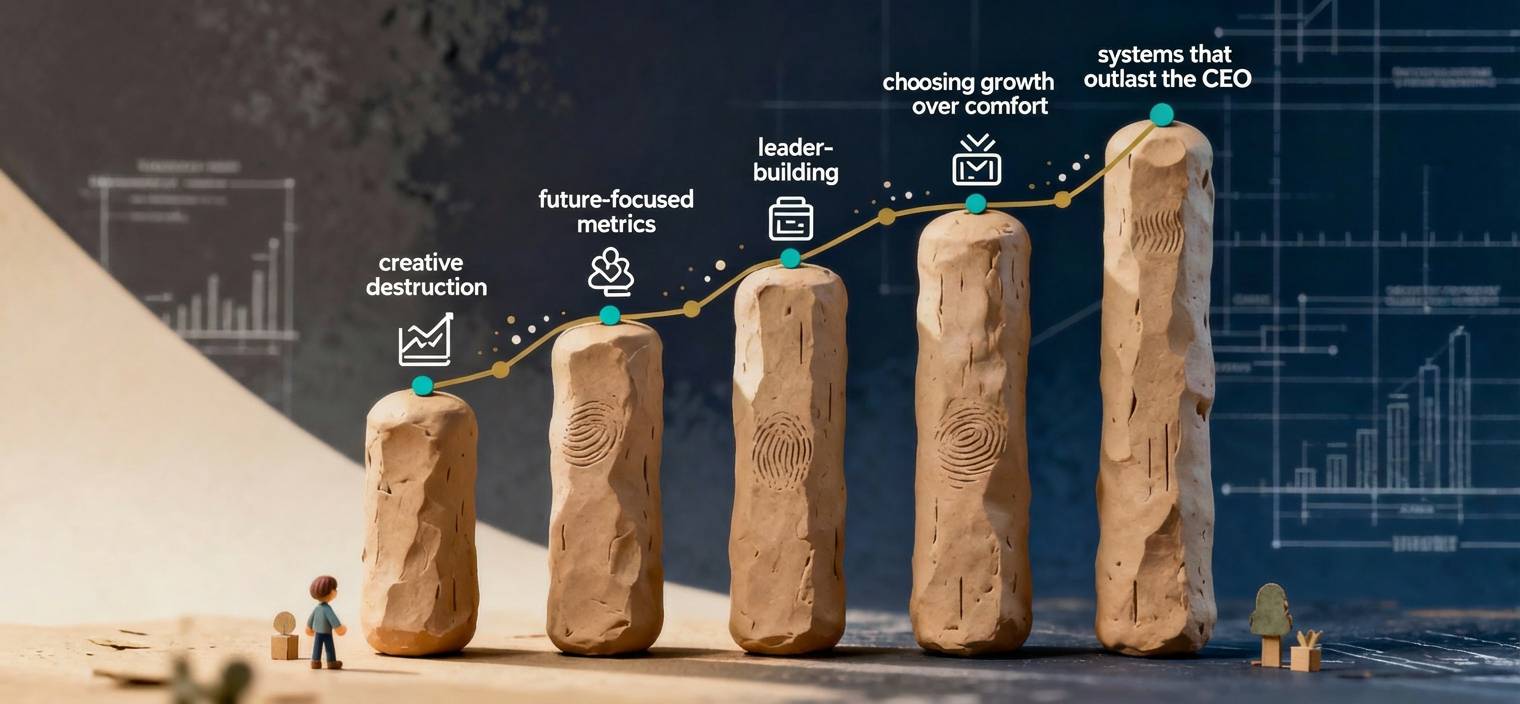
After obsessively studying the CEOs who never plateau, I’ve identified five observable characteristics that separate them from everyone else. Not personality traits. Not inherent talents. Observable behaviors you can develop.
Before diving in, understand your current leadership profile. Take the Leadership Type Assessment to see which characteristics you already possess and which you need to develop.
The Plateau Problem Nobody Discusses
First, let’s be honest about plateaus:
The Brutal Statistics:
- 96% of companies never reach $1M
- 86% that reach $1M never hit $10M
- 95% that reach $10M never hit $50M
- Most plateaus last 3-5 years (or forever)
The conventional wisdom says plateaus happen because of:
- Market saturation
- Competition
- Economic conditions
- Team limitations
- Capital constraints
That’s bullshit.
Plateaus happen because the CEO stops evolving. Period.
The market didn’t change. You didn’t. Your competition didn’t get better. You stayed the same. The economy didn’t shift. Your leadership didn’t.
“I was stuck at $8M for three years, blaming everything except myself. Once I understood these characteristics and developed them, we hit $25M in 18 months.” – Patricia Chen, CEO of LogisticsPro
Characteristic #1: They Destroy What’s Working
The Observable Behavior: CEOs who never plateau kill successful initiatives while they’re still working.
The Pattern in Action
Every quarter, plateau-breaking CEOs ask: “What’s working well that we need to stop doing?”
Sounds insane? Here’s what I observe:
| What They Kill | When They Kill It | Why They Kill It | What Happens Next |
| Best product line | At peak profitability | To force innovation | New product 3x bigger |
| Top sales channel | While still growing | To avoid dependence | Discover better channels |
| Star employee’s role | At maximum performance | To develop others | Team capability multiplies |
| Comfortable process | When perfectly optimized | To prevent stagnation | Breakthrough efficiency |
| Winning strategy | Before competition copies | To stay ahead | Competitors chase ghosts |
The Quarterly Destruction Ritual
CEOs who never plateau run this exercise:
Step 1: List Your Sacred Cows
- What would be “crazy” to change?
- What does everyone say works perfectly?
- What would cause panic if removed?
Step 2: Pick One to Kill
- Usually the one that scares you most
- Set a sunset date
- Communicate the why clearly
Step 3: Force Innovation
- No replacing with similar
- Must be 10x better, not 10%
- Team must own solution
Real Example from My Mastermind
Software CEO at $12M killed their entire outbound sales team (40% of revenue) while it was working perfectly.
Why? “If it’s working perfectly, it’s about to stop working. Perfect means no learning.”
Result: Forced to build product-led growth. Revenue went from $12M to $45M in two years.
The Measurement
Track your “Destruction Ratio”:
- Things killed while working ÷ Things killed after failing
- Plateau-breakers: >1.0
- Plateau-victims: <0.2
Most CEOs only kill what’s already dead. That’s management, not leadership.
Characteristic #2: They Measure Against Tomorrow
The Observable Behavior: CEOs who never plateau judge today’s performance against future requirements, not past benchmarks.
The Time Orientation Difference
| Plateau CEO Thinking | Plateau-Breaker Thinking |
| “We grew 20% last year” | “We need 200% to matter in 3 years” |
| “Better than Q1” | “Still won’t work at 10x scale” |
| “Beating competition” | “Creating new category” |
| “Improving metrics” | “Changing the game” |
| “Month-over-month growth” | “Decade-defining moves” |
The Future-Back Planning Method
Plateau-breakers use this framework:
Year 3 Vision:
- Revenue: Current × 10
- Market position: Category leader
- Team size: Current × 5
- Capabilities: Completely different
Year 2 Requirements:
- What must be true?
- What capabilities needed?
- What current limits must die?
Year 1 Actions:
- What starts today?
- What stops today?
- What transformations begin?
This Quarter:
- Three bold moves toward Year 3
- Not incremental improvements
The Metrics That Matter
Plateau-breakers track different metrics:
| Standard Metrics | Plateau-Breaker Metrics |
| Revenue growth rate | Time to 10x |
| Customer satisfaction | Customer transformation |
| Employee retention | Leadership pipeline depth |
| Market share | Market creation |
| Efficiency gains | Capability multiplication |
Real Pattern I See Weekly
Plateau CEO in mastermind: “We improved efficiency by 15%!”
Plateau-breaker’s response: “Cool. Will that matter when you’re 10x bigger? No? Then you’re optimizing yesterday instead of building tomorrow.”
Harsh? Yes. True? Always.
The Daily Practice
Every morning, plateau-breakers ask:
- Is today’s plan building tomorrow’s capability?
- Are we solving future problems or perfecting past solutions?
- Would our 10x-bigger future company recognize what we’re doing today?
If the answer is no to any, they change the plan.
This connects to CEO Mindset: Thinking Like a Visionary.
Characteristic #3: They Build Leaders, Not Followers
The Observable Behavior: CEOs who never plateau develop people who could replace them, not people who need them.
The Multiplication Method
Look at the math:
| CEO Type | Direct Reports | Their Capability | Total Leadership Capacity |
| Plateau CEO | 8 followers | 50% of CEO | CEO × 1.4 |
| Plateau-Breaker | 5 leaders | 120% of CEO | CEO × 6.0 |
One builds dependence. One builds leverage.
The Leadership Development Obsession
Plateau-breakers spend time differently:
| Activity | Plateau CEO | Plateau-Breaker |
| Solving problems | 40% | 5% |
| Managing work | 30% | 10% |
| Meetings | 20% | 15% |
| Strategy | 10% | 20% |
| Developing leaders | 0% | 50% |
Half their time developing others? Yes. That’s the multiplier.
The Replacement Planning Reality
Every plateau-breaker I know can answer these:
- Who could run the company tomorrow?
- Who’s being developed for each key role?
- What capability are we building for next year?
- Which leader is ready for their next level?
Most plateau CEOs can’t answer any of these.
The Weekly Leadership Development Ritual
Monday: One-on-one coaching with high potential Tuesday: Assign stretch project to emerging leader Wednesday: Shadow and feedback session Thursday: Leadership book club or training Friday: Celebrate someone else’s leadership win
“If I’m not developing someone daily, I’m building a cage, not a company.”
The Brutal Test
Plateau-breakers regularly leave for 2-4 weeks without checking in.
What happens?
- Plateau companies: Chaos, waiting, degradation
- Plateau-breaker companies: Growth, innovation, acceleration
If your company needs you daily, you’ve built dependency, not leadership.
Learn more: How to Go From Director to VP.
Characteristic #4: They Choose Growth Over Comfort
The Observable Behavior: When faced with any decision, CEOs who never plateau consistently choose the option that forces growth, even when the comfortable option seems logical.
The Decision Pattern
Every decision point reveals this characteristic:
| Decision Type | Comfortable Choice | Growth Choice | Plateau-Breaker Pick |
| Hiring | Proven performer | High-potential stretch | Stretch (90% of time) |
| Strategy | Expand existing | Enter new market | New market |
| Investment | Optimize current | Build new capability | New capability |
| Problems | CEO solves | Team struggles/learns | Team learns |
| Standards | Maintain quality | Raise bar again | Raise bar |
The Comfort Rejection Framework
When plateau-breakers feel comfortable, they immediately:
- Raise the bar: If hitting goals easily, double them
- Change the game: If winning consistently, play harder game
- Add constraints: If resources abundant, operate leaner
- Increase speed: If timeline comfortable, cut in half
- Expand scope: If managing well, take on more
“Comfort is the enemy of growth. When I feel comfortable, I know I’m about to plateau.”
The Growth Choice Tracker
I have CEOs track this weekly:
| Situation | Comfortable Option | Growth Option | What You Chose | Result |
| Monday decision | ||||
| Tuesday decision | ||||
| Wednesday decision | ||||
| Thursday decision | ||||
| Friday decision |
Plateau-breaker score: 80%+ growth choices Plateau risk: <50% growth choices
Real Examples from This Month
Plateau CEO: “We’re hitting our numbers, team is happy, customers satisfied.” Action: Maintains course
Plateau-breaker: “We’re hitting our numbers, team is happy, customers satisfied.” Action: Triples targets, enters new market, promotes three people beyond ready
One maintains. One grows.
The Discomfort Indicator
Plateau-breakers measure their discomfort level:
| Comfort Level | What It Means | Action Required |
| 8-10 (Very comfortable) | Plateau imminent | Major disruption needed |
| 5-7 (Manageable) | Growth zone | Maintain pressure |
| 2-4 (Very uncomfortable) | Breakthrough zone | Support but persist |
| 0-1 (Panic) | Too much too fast | Slight pullback |
They aim to live at 3-5 constantly.
“I realized I was choosing comfort disguised as ‘prudent decisions.’ Once I started choosing growth consistently, we broke through our three-year plateau in six months.” – Michael Ross, CEO of TechServices
Characteristic #5: They Create Systems That Outlast Them
The Observable Behavior: CEOs who never plateau build systems, cultures, and capabilities that would thrive even if they disappeared.
The Immortal Company Framework
Plateau-breakers build three layers:
| Layer | What It Is | How It Persists | Success Metric |
| Systems | Processes that run without you | Documentation + automation | Runs 30 days alone |
| Culture | Beliefs that guide decisions | Stories + rituals | Decisions match vision |
| Capabilities | Skills that compound | Development + promotion | Leaders creating leaders |
The Dependency Audit
Every quarter, they ask:
What breaks if I disappear?
- Revenue generation?
- Customer relationships?
- Team motivation?
- Strategic direction?
- Cultural standards?
Then they systematically eliminate each dependency.
The System Building Progression
Month 1-3: Document Everything
- Every process you touch
- Every decision you make
- Every relationship you manage
Month 4-6: Delegate and Test
- Hand off one system weekly
- Let it run without you
- Document failures and fixes
Month 7-9: Automate and Scale
- Technology where possible
- Frameworks for decisions
- Templates for communication
Month 10-12: Disappear and Verify
- Take 2-week vacation
- No check-ins allowed
- Measure what happens
The Legacy Test
Plateau-breakers imagine selling their company tomorrow:
Would the buyer get:
- Just revenue? (Weak)
- Revenue + systems? (Better)
- Revenue + systems + culture? (Good)
- Self-improving organism? (Excellent)
Most CEOs are selling themselves. Plateau-breakers build sellable assets.
Real Story from Last Quarter
CEO in my mastermind got emergency surgery. Out for 6 weeks unexpectedly.
Plateau CEO friend: Company lost 30% revenue, 3 key employees quit Plateau-breaker member: Company grew 15%, launched new product
The difference? One built around themselves. One built beyond themselves.
This aligns with Founder to CEO: Delegation & Systems.
The Observable Patterns Across All Characteristics
After studying hundreds of CEOs, clear patterns emerge:
The Plateau-Breaker Daily Rituals
| Time | Plateau CEO | Plateau-Breaker |
| 6 AM | Email firefighting | Strategic thinking |
| 9 AM | Status meetings | Leader development |
| 12 PM | Problem solving | System building |
| 3 PM | More meetings | Market creation |
| 6 PM | Still working | Done, thinking ahead |
The Quarterly Evolution Cycles
Plateau-breakers run 90-day cycles:
Days 1-30: Identify next constraint Days 31-60: Build capability to break it Days 61-90: Implement and institutionalize
Every quarter, something fundamental changes. Not improved. Transformed.
The Annual Transformation Requirement
| Year | Plateau CEO | Plateau-Breaker |
| Year 1 | Same person, working harder | Fundamentally different leader |
| Year 2 | Same company, slightly bigger | Unrecognizable organization |
| Year 3 | Same model, optimized | Completely new business |
If you’re the same CEO running the same company the same way after 12 months, you’re plateauing.
How to Develop These Characteristics
You can’t develop all five simultaneously. Here’s the sequence that works:
Phase 1 (Month 1-3): Measure Against Tomorrow
Start here because it changes your perspective on everything else.
Week 1-2: Define your 10x vision Week 3-4: Map required capabilities Week 5-8: Start making future-based decisions Week 9-12: Kill first comfortable success
Success Metric: Making 3+ decisions weekly based on future not past
Phase 2 (Month 4-6): Choose Growth Over Comfort
With future vision clear, growth choices become obvious.
Week 1-2: Track comfort level daily Week 3-4: Choose growth in small decisions Week 5-8: Choose growth in major decisions Week 9-12: Make discomfort your default
Success Metric: 80% growth choices in decision log
Phase 3 (Month 7-9): Build Leaders Not Followers
Now develop others to handle growth.
Week 1-4: Identify high-potentials Week 5-8: Assign stretch projects Week 9-12: Step back and let them lead
Success Metric: 3+ people ready for next level
Phase 4 (Month 10-12): Create Systems That Outlast You
With leaders developed, build systems.
Week 1-4: Document core processes Week 5-8: Delegate system ownership Week 9-12: Test with your absence
Success Metric: Company runs 2 weeks without you
Phase 5 (Month 13-15): Destroy What’s Working
With foundation built, start creative destruction.
Month 1: Identify sacred cows Month 2: Kill biggest one Month 3: Build replacement
Success Metric: One major innovation from destruction
Use the Leadership Skills Assessment to identify which characteristics need most work.
The Warning Signs You’re About to Plateau
I see these patterns weeks before CEOs plateau:
Early Warning Signs (6 Months Out)
- Growth rate declining but still positive
- Decisions taking longer
- Less excited about Monday morning
- Team asking “what’s next?” less often
- Competition catching up
Action: Minor course correction needed
Critical Warning Signs (3 Months Out)
- Same problems recurring
- Best people getting bored
- You’re the smartest in every room
- Comfort level above 7/10
- Strategy conversations become tactical
Action: Major intervention required
Emergency Warning Signs (Plateau Imminent)
- Three months of flat growth
- You’re working harder for same results
- Team waiting for your decisions
- No major changes in 6 months
- You’re defending status quo
Action: Radical transformation or accept plateau
The Plateau-Breaking Action Plan
If you recognize plateau signs, here’s your break-free protocol:
Week 1: The Brutal Assessment
Answer honestly:
- Which characteristic is weakest?
- What am I avoiding?
- What would I do if starting over?
- Who on my team sees the problem?
- What would a new CEO change immediately?
Week 2-4: The Public Declaration
- Tell your team you’re transforming
- Share specific changes coming
- Ask for their support and patience
- Set 90-day transformation timeline
- Create accountability structure
Month 2-3: The Rapid Implementation
Pick ONE characteristic to develop:
- Daily practice required
- Weekly measurement
- Monthly milestone
- Quarterly transformation
Month 4 and Beyond: The New Normal
- Institutionalize changes
- Move to next characteristic
- Never stop evolving
- Celebrate growth over comfort
The CEOs Who Exemplify These Characteristics
Without naming names, here are patterns from my mastermind:
The Destroyer: Kills a successful product line annually. Result: $3M to $47M in 4 years.
The Future-Builder: Plans from 10 years out. Result: Created entirely new category.
The Leader-Maker: Promoted herself out of every role. Result: $5M to $30M with less work.
The Growth-Chooser: Takes scariest option always. Result: 100% annual growth for 5 years.
The System-Builder: Company runs without him for months. Result: Sold for 15x revenue.
These aren’t special people. They developed these characteristics deliberately.
Your Personal Characteristic Development Plan
Based on working with 200+ CEOs, here’s what you probably need:
If You’re Stuck at $1-5M:
Missing Characteristic: Creating systems that outlast you Your 90-Day Focus: Document and delegate everything Success Metric: Take 1-week vacation with no check-ins
If You’re Stuck at $5-10M:
Missing Characteristic: Building leaders not followers Your 90-Day Focus: Develop 3 people to replace you Success Metric: They make major decisions without you
If You’re Stuck at $10-25M:
Missing Characteristic: Destroying what’s working Your 90-Day Focus: Kill your most successful initiative Success Metric: Innovation that makes old way obsolete
If You’re Growing But Slowly:
Missing Characteristic: Measuring against tomorrow Your 90-Day Focus: Make all decisions based on 10x vision Success Metric: Strategic moves that confuse competition
If You’re Comfortable:
Missing Characteristic: Choosing growth over comfort Your 90-Day Focus: Triple your targets and constraints Success Metric: Discomfort level of 3-5 daily
Take the Leadership Style Assessment to confirm your development needs.
The Final Truth About Plateaus
After watching hundreds of CEOs, I can tell you this with certainty:
Plateaus are not inevitable. They’re chosen.
Every day you don’t develop these characteristics, you choose plateau. Every comfortable decision, you choose plateau. Every time you solve instead of develop others, you choose plateau. Every time you optimize instead of destroy, you choose plateau. Every time you measure against yesterday instead of tomorrow, you choose plateau.
The CEOs who never plateau aren’t lucky. They’re not special. They’re not uniquely talented.
They just refuse to stop evolving.
“I thought I was special because I’d grown to $8M. Then I met CEOs with these characteristics and realized I was playing checkers while they played chess. Developing these characteristics changed everything. We’re now at $32M and accelerating.” – Jennifer Park, CEO of ModernSystems
Your Choice Point
You now know the five characteristics of CEOs who never plateau:
- They destroy what’s working
- They measure against tomorrow
- They build leaders not followers
- They choose growth over comfort
- They create systems that outlast them
You can observe these. You can develop these. You can become these.
The question isn’t whether you’re capable. You are.
The question is whether you’re willing to become uncomfortable enough to grow.
Your next action:
- Identify your weakest characteristic
- Commit to developing it for 90 days
- Start tomorrow with one uncomfortable decision
- Track progress weekly
- Transform or accept plateau
The choice is yours. Choose wisely.
Consider joining a CEO Peer Group for accountability in developing these characteristics.
About the Author
Andreas Petterson is a 3x CEO and founder of Leaders ADAPT. After working with 200+ CEOs through growth plateaus, he’s identified the observable characteristics that separate those who break through from those who stay stuck. These aren’t theories. They’re patterns.
Related Resources
Assessment Tools:
Further Reading:
YOUR JOURNEY STARTS TODAY
Isn’t it time you had an advisory team that truly elevates you!

I’m an executive advisor and keynote speaker—but before all that, I was a tech CEO who learned leadership the hard way. For 16+ years I built companies from scratch, scaled teams across three continents, and navigated the collision of startup chaos and enterprise expectations.