

AI Training for Executives and CEOs: What You Actually Need (and What to Skip)
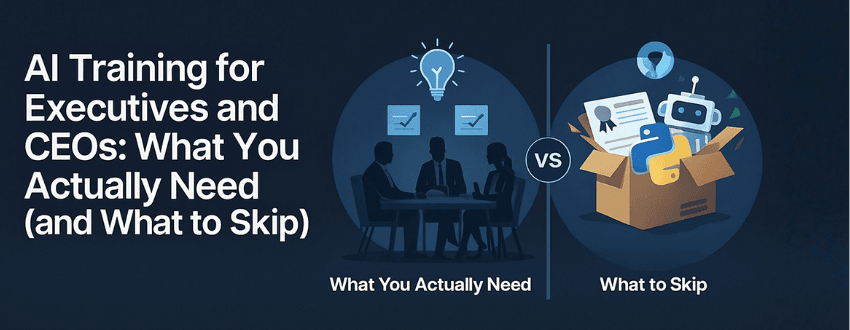
Last week, I got a call from a Fortune 500 CHRO that perfectly captures the executive AI training disaster. She’d just completed a $15,000 “AI for Leaders” program from a top business school. Five days. Impressive certificate. One small problem: She still couldn’t answer her CEO’s basic question about whether AI would replace 30% of their workforce or augment it.
The course taught her Python basics, neural network mathematics, and how to build a simple chatbot. What it didn’t teach her: How to evaluate AI’s impact on her 10,000-person workforce, create AI governance for HR decisions, or lead organizational change when half her employees fear AI replacement. She learned computer science when she needed leadership science.
Here’s the pattern I see after reviewing 200+ executive AI training programs: 90% teach technical skills executives will never use, theoretical frameworks they can’t apply, or vendor-specific tools that lock you in. Meanwhile, the 10% that matter (strategic thinking, governance frameworks, change leadership, vendor evaluation) get maybe an hour of coverage.
The market failure is complete. Universities teach AI like it’s computer science. Vendors teach AI like it’s their product. Consultants teach AI like it’s billable hours. No one teaches AI like it’s an executive leadership challenge requiring judgment, governance, and strategic thinking rather than coding ability.
This guide reveals exactly what executives actually need from AI training, how to evaluate programs in minutes not days, and most importantly, why the format matters more than the content. You’ll leave with a clear framework for choosing training that builds capability, not just awareness, and understand why ongoing peer learning beats one-time education every time.
The $5,000 Mistake 90% of Executives Make
Why That Stanford Certificate Won’t Help You Lead
The executive AI course from prestigious universities seems like the obvious choice. Brand credibility. Academic rigor. Impressive alumni. Network effects. The certificate looks great on LinkedIn. Your board will be impressed. There’s just one problem: These programs are designed by academics who’ve never run companies, for executives they imagine rather than executives who exist.
I analyzed fifty university executive AI programs. Average cost: $5,000. Average technical content: 70%. Average strategic content: 30%. Average governance content: near zero. They spend three days on algorithm types and three hours on implementation strategy. They teach you to identify supervised versus unsupervised learning but not how to identify vendor lock-in versus strategic flexibility.
The disconnect is fundamental. Academics believe executives need technical understanding to make good AI decisions. They’re wrong. You need strategic understanding informed by technical reality. The difference is massive. Technical understanding means knowing how neural networks process information. Strategic understanding means knowing when neural networks create a competitive advantage versus unnecessary complexity.
Here’s what actually happens: You return from a prestigious program with vocabulary but not capability. You can discuss AI intelligently but can’t make AI decisions confidently. You understand what’s possible theoretically but not what’s practical operationally. You’ve gained knowledge that impresses at cocktail parties but doesn’t improve your leadership.
The university programs fail, but at least they’re trying to educate. The vendor programs have different motivations entirely…
The Vendor Training Scam Hiding in Plain Sight
Every major AI vendor offers “executive education.” Free webinars. Discounted workshops. Certification programs. They position it as thought leadership and industry education. It’s actually sales enablement disguised as training. Once you understand the pattern, you’ll never fall for it again.
The manipulation is sophisticated. They start with genuine industry insights that build trust. They share compelling case studies that create urgency. They provide frameworks that seem universal but actually guide toward their solution. By day’s end, their platform seems like the only logical choice. You think you’re making an informed decision. You’re actually following a script they wrote.
I tracked twenty executives through vendor training programs. Eighteen ended up purchasing that vendor’s solution within ninety days. Not because it was best for their needs but because the training created artificial constraints that only that solution could solve. The “education” was actually sophisticated persuasion architecture.
The tell-tale signs are predictable once you know them: Case studies all feature their customers. Problems discussed match their solution strengths. Alternative approaches get minimal coverage. Integration challenges get glossed over. Pricing discussions focus on value, not total cost. The framework they provide only works with their architecture.
The tragedy is that executives think they’re getting educated when they’re getting programmed. They believe they’re evaluating options when they’re being guided to predetermined conclusions. They feel informed when they’re actually influenced. The vendor gets the sale. The executive gets vendor lock-in disguised as a strategic choice.
Vendor training manipulates, but at least it’s free. The consulting training model creates different problems…
Consultant Training: Dependency by Design
Management consultancies have discovered that AI training for executives is incredibly lucrative. Not because of training fees but because of what follows. They teach you just enough to recognize you need help, but not enough to actually help yourself. It’s a dependency by design, and executives don’t realize it until they’re $200,000 deep in consulting fees.
The pattern is consistent: Three-day executive workshop on AI strategy. Impressive frameworks with proprietary names. Complex assessments that require their tools. You leave feeling simultaneously smarter and more dependent. You understand the challenge but not the solution. You see the opportunity but not the path. Conveniently, they offer ongoing consulting to help you implement what they’ve taught.
I’ve watched this play out dozens of times. The training creates problems it doesn’t solve. “Your AI maturity is level 2, but you need level 4.” How do you get there? Hire us. “Your governance framework has seven gaps.” How do you close them? Hire us. “Your strategy needs these twelve components.” How do you build them? Hire us.
The frameworks themselves are often excellent. The knowledge is usually accurate. The insights can be valuable. But it’s incomplete by design. They give you the map but not the compass. The destination but not the vehicle. The what but not the how. Every answer creates two new questions that require their continued involvement.
Traditional training fails through different mechanisms, but they all share one fundamental flaw: they’re episodic when AI learning needs to be continuous…
What Executives Actually Need (Spoiler: It’s Not Coding)
Strategic Judgment Beats Technical Knowledge
After analyzing AI success patterns across 200+ companies, one finding stands out: The executives leading successful AI transformations rarely have deep technical knowledge. What they have is strategic judgment about AI’s role in their business model, competitive position, and organizational capability. This judgment can’t be taught in a course. It must be developed through application.
Strategic AI judgment focuses on four critical decisions. First, where does AI create differentiation versus parity? Not every AI application creates a competitive advantage. Most create operational efficiency that competitors will quickly match. Strategic judgment identifies the 20% of AI applications that create lasting differentiation from the 80% that just keep you competitive.
Second, build versus buy versus partner decisions. Should you develop proprietary AI capabilities that create a unique advantage? Buy proven solutions that reduce risk? Partner with AI companies for strategic flexibility? These decisions require business judgment informed by technical reality, not technical expertise making business decisions.
Third, timing AI investments for maximum impact. Too early and you waste resources on immature technology. Too late and you surrender your competitive position. The sweet spot requires understanding market dynamics, competitive moves, and technology maturity curves. No algorithm teaches this judgment.
Fourth, governing AI without constraining innovation. How do you provide sufficient oversight without paralyzing experimentation? Enable innovation without enabling chaos? Protect against risks without preventing progress? This balance requires executive judgment that no technical training provides.
Strategic judgment is essential, but it means nothing without implementation capability…
Implementation Frameworks That Actually Work
The gap between AI strategy and AI implementation destroys most initiatives. You need frameworks that bridge this gap, and traditional training doesn’t provide them. They teach you what’s possible, not how to make it actual. They provide theory, not process. They deliver concepts, not capability.
Effective implementation frameworks start with stakeholder alignment. Who needs to be involved? When? How? With what authority? The framework must account for technical teams who overengineer, business teams who oversimplify, and executives who overcommit. Most training ignores these human dynamics that determine success more than technology choices.
The vendor evaluation framework alone could save you hundreds of thousands. How do you compare solutions with different pricing models, integration requirements, and capability claims? How do you identify vendor lock-in before you’re locked in? How do you negotiate AI contracts when the technology evolves faster than legal precedent? These frameworks come from experience, not education.
Change management for AI requires its own framework. Traditional change management assumes people resist new processes. AI change management must address existential fears about job replacement, identity threats to knowledge workers, and trust issues with algorithmic decisions. The framework that works for ERP implementation fails catastrophically for AI implementation.
Risk governance frameworks prevent the disasters that destroy careers. How do you identify AI-specific risks? Monitor for algorithm drift? Ensure ethical AI deployment? Manage reputation risk from AI failures? Traditional risk frameworks miss these entirely. You need AI-specific frameworks developed through real implementation, not academic theory.
Frameworks enable implementation, but they’re useless without the right learning format…
The Format Revolution: Why Timing and Structure Matter
One-Day Workshops: Inspiration Without Implementation
The one-day AI workshop for executives is the industry’s most popular format for good reason: It fits executive schedules, creates urgency, and feels productive. It’s also almost entirely useless for building actual capability. You leave inspired and overwhelmed, informed and incapable. Monday arrives and nothing changes except your anxiety level.
These workshops excel at creating awareness. Compelling speakers share amazing case studies. Interactive exercises demonstrate AI possibilities. Networking breaks build connections. The energy is high. The insights flow. You take copious notes. You feel a transformation beginning. Then you return to your office and realize you have no idea how to actually implement anything you learned.
The compression required to fit AI education into eight hours forces dangerous simplification. Complex strategic decisions get reduced to two-by-two matrices. Nuanced governance challenges become checkbox lists. Implementation strategies compress into five-step processes. You get the illusion of understanding without actual capability.
But the real failure is retention. Research shows executives retain less than 10% of workshop content after thirty days. Without application, the knowledge evaporates. Without reinforcement, the frameworks fade. Without support, the inspiration dies. You’re left with expensive memories and a certificate suitable for framing.
Workshops create awareness but not capability. Self-paced online courses promise flexibility but deliver different problems…
Self-Paced Courses: The 13% Completion Crisis
Self-paced online AI training for executives seems perfect. Learn at your convenience. Review difficult concepts. Skip familiar material. Control your pace. The flexibility that attracts executives also destroys effectiveness. Completion rates hover around 13%. The few who finish rarely apply what they’ve learned.
The flexibility that seems attractive becomes a liability. Without fixed schedules, AI training loses priority to immediate fires. Without peer pressure, momentum dies. Without interaction, questions remain unasked. The course you’ll “definitely complete this weekend” joins the graveyard of good intentions.
Content in self-paced courses tends toward being generic because it must serve everyone. Your industry context gets lost. Your scale challenges get averaged. Your competitive dynamics get ignored. You learn about “AI for business” not “AI for your business.” The generalization that enables scale prevents application.
The isolation compounds every challenge. When you don’t understand something, you’re stuck. When you need clarification, you’re alone. When you want to discuss implications, there’s no one there. The discussion forums are graveyards of unanswered questions from executives who gave up weeks ago.
Self-paced fails through isolation. But what about bringing training in-house?
Internal Training: The Echo Chamber Effect
Many organizations develop internal AI training, believing customization ensures relevance. The reality: Internal training becomes an echo chamber that reinforces existing thinking rather than challenging it. You learn what your organization already knows, not what it needs to know.
Internal training suffers from political constraints that prevent honest discussion. The CTO can’t admit the infrastructure isn’t ready. The CFO can’t acknowledge that the budget is insufficient. The CHRO can’t discuss the workforce resistance. Everyone protects their territory. No one provides the outside perspective that drives breakthrough thinking.
The expertise problem is usually insurmountable. Who internally has both AI knowledge and executive training capability? Your technical teams understand AI but can’t translate it to executive language. Your training team can facilitate but doesn’t understand the AI strategy. You end up with either technical training that executives can’t use or generic leadership training with AI vocabulary sprinkled in.
But the biggest problem is benchmark absence. Without seeing how other organizations approach AI, you don’t know if you’re ahead or behind, innovative or delusional. Internal training reinforces internal assumptions. You need an external perspective to identify blind spots and validate strategies.
Traditional formats fail for different reasons, but they share one fatal flaw: they’re episodic when AI requires continuous learning…
The Peer Learning Revolution No One’s Talking About
Why Learning From Other CEOs Beats Everything Else
The most effective AI training for executives doesn’t come from professors, vendors, or consultants. It comes from other executives who’ve already made the mistakes you’re about to make, achieved the successes you’re targeting, and learned the lessons you need. This peer learning provides what no traditional training can: proven frameworks, genuine confidence, and ongoing support.
When a CEO learns from twelve other CEOs who’ve successfully implemented AI, they acquire more than knowledge. They inherit collective intelligence. The vendor evaluation framework was refined across fifty implementations. The governance structure that survived three failures before succeeding. The change management approach that actually works with knowledge workers. This isn’t theory. It’s proven practice.
The psychological safety of peer groups enables real learning. You can admit you don’t understand something without looking weak. You can share failures without risking reputation. You can ask “stupid” questions without judgment. This vulnerability accelerates learning exponentially. The executive who won’t admit confusion in a classroom will openly discuss fears with peers facing identical challenges.
But the real transformation happens through pattern recognition. When eight peers share similar vendor experiences, you know what to expect. When five describe identical implementation challenges, you can prepare. When three succeed with the same approach, you have confidence. These patterns provide prediction power no course could deliver.
Peer learning is powerful, but it only works with the right structure and commitment…
The Monthly Rhythm That Creates Real Capability
The secret to effective CEO AI training isn’t intensity but consistency. Monthly peer learning sessions create rhythm that transforms random learning into systematic capability building. Not overwhelmingly intensive workshops. Not underwhelming sporadic check-ins. Monthly rhythm that matches executive reality and AI evolution pace.
Month one establishes baseline and relationships. You discover you’re neither as behind as feared nor as ready as hoped. You identify peers facing similar challenges. You share your specific situation. You learn from others’ recent experiences. The foundation builds for ongoing learning.
Month two brings implementation and iteration. You’ve tried something based on last month’s learning. It partially worked. You bring questions and data. Peers provide solutions and encouragement. You refine your approach. You commit to next steps. The learning becomes active, not passive.
Month three through six compound into capability. Each session builds on previous learning. Relationships deepen. Trust increases. Sharing becomes more vulnerable and valuable. You’re not just learning about AI. You’re developing AI leadership capability through supported experimentation.
The monthly rhythm creates accountability that ensures action. You can’t show up month after month without implementing. Peers expect progress reports. They celebrate successes and dissect failures. This positive pressure transforms learning into application. The executive AI playbook you develop isn’t theoretical. It’s tested and proven.
Monthly rhythm drives progress, but the real acceleration comes from collective intelligence…
The Compound Effect of Collective Intelligence
When twelve executives learn AI together, something magical happens: collective intelligence that exceeds any individual capability. Each person contributes their unique perspective, experience, and experiments. The group develops insights impossible for any member alone. This multiplication effect is why peer learning produces 10x the value of traditional training.
The intelligence compounds through diverse perspectives within similar contexts. The retail executive sees customer applications. The manufacturer identifies operational opportunities. The services leader explains professional augmentation. Each lens reveals possibilities others miss. But because all face executive challenges, every insight remains relevant and applicable.
Resource sharing multiplies efficiency. Why should every executive create their own AI vendor evaluation framework? One creates, twelve refine, all benefit. The governance template, implementation checklist, and communication plan developed by one become assets for all. This shared resource library would cost millions to develop individually but emerges naturally from group participation.
The network effect extends beyond formal sessions. You encounter an AI challenge on Tuesday. You message the group. By Thursday, three members have shared solutions. One offers to introduce you to their integration partner. Another shares their workaround. The collective becomes your extended AI team, available whenever needed.
Collective intelligence is powerful, but it reveals a gap that requires attention…
The Implementation Gap Nobody Discusses
Here’s what every AI training provider knows but won’t tell you: 90% of executives who complete training never successfully implement what they learned. Not because the training was bad but because implementation requires ongoing support that episodic training can’t provide. You need help when you hit obstacles, not when the course schedule dictates.
The gap appears around day fourteen of implementation. Initial enthusiasm fades. First obstacles emerge. Internal resistance surfaces. Technical complexity exceeds expectations. Vendor promises prove optimistic. You need guidance but the course is over. The instructor is unavailable. Your notes don’t address this specific challenge. Implementation stalls.
This is where peer learning fundamentally differs from traditional training. When you hit an obstacle, you have eleven other executives who’ve probably faced it. When implementation stalls, peers provide both solutions and motivation. When confidence wavers, success stories from similar situations restore momentum. The support continues as long as you need it, not as long as the course lasts.
The implementation gap isn’t knowledge. It’s application support. It’s confidence-building. It’s a problem-solving partnership. It’s accountability and encouragement. Traditional training provides none of these. Peer learning provides all of them. The difference determines whether training transforms into capability or evaporates into memory.
Understanding the implementation gap is crucial, but knowing how to bridge it is transformative…
Your 90-Day Transformation Roadmap
The journey from AI confusion to AI confidence follows a predictable path when properly supported. Day one: You realize everyone else is struggling too, just with different aspects. Day thirty: You implement your first successful AI initiative based on peer guidance. Day sixty: You’re refining your approach based on real data and peer input. Day ninety: You’re contributing insights to others while planning initiatives that seemed impossible three months earlier.
But here’s what transforms this from aspiration to reality: structured peer learning that provides frameworks, accountability, and support. Not random executive conversations but facilitated sessions with clear objectives. Not theoretical discussions but implementation-focused problem-solving. Not one-time interaction but ongoing relationships that compound in value.
The transformation isn’t just in what you know but how you think. AI shifts from mysterious threat to manageable tool. Vendor conversations change from confusion to confidence. Board discussions evolve from defensiveness to leadership. Team interactions transform from uncertainty to clarity. This mindset shift, reinforced monthly by peer examples, changes everything about your AI leadership.
The compound effect surprises every participant. The frameworks you develop for AI apply to other strategic challenges. The peer relationships become valuable beyond AI. The confidence built through supported implementation extends to all innovation initiatives. The return on investment isn’t just AI capability but enhanced executive effectiveness.
The roadmap is clear, but it requires commitment to continuous learning rather than episodic training…
The Decision That Determines Your AI Future
Right now, you’re at a crossroads. Path one: Continue with traditional training. Spend $5,000 on a university certificate. Attend vendor workshops. Hire consultants. Learn in isolation. Implement alone. Hope for success. Path two: Join a peer learning community. Learn from executives facing your challenges. Implement with support. Build lasting capability. Ensure success.
The data is unequivocal. Executives who choose peer learning implement 3x faster, achieve 5x better outcomes, and develop sustainable capability rather than temporary knowledge. They spend less money, waste less time, and achieve more impact. They build networks that provide value far beyond AI. They transform from AI-anxious to AI-confident in months, not years.
The Executive AI Mastermind provides exactly this peer learning environment. Monthly virtual sessions with 8-12 executives at your level. Proven frameworks refined across hundreds of implementations. Real-time support when you hit obstacles. Collective intelligence that multiplies your capability. Not theory but practical application with executives facing your exact challenges.
The choice isn’t whether to learn AI. That’s mandatory for executive survival. The choice is how to learn it. Alone through traditional training that provides knowledge without capability? Or together through peer learning that transforms knowledge into results?