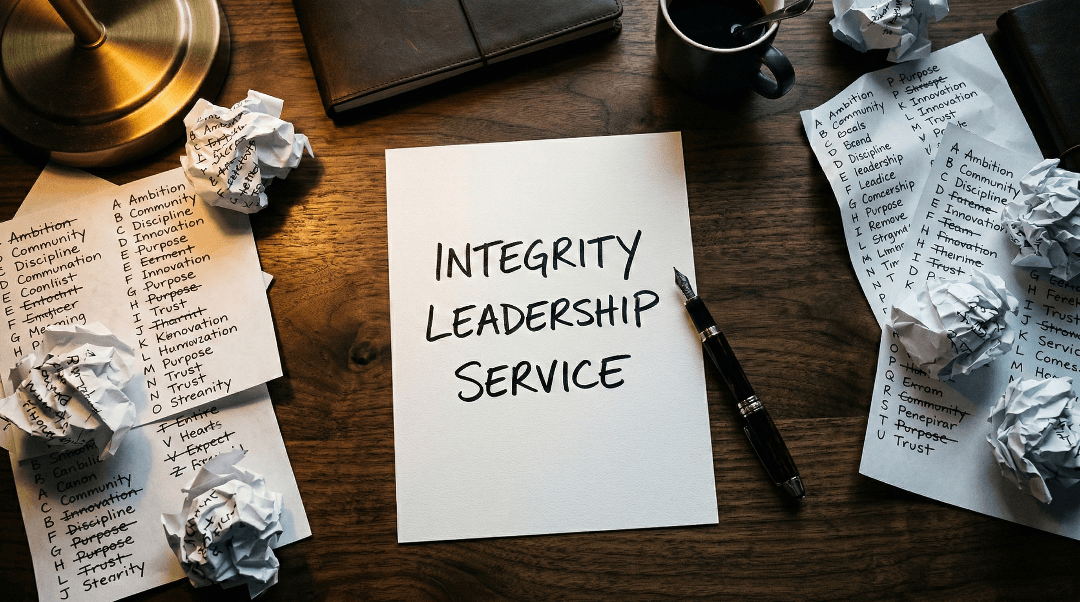

Three posters. “Integrity. Innovation. Teamwork.” Framed. Hung in the conference room. Completely ignored.
Nobody referenced them in meetings. Nobody used them to make decisions. Nobody got hired or fired based on them. They were decoration. Expensive, meaningless decoration.
That’s the reality of core values in the workplace for most companies. They exist on paper. They exist on walls. They don’t exist in practice. And the gap between stated values and lived values is where culture goes to die.
AIHR research backs this up: only 23% of employees say they can apply their company’s values to their actual work. Only 27% believe in those values at all. That means roughly three out of four employees see your core values as irrelevant to what they do on a daily basis.
This post is about fixing that. Not the theory. The actual operational mechanics of embedding core values into the daily rhythm of your workplace so they become decision tools, not wall art.
Why Core Values Fail in Most Workplaces
Before we fix it, we need to understand why it breaks. I’ve seen the same three failure patterns in every company I’ve worked with.
Failure 1: Values were chosen, not discovered
Most companies pick values during a retreat. Someone brings a list. People circle words. They negotiate. They compromise. They end up with five values that nobody disagrees with and nobody remembers.
Real values aren’t chosen from a menu. They’re discovered from decisions. The process starts with looking at how the company actually behaves under pressure, not how it wishes it behaved during an offsite.
If you haven’t done this foundational work yet, start with how to define your core values before trying to operationalize them. You can’t embed values you haven’t properly identified. Trying to is like building on sand.
Failure 2: Values have no behavioral rules
“We value integrity” tells nobody what to do at 9 AM on Tuesday. It’s too abstract to be actionable.
Every value needs specific behavioral rules that translate principle into practice. When I rebuilt our values framework at Arcules, each value had three to five rules attached. Not guidelines. Rules. Things that were observable, measurable, and enforceable.
Example: Our value of “say the hard thing early” came with these rules:
- If you have feedback for a team member, deliver it within 24 hours.
- Frame feedback as respect, not criticism. Silence isn’t kindness. It’s avoidance.
- Accept the same standard in reverse. Your reaction to feedback determines whether anyone gives it to you again.
That’s operational. That’s something a new hire on day three can understand and act on.
Failure 3: Values have no consequences
If violating a value has no consequences, the value doesn’t exist.
The fastest way to kill values in the workplace is to let a high performer violate them without repercussions. Your team watches every exception. They adjust their behavior accordingly.
At Arcules, I waited too long to address my top sales rep who was overpromising to close deals. His numbers were great. His integrity was garbage. I let it slide for two quarters because I was afraid of the revenue hit. Cost: three churned clients and a credibility problem with the delivery team that took months to repair.
The lesson: the first time you tolerate a values violation from a top performer, you’ve communicated that values are optional for people who generate revenue. That message spreads instantly.
The 5 Operational Touchpoints Where Values Must Live
Here’s the framework I use with every CEO I coach. Values need to be embedded in five specific operational touchpoints. If they’re missing from any of these, they’re not operational.
Touchpoint 1: Hiring
This is where most companies fail first. They hire for skills and hope for culture fit. That’s backwards.
Skills can be taught. Values alignment can’t.
Build values into your interview process structurally. For each core value, create at least two behavioral interview questions. Not hypothetical questions (“What would you do if…”). Behavioral questions that require real examples (“Tell me about a time when…”).
If “say the hard thing early” is a value, ask: “Describe a situation where you gave someone feedback they didn’t want to hear. What happened? What did you learn?”
If “decide fast, correct faster” is a value, ask: “Tell me about a decision you made with incomplete information. How did you handle the uncertainty? What was the outcome?”
The specifics of their answer tell you whether they’ve actually lived this value or are performing it for the interview. People who have lived a value tell stories with texture, cost, and consequence. People who haven’t give theoretical answers.
At Arcules, after we embedded values into hiring, our 90-day turnover rate dropped by 40%. Not because we hired smarter people. Because we hired aligned people. The skills gap was fixable. The values gap never was.
Touchpoint 2: Onboarding
The first 30 days determine whether a new hire adopts your values or defaults to whatever they practiced at their last company.
Most onboarding covers systems, processes, and policies. That’s necessary but insufficient. Values onboarding needs to happen in parallel.
Here’s how we structured it: Day 1, the new hire received our three values with behavioral rules printed on a single card. Not in a 50-page handbook. A card. Small enough to keep at their desk.
During their first week, they shadowed three different team members. After each shadow, they answered one question: “Where did you see our values in action today?” That forced pattern recognition from day one.
By week two, their manager had a conversation specifically about values. Not performance. Not goals. Values. “Here’s how we live these here. Here’s what it looks like when someone does it well. Here’s what it looks like when someone doesn’t. Questions?”
By day 30, the new hire could articulate the values, give examples of each, and identify where they’d seen them applied. That’s the benchmark.
Touchpoint 3: Weekly Meetings
This is the highest-leverage touchpoint because it’s recurring. Values that show up in weekly rhythms become embedded in how people think.
Two questions. That’s all it takes. Add these to every weekly team meeting:
“Where did we see our values in action this week?”
“Where did we fall short?”
The first question reinforces positive behavior. When someone names a specific moment and connects it to a specific value, the entire team learns what good looks like. The second question normalizes honest reflection. It signals that gaps are expected and addressable, not shameful.
This is part of the Rhythm Protocol in the Team OS I built. The pattern compounds. After a month of these questions, your team starts noticing values moments in real time. After three months, they reference values in conversations you’re not part of. That’s when you know it’s working.
If you’re building these rhythms into your team for the first time, The 5-Minute Leader includes the Daily Command and Weekly Reset protocols that give you a framework for keeping values and priorities aligned without adding more meetings to your calendar.
Touchpoint 4: Performance Reviews and Recognition
What gets measured gets managed. What gets recognized gets repeated.
Build values into your performance review framework explicitly. Not as a vague “cultural fit” checkbox. As a structured dimension with the same weight as outcomes.
Here’s the format I teach: every performance conversation includes two components. Results (what they achieved) and Values (how they achieved it). A person who hits every target but violates values is not a high performer. They’re a culture risk.
Recognition works the same way. Every quarter, identify one person who exemplified a specific value in a meaningful way. Name the value. Describe the behavior. Connect it to the business outcome.
“Sarah stayed late to rework the client proposal because she noticed we’d overpromised on timeline. That’s ‘say the hard thing early’ in action. She flagged the problem before it became a delivery failure. That’s the standard.”
That 30-second recognition moment teaches more about your values than any training session.
Touchpoint 5: Firing
This is the hardest and most important touchpoint. Because nothing communicates values louder than who you remove and why.
When you fire someone for a values violation (not just a performance failure), and the team understands the reason, you send a signal that echoes for years. It tells everyone: these aren’t suggestions. They’re the terms of employment.
I’m not talking about surprise terminations. I’m talking about the documented pattern: the accountability conversation, the second conversation, the clear warning, and then the exit when the behavior doesn’t change.
At Arcules, after Peter (my Engineering Manager) and I had the values conversation, his behavior shifted. Turnover on his team dropped from 20% to 8%. But I’ve coached other CEOs where the conversation didn’t produce change. In those cases, the exit, handled with respect but firmness, was the strongest culture signal the team ever received.
You don’t need to fire people often for values violations. You need to be willing to. And your team needs to know you are.
What It Looks Like When Core Values Are Actually Working
Here are the three signals I tell every CEO to watch for.
Signal 1: Your team uses values language without prompting. You overhear someone say “That doesn’t align with how we do things here” in a conversation you weren’t part of. They’re not quoting a poster. They’re applying an internalized principle.
Signal 2: You hear about values moments secondhand. Someone on your team recognized another team member for living a value, and you find out after the fact. The values are self-reinforcing without your direct involvement.
Signal 3: A candidate rejects your offer because of values mismatch, and tells you that’s the reason. This sounds bad. It’s actually great. It means your values are visible enough from the outside that people can self-select. You just avoided a bad hire without spending a dollar.
When all three signals are present, your values are operational. You’ve moved from decoration to infrastructure.
For a broader view of how this connects to leadership, read about leadership values that build trust and the seven principles that separate CEOs who scale from those who plateau.
The 90-Day Workplace Values Implementation Sprint
If you’re starting from scratch or rebuilding, here’s the timeline.
Week 1-2: Foundation. Define or refine your three core values. Write behavioral rules for each (three to five rules per value). If you haven’t done this work, start with the complete guide to defining your core values and narrow using the core values list.
Week 3-4: Hiring integration. Rewrite your interview question bank to include two behavioral questions per value. Train your hiring managers on what good answers sound like versus theoretical ones.
Week 5-6: Onboarding redesign. Create the values card. Build values shadowing into the first-week schedule. Design the 30-day values conversation with managers.
Week 7-8: Weekly rhythm. Add the two values questions to every team meeting. Coach managers on how to facilitate honest answers to the “where did we fall short” question without making it punitive.
Week 9-10: Performance integration. Update your review framework to include a Values dimension alongside Results. Train managers on evaluating both.
Week 11-12: Recognition launch. Implement a quarterly values recognition practice. First quarter, you lead it. Second quarter, you delegate it. Third quarter, the team runs it without you.
By week 12, your values should be visible in hiring decisions, present in every weekly meeting, referenced in performance conversations, and reinforced through recognition. That’s operational.
Frequently Asked Questions About Core Values in the Workplace
Why do core values matter in the workplace?
Core values matter because they’re the operating system your team uses to make decisions when you’re not in the room. Without clear, enforced values, every decision either waits for the CEO or gets made based on individual judgment that may not align with what the company stands for. At scale, that inconsistency kills culture and slows execution. For the full case, read why core values matter in business.
How do you identify core values for a workplace?
You don’t brainstorm them during a retreat. You discover them from your company’s actual behavior under pressure. Look at your hardest decisions. Look at who you’ve fired and why. Look at what you tolerate and what you refuse to tolerate. The patterns reveal your real values. Then name them with specific, action-oriented phrases. “Say the hard thing early” beats “Honesty.” For the full process, read how to define your core values.
How many core values should a workplace have?
Three. Not five. Not seven. Three that every person in your company can recite from memory and apply without a reference card. If your team needs to look up your values, they’re not embedded. Brene Brown recommends two. Lencioni says three to five. In my experience, three is the sweet spot for memorability and application.
What is the difference between company values and workplace culture?
Values are the principles. Culture is what happens when those principles meet daily behavior at scale. You control values. Culture is the emergent result of how consistently values are reinforced. A company can state beautiful values and have a toxic culture if those values aren’t enforced. Culture is determined by what gets rewarded, what gets tolerated, and what gets punished, not by what gets printed.
How do you hold employees accountable to core values?
Same format every time: state the fact, ask what happened, agree on recovery, name the impact. No drama. No personal attacks. Just behavioral observation and forward movement. Apply it identically to your newest hire and your top performer. The moment accountability becomes selective, values become optional. For more on how this works in practice, read about the CEO vs manager mindset.
Can core values improve employee retention?
Directly. When people work in an environment where stated and lived values match, they stay longer. When there’s a gap, they leave, and usually the best ones leave first because they have options. After we embedded values into hiring at Arcules, our 90-day turnover rate dropped 40%. The people who stayed were more aligned, more engaged, and significantly less expensive to manage.
What to Do Monday Morning
Don’t try to overhaul your entire values infrastructure this week. Do one thing.
Add the two questions to your next team meeting: “Where did we see our values in action?” and “Where did we fall short?”
That’s it. The first time you ask, it’ll be awkward. People will give generic answers or stare at you. That’s normal. Keep asking. By week four, the answers will be specific. By week eight, your team will start noticing values moments in real time without being prompted.
One recurring question. Every meeting. That’s how values move from the wall to the floor.
And if you want a daily structure that keeps values, priorities, and decisions aligned without adding more meetings, The 5-Minute Leader was built for exactly this. Five daily protocols for CEOs who want their team to execute without constant oversight.