
AI is transforming every industry, from finance to healthcare. Ensuring women are at the forefront of this revolution isn’t just about equality – it’s about shaping an inclusive future for everyone.
Artificial intelligence is reshaping the very nature of work. Tasks that once took hours can now be automated in seconds. Decisions guided by gut instinct are increasingly augmented by data-driven AI insights. By 2030, AI is projected to contribute a staggering $15.7 trillion to the global economy. This is not a distant prospect – it’s happening now. Companies are “all-in on AI workflow tools”, even evaluating employees on “AI fluency” as a new core competency. In short, AI is rewriting the rules of success in real time. The question is: will women lead this transformation, or be left behind?
This moment is especially critical for women professionals and leaders. From the first day women entered the workplace, they have fought to be seen and heard on equal footing. Now, as AI rises, women face a double-edged sword: the AI gender gap. On one side, women remain underrepresented in AI creation – globally, less than a third of AI professionals are women. On the other side, women’s jobs are disproportionately at risk of automation. One analysis found that eight in ten women (59 million) work in occupations “highly exposed” to generative AI, compared to six in ten men. In other words, 21% more women than men could see their roles disrupted by AI in the near term. Unless women seize leadership in this AI revolution, they could face both exclusion from building the future and displacement from their current careers.
The urgency cannot be overstated. “The corporate world, which is transforming at breakneck speed—AI disruption, global teams, hybrid work environments…demands leaders who can adapt without losing themselves, who bring empathy alongside strategy, who build genuine relationships while driving hard results. These leaders…they’re often women… [Yet] too many of us still feel pressure to suppress these qualities to fit traditional corporate molds. That’s exactly backward.” These words from Andreas Pettersson’s Power Without Permission underscore the opportunity before us. The qualities that women leaders frequently bring – adaptability, empathy, emotional intelligence – are exactly what the AI era needs. Now is the time for women to step forward and lead with these strengths, not hide them. AI is rewriting the future right now, and if women’s voices and vision are not central in that writing, the script of tomorrow will be incomplete and inequitable. As Pettersson argues, women can’t afford to wait for someone to hand them permission or power – they must claim it. In his words, too many women have “been told…to wait for approval before stepping into positions of influence…to overachieve, over-prepare, and still feel unworthy until someone else deems them ‘ready.’” But with AI reshaping everything, there’s no time to wait for “ready.” Women are ready now, and the world needs their leadership now.
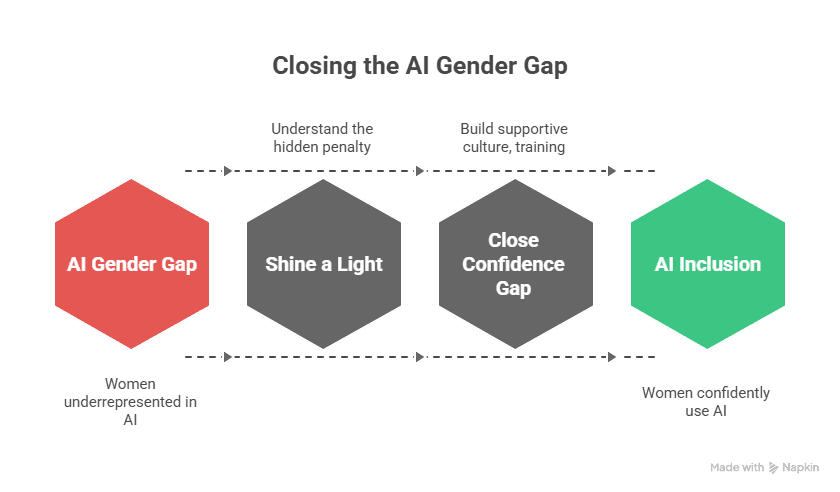
To understand why this moment demands action, we have to confront the reality of the AI gender gap today. Despite the hype around tools like ChatGPT and AI assistants, adoption on the ground remains strikingly low – and uneven. A recent Pew survey found that two years after ChatGPT’s debut, only 16% of American workers were using AI in their job, even though 91% said their employers permitted it. But within that 16%, women are underrepresented. At one leading tech company that rolled out a cutting-edge AI coding assistant, just 41% of engineers tried it in the first year. More troubling: female engineers’ adoption rate was only 31%. In other words, not even a third of the women offered an AI tool felt comfortable using it.
Why would talented women hesitate to use a productivity-boosting tool? The answer lies in a pernicious double standard researchers have begun calling the “competence penalty.” In a 2025 Harvard Business Review study, engineers were asked to evaluate a piece of code. Some were told the coder used an AI assistant; others were told it was written without AI. The code was identical in quality. Yet when reviewers believed an engineer had used AI, they rated that engineer’s competence 9% lower on average. Simply using an AI tool – even to produce good work – made colleagues see you as less capable. And the bias wasn’t uniform: If the engineer was male, his competence score fell by 6%. If the engineer was female, it fell by 13%. In other words, women were judged twice as harshly for relying on AI assistance. The study further found that male engineers who personally refused to adopt AI were the most critical of colleagues who did – especially of female colleagues. Male non-adopters penalized female AI-users 26% more harshly than they penalized male AI-users.
This hidden penalty creates a vicious cycle. Women are aware of the extra scrutiny. They know, as one tech leader put it, that “women often face extra scrutiny over their skills… There may be a deep-rooted concern that leveraging AI tools may be perceived as cutting corners or reflect poorly on [their] skill level. Facing this bias, many women understandably hesitate to use AI openly. The HBR researchers found exactly that: “Those who most feared competence penalties…—disproportionately women and older engineers—were precisely those who adopted AI least. The very groups who might benefit most from productivity-enhancing tools felt they couldn’t afford to use them.. Women, along with other underrepresented or more senior groups, often feel they must be perfect at all times to prove themselves. Adopting a new, not yet trusted tool carries risk – it might mark them as less competent in others’ eyes. So the confidence gap widens.
This phenomenon has been dubbed the AI confidence gap for women, echoing the broader confidence gap that has long existed in workplaces. Even when women have equal or better skills, they are often less confident in asserting them, partly due to social conditioning. With AI, that gap is compounded by real bias against AI users. It’s a lose-lose: avoid AI and risk falling behind, or use AI and risk unfair judgment. A Harvard Business School study by Rembrand Koning confirms that across industries, women are adopting AI tools at a 25% lower rate than men on average. Not because women lack ability – but because many question whether using AI is truly “safe” for their careers. In some cases, women also voice more ethical reservations, worrying if using AI is appropriate for their role. These are valid concerns we must address.
The result is a stark gender gap in who’s embracing AI’s potential. One survey found junior women in technical roles are far less likely than their male peers to recognize the need to develop AI skills – only 38% of young women said mastering AI was critical for their career, versus 53% of young men. This isn’t a lack of ambition; it’s a lack of inclusion. Researchers suggest young women may not have the same access to AI projects, mentorship or “inside discussions” about tech strategy as men do. In short, women are too often left on the sidelines of the AI wave.
So what do we do about it? First, we shine a light on the bias. The HBR study’s authors bluntly warn that if organizations ignore this dynamic, offering AI tools could inadvertently “increase bias against female engineers” in male-heavy environments. But knowledge is power: once we understand the hidden penalty, we can actively work to eliminate it (more on that in our Calls to Action section). Second, we must close the AI confidence gap through culture and training. For a deeper dive on nurturing women’s confidence with AI in the workplace, check out our guide “How to Close the AI Confidence Gap in Your Workplace” – it offers practical strategies to build a supportive culture for women adopting new tech (see How to Close the AI Confidence Gap in Your Workplace. The bottom line is that the current state of affairs is unacceptable. Low adoption and lower confidence among women in AI isn’t a women’s issue – it’s a leadership issue. Companies are leaving productivity on the table and diverse talent untapped. We cannot let outdated biases or lack of support prevent women from seizing tools that could amplify their impact. The next section looks at how history warns us against repeating such mistakes.
If we look to history, we see a troubling pattern: during past technology revolutions and power shifts, women have often been marginalized or outright excluded. From medicine to computing to corporate leadership, women’s contributions were belittled or blocked – to the detriment of those fields. As we stand on the brink of the AI age, these historical lessons loom large. We must not allow AI to become “another boys’ club” or we risk baking in old inequalities into the future.
Consider the field of medicine. For centuries, women were barred from attending medical schools and joining physician guilds. The first American woman to receive a medical degree, Elizabeth Blackwell, did so in 1849 only after being admitted as a joke; it took almost a hundred years more for U.S. medical schools to widely admit women. Even in clinical research, women were long excluded from trials – leading to diagnostic criteria and treatments that defaulted to male patients. The result? Heart attack symptoms in women went unrecognized for decades; medications dosed for “average” (male) bodies caused adverse effects in women. The exclusion of women’s perspectives harmed health outcomes for half the population. It’s a stark parallel: if women’s voices are missing in AI development, the “diagnoses” and solutions AI produces may similarly fail to serve women’s needs.
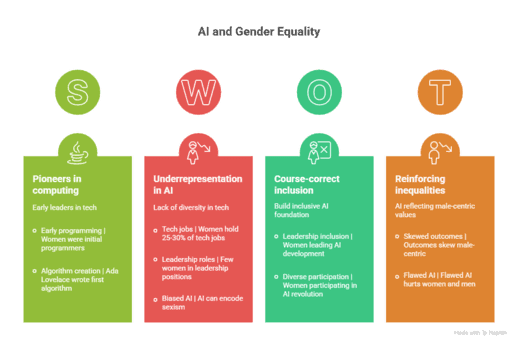
Or take the tech industry itself. In the early days of computing, women were pioneers. Ada Lovelace wrote the first algorithm in the 1800s. Women programmers (the “ENIAC Six”) programmed some of the first electronic computers in the 1940s. Programming was even seen as “women’s work” initially – akin to clerical labor. But as computing grew in prestige and profitability, women were pushed out. By the 1980s, a culture of male “computer geeks” had taken over, and the percentage of women in computer science plummeted. The industry is still recovering; today women hold only about 25–30% of tech jobs and an even smaller share in AI specialties. This lack of diversity has real consequences. Technology created in a male bubble often fails women in surprising ways. For example, Amazon famously had to scrap a hiring AI tool that showed bias against women applicants. The machine learning model had been trained on 10 years of past resumes – most from men, reflecting the tech industry’s male dominance. Consequently, the AI “taught itself that male candidates were preferable” and began penalizing resumes that included the word “women’s,” (as in “women’s chess club captain”). It even downgraded graduates of women’s colleges. Amazon’s engineers tried to correct it, but ultimately the project was abandoned when they couldn’t guarantee the AI wouldn’t invent new discriminatory rules. This case is a flashing warning sign: if women are not involved in designing and vetting AI systems, those systems can literally encode sexism into software. The AI gender gap isn’t just unfair to women; it can result in flawed AI that hurts women and men through biased decisions.
In the realm of leadership, the story has been one of slow, hard-won progress against exclusion. It wasn’t so long ago that boardrooms and C-suites were almost exclusively male. In 1998, only two Fortune 500 CEOs were women. Even today, women lead just about 10–11% of Fortune 500 companies. While we celebrate that record 55 women are now Fortune 500 CEOs (as of 2025, the most ever, that’s still under 11% of top companies – meaning nearly 9 in 10 are led by men. And women of color hold an even tinier fraction of those roles. Why does this matter for AI? Because leadership shapes vision. If the people deciding how AI is used – what problems it solves, what data it’s trained on, what ethical guardrails are in place – are homogenous, their blind spots become baked into AI strategies. We’ve seen what happens when leadership lacks diversity: products like early voice recognition systems that couldn’t understand women’s voices, health apps that initially forgot to include menstrual tracking, safety equipment (like crash-test dummies) built to male specifications that resulted in higher injury rates for women. All these examples stem from a simple truth: when women are absent from the decision-making table, the outcomes skew male-centric. AI, as powerful as it is, will reflect the values and assumptions of its creators. Without women in AI leadership, we risk creating algorithms and automated decisions that reinforce old inequalities or overlook female perspectives by design.
The historical parallels are clear. We stand at a crossroads similar to the industrial revolution or the dawn of the internet age. Will we repeat the mistakes of the past – allowing a new technology to widen gender gaps and sideline women’s talents? Or will we use this moment to course-correct and build a more inclusive foundation? The World Economic Forum observes that right now, “the generative AI boom is being shaped in ways that don’t fully reflect the diversity of society, leaving women underrepresented in the jobs and leadership roles of the future.” But critically, “this moment offers a rare opportunity to course-correct.. We can choose a different path. To do so, women must not only participate in the AI revolution but lead it.
Closing the gender gap in AI isn’t just about getting more women to use chatbots or automation in their daily work. That’s necessary, but not sufficient. The true vision is women in AI leadership – women guiding the direction of AI development, deployment, and strategy. In short, women shouldn’t only use AI tools; they should be the ones building them, choosing them, and implementing them.
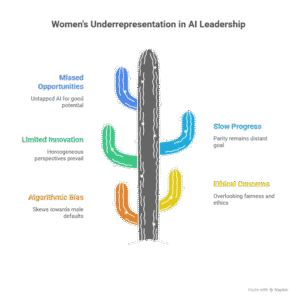
There’s a simple reason for this: inclusive leadership leads to better technology. AI is not neutral – it reflects the intentions and biases of those who create it. Diverse teams are proven to be more innovative and produce better results. In AI specifically, having women in the room leads to questions and insights that homogeneous teams might miss. For example, Joy Buolamwini – a Black woman in AI research – discovered that facial recognition algorithms had drastically higher error rates for women and people with dark skin, because the training data was overwhelmingly white and male. Her work prompted industry-wide reforms and awareness of algorithmic bias. It’s no coincidence that a woman uncovered this issue; a homogeneous team might never have even tested the tool on a variety of faces. Likewise, women leaders often emphasize ethics and fairness in AI. Many of the voices pushing for AI responsibility, transparency, and human-centric design are women – from renowned researchers to AI ethicists in tech companies. As noted in CIO Business World, women in AI leadership combine “analytical rigor and creative thinking, ensuring that AI solutions are not only technically sound but also practical and ethical. Women tend to approach technology with a collaborative, problem-solving mindset and a desire to use tech for social good. When women lead AI projects, they bring these values to the forefront. A recent Deloitte study put it plainly: as long as the AI field remains male-dominated, biased outcomes will persist. Conversely, the more we can bring diverse voices into AI, the more we can debias these systems and unlock AI’s full potential for everyone.
We are starting to see glimmers of progress. The share of women in AI roles globally has inched upward – from around 22% a few years ago to about 26% in 2025. Women-led AI startups are reportedly growing at twice the industry average rate, showing that when women aren’t given a seat at the table, they are building their own tables. Programs like Women in Machine Learning, AI4All, and countless grassroots communities are training and mentoring the next generation of female AI leaders. This is encouraging – but we need to accelerate it. Because 26% representation is still far from parity, and “growth” from 22% to 26% over several years is too slow when AI is exploding in importance right now. Women must have power without permission in the AI domain – stepping up even if they are the “first” or “only” in the room.
What does it look like when women lead in AI? It looks like inclusive AI design. It means the team designing a healthcare AI includes women doctors who point out when an algorithm might not account for female-specific symptoms. It means the fintech AI team has women who ensure a lending algorithm isn’t subtly penalizing women (as has happened historically with credit scoring). It means women in product leadership who insist on a more diverse dataset before an AI model goes into production. And it’s not only about preventing harm – it’s about opening new frontiers. Women leaders often identify markets and problems that others overlook. Who better than women to drive AI solutions for challenges that disproportionately affect women, from maternal healthcare to childcare management to workplace safety from harassment? There is a vast untapped realm of “AI for good” that women in leadership are especially well positioned to realize.
Crucially, women in leadership also attract more women into the field. They serve as role models and mentors. In AI, this cascading effect is needed to break the cycle of underrepresentation. When a woman heads an AI team, she’s more likely to hire other talented women, to create a culture where women technologists feel they belong, and to promote rising women. As an example, consider that teams with female leadership have been shown to be more attentive to team dynamics and inclusion (a trait often linked to higher team performance). In AI, where interdisciplinary collaboration is key, that inclusive team culture can be the difference between success and failure.
For businesses wondering why they should prioritize diversity in their AI initiatives, the answer is simple: it’s a competitive advantage. Research has repeatedly found that diverse teams drive more innovation and better financial outcomes. Inclusive AI teams are less likely to build products that alienate portions of your customer base. They are more likely to anticipate pitfalls that could lead to PR disasters or compliance issues. In sum, diversity in AI = better AI. (For more on the performance boost that comes from diverse tech teams, read “The Business Case for Inclusive AI Teams” – we explore how companies with inclusive AI leadership outperform their peers, with citations to the latest studies on innovation and ROI: see The Business Case for Inclusive AI Teams.)
It’s worth noting that inclusivity isn’t just about gender, of course. True diversity includes race, ethnicity, age, and background as well. But given that women are half the population and yet so underrepresented in AI, closing the gender gap is a foundational step towards broader diversity. As Andreas Pettersson writes in Power Without Permission, “I don’t want to live in a world where men are the only leaders—where boardrooms echo with the same voices, same instincts, and same approaches, decade after decade. Not simply to create balance or fairness, but because women are brilliant in their own right and necessary for us to establish a better future.” Women’s leadership in AI is not about tokenism or checking a box; it’s about injecting excellence and insight that would otherwise be missing. When women lead, everybody wins – products are better, companies perform better, and societies progress toward equity.