
⏱️ 13 min read
Add as a Google preferred sourceLeaders ADAPT on core values exercises for teams: Five core values exercises that produce values people actually use. The founder defines values first, the team pressure-tests second. Get exercises your team can run this week.
By Andreas Pettersson, founder of Leaders ADAPT and a former Canon executive who has built and scaled multiple companies.
I’ve sat through a lot of core values exercises. The brainstorming sessions where everyone circles words on a list. The sticky-note workshops where groups cluster themes on a whiteboard. The voting rounds where the leadership team negotiates until they find five words nobody objects to.They all produce the same result: a set of values that sounds right, feels collaborative, and gets forgotten within 60 days.The problem isn’t the facilitation. The problem is the design. Most values exercises are built for consensus. They’re built to make everyone feel heard. They’re not built to produce values that actually change how people work.The five exercises below are different. Each one is designed to surface real values (not aspirational ones), pressure-test them with real stakes, and connect them to daily operations. I’ve used all five with leadership teams I coach, and I’ve refined them based on what works and what doesn’t.If you haven’t already defined your company’s core values, start with the 6-step discovery process before running these exercises with your team. The exercises below are for pressure-testing and embedding values that have already been identified by the founder or CEO. They’re not for creating values from scratch through group consensus, which produces lowest-common-denominator results.For a deeper look at how core values for leaders shape company culture and decision-making from the top, start there before running team-level exercises.Before You Start: Three Rules for Values Exercises That Work
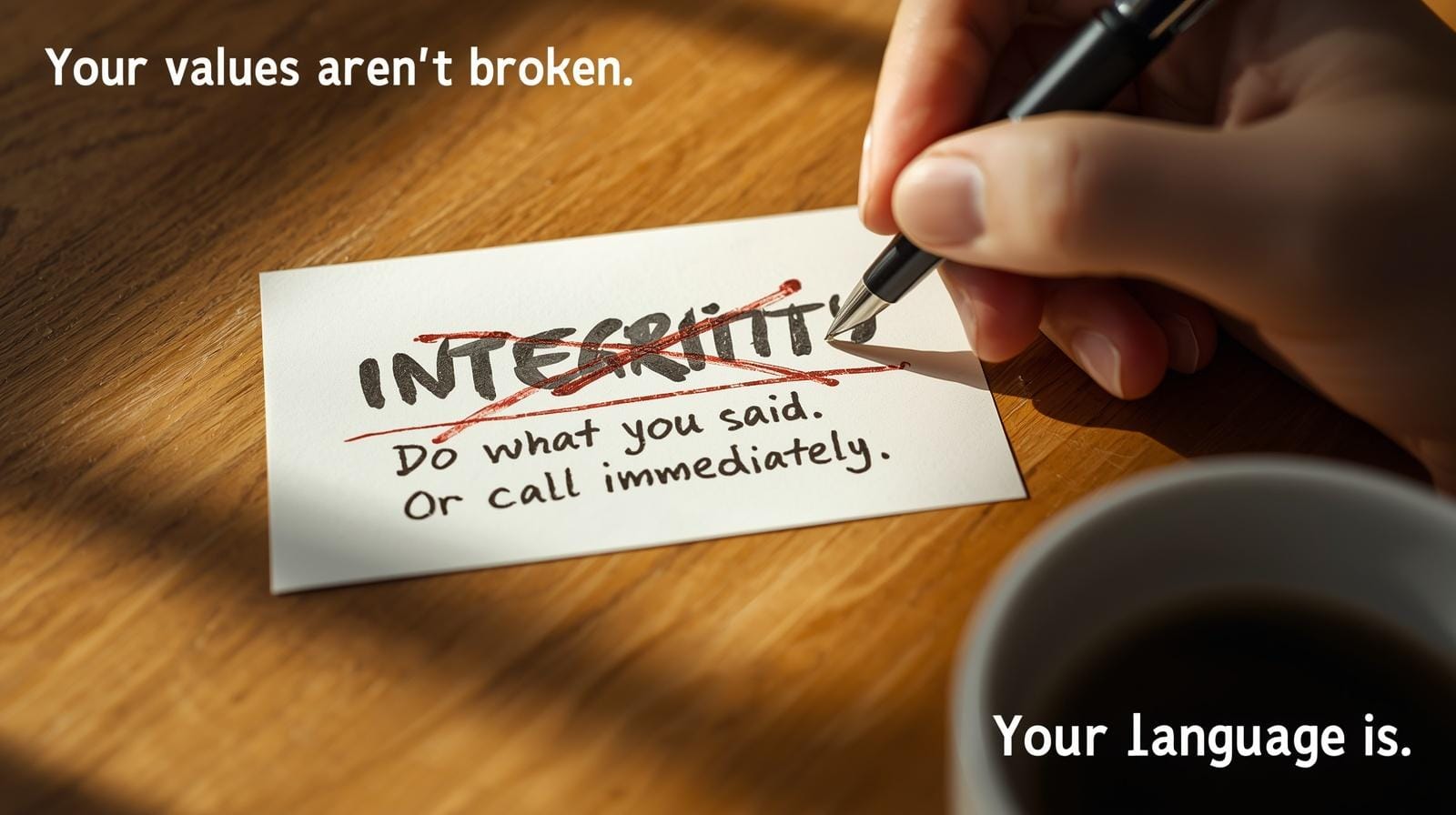
Rule 1: The founder defines first. The team pressure-tests second. In a founder-led company, the founder’s values are already the operating system. The team’s job isn’t to create new values. It’s to stress-test the founder’s values, refine the language, and build behavioral ownership. If you start with group brainstorming, you’ll end with generic values nobody owns.Rule 2: Every exercise must produce behavioral rules, not just words. If the exercise ends with a word like “Integrity” on a whiteboard, it failed. If it ends with “Do what you said you’d do, or communicate immediately when you can’t,” it worked. The behavioral rule is the unit of value.Rule 3: Every exercise must include a real scenario with real stakes. Hypothetical discussions produce hypothetical commitment. When people apply values to real situations from their own experience, the values become personal, memorable, and actionable.Exercise 1: The Decision Archaeology
Time: 60 minutes Group size: 4-12 people (leadership team ideal) What it produces: Your company’s actual values, discovered from behavior, not aspirationsThis is my adaptation of the individual Decision Audit from the definition process, redesigned for team use.Setup: Ask each team member to come prepared with two decisions from the past year. Not routine decisions. Decisions that involved real tension: a trade-off, a risk, a cost, an uncomfortable conversation. Write each decision on a separate card with three details: what happened, what was at stake, and what they chose.Round 1 (20 minutes): Each person shares one decision. After each share, the group answers: “What value was this person protecting?” Write every answer on the board. No debate during this round. Just observation.Round 2 (20 minutes): Look at the board. Circle the patterns. You’ll find that certain themes repeat across multiple people’s decisions. Honesty. Speed. People development. Accountability. Whatever they are, the repetition reveals values that are already operating in your company.Round 3 (20 minutes): For each pattern, ask: “Can we turn this into a behavioral rule? What would this look like at 9 AM on Tuesday?” Force the group from abstraction to specificity. “Honesty” becomes “Share bad news within 24 hours, even if you don’t have a solution yet.”Why it works: It starts with actual behavior, not desired behavior. The values that emerge have already been lived. That makes them credible and adoptable because people recognize them from their own experience.Debrief question: “Were there any decisions where the values we just named were violated? What happened?”That question surfaces the cost of values gaps without accusation. It shows the team that these values already have consequences.Exercise 2: The Values Collision
Time: 45 minutes Group size: 4-12 people What it produces: A values hierarchy and clarity on what happens when values conflictThis is the exercise that separates operational values from decorative ones.Setup: Write your three to five core values on the board. Then present three real scenarios where two values are in direct tension. Use scenarios from your actual business, not hypothetical ones. If you need to anonymize details, fine. But the situations must be real.Example scenarios I’ve used:“A client wants to expand their contract by 40%. Accepting requires committing to a delivery timeline your team says is unrealistic. Your value of ‘say the hard thing early’ says push back on the client. Your value of ‘decide fast’ says take the opportunity. Which wins?”“A team member consistently delivers excellent work but undermines colleagues in private conversations. Your value of ‘build leaders’ says invest in coaching them. Your value of ‘say the hard thing’ says confront the behavior and set a deadline. Which wins? What if coaching doesn’t work?”“You discover that a product feature was shipped with a known issue because the team prioritized speed over thoroughness. Your value of ‘decide fast, correct faster’ says fix it and move on. Your value of accountability says address why the known issue wasn’t flagged. How do you handle both?”The exercise: For each scenario, the team discusses and decides which value takes priority. The goal isn’t unanimous agreement. The goal is clarity. By the end, you should have a hierarchy: when Values A and B conflict, A wins. When B and C conflict, B wins.Why it works: Most values exercises treat values as non-conflicting. In reality, values collide constantly. This exercise forces the team to confront that reality and build a decision framework for handling it. The hierarchy becomes a tool every team member can use during real decisions.Debrief question: “When was the last time you faced a values collision in your actual work? How did you resolve it? Would this hierarchy have helped?”Exercise 3: The Behavioral Translation Workshop
Time: 90 minutes Group size: Full team (can be done in breakout groups of 3-5) What it produces: Three to five behavioral rules per value, written by the team, with real-world anchoringThis is the exercise that turns words into operating instructions.Setup: Write each core value on a separate flip chart or whiteboard section. Beneath each value, create three columns: “Looks Like,” “Doesn’t Look Like,” and “Tuesday Morning Test.”Phase 1: Looks Like / Doesn’t Look Like (40 minutes)For each value, the team brainstorms specific, observable behaviors in both columns. Not feelings. Not attitudes. Behaviors that a camera could record.“Say the hard thing early” might produce:- Looks Like: “Telling a client the timeline is unrealistic before signing the contract.” “Giving a team member feedback the same day you notice the issue.” “Sharing revenue numbers with the team, even when they’re bad.”
- Doesn’t Look Like: “Waiting until a 1:1 to mention something you noticed three weeks ago.” “Softening feedback so much the recipient doesn’t understand the severity.” “Sharing only good news in all-hands meetings.”
Exercise 4: The Cost Audit
Time: 30 minutes Group size: Leadership team (4-8 people) What it produces: Validation that your values are real, plus identification of values that haven’t been tested yetShort exercise. High impact.Setup: List each core value on the board. For each one, ask two questions:“When has this value cost us something? Name a specific situation where holding this value cost us revenue, a client, a hire, speed, or comfort.”“When have we compromised this value? Name a situation where we didn’t hold the line.”The discussion: Go around the room for each value. If someone can point to a specific cost, the value is real. It’s been tested and held. Write the cost next to the value.If nobody can point to a cost, the value hasn’t been tested yet. That doesn’t mean it’s fake. It means you haven’t faced the moment where it matters. Flag it. Watch for it. And when the test comes, hold the line.If someone names a compromise, don’t punish. Explore. What made the compromise happen? Was it pressure? Convenience? A competing priority? The answers reveal where your values system needs reinforcement.At the company I ran, our cost audit revealed that “build leaders, not followers” had cost us the PE deal (higher valuation, wrong cultural fit) and 18 months of patience with Daniel (more than $1M in accumulated impact). Those costs made the value credible to the leadership team. They’d seen the price. They knew it was real.“Decide fast, correct faster” had cost us a few bad calls that needed reversal. But the net speed advantage was so clear that nobody questioned the value. The imperfect decisions were the cost. The 60+ correct-fast decisions per quarter were the payoff.Why it works: Abstract values become concrete when you can point to what they cost. This exercise grounds the team in reality and builds conviction that values aren’t aspirational. They have teeth.Debrief question: “Based on what we just discussed, are there any values we should add, remove, or reword?”Exercise 5: The New Hire Simulation
Time: 45 minutes Group size: 4-12 people (works best with a mix of tenured and newer team members) What it produces: A values onboarding script and a test of whether your values are teachableThis is the exercise that proves whether your values system is complete.Setup: Pair people up. One person plays a new hire on day three. The other plays their manager.Scenario: The manager has 10 minutes to explain the company’s core values, behavioral rules, and the decision hierarchy to the “new hire.” No handouts. No slides. Just a conversation.Round 1 (10 minutes): The manager explains. The new hire listens and asks questions.Round 2 (10 minutes): The new hire receives a scenario card (prepare these in advance). Each card describes a realistic situation requiring a values-based decision. The new hire must use what they just learned to make the call. The manager observes but doesn’t coach.Example scenario cards:- “A potential client asks you to bend the terms of the standard agreement to close the deal faster. What do you do?”
- “You notice a colleague missed an important deadline but hasn’t told anyone yet. What do you do?”
- “Your manager asks you to prioritize a task you believe is less important than what you’re working on. How do you respond?”