
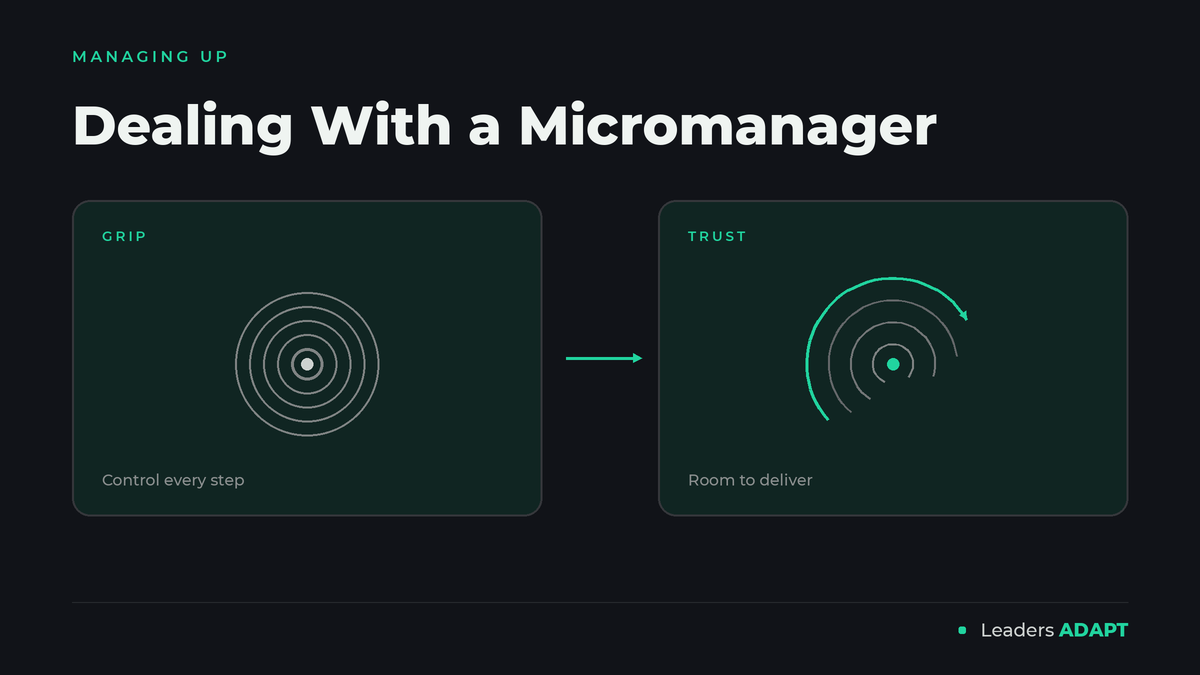
It’s 9:02 on a Monday. You sent the update at nine sharp, like always.
By 9:04 the reply lands. “Can you walk me through your plan for this? And loop me on the next three steps.”
You feel it in your jaw. You did the work. You sent the proof. And still, the hovering.
Here’s the truth. That’s not a competence problem. That’s not a you problem. It’s a trust gap, and learning how to deal with a micromanager starts with seeing it that way.
I learned this running my own company. We scaled from three people to 150 across three countries, then sold to Canon.
I had managers who checked everything, and I was one myself before I knew better. The checking was never about the work. It was about the fear underneath it.
That’s the thing almost nobody tells you when you go looking for how to deal with a micromanager. The behavior is loud, but the cause is quiet. Your boss isn’t managing you. They’re managing their own anxiety.
Quick answer: How to deal with a micromanager comes down to closing the trust gap that drives the hovering. Send a short, proactive status update before they ask, so uncertainty never builds. Then name the pattern without the trigger word. Reduce what they fear, and the behavior fades on its own.
This post gives you the exact move, the reason the hovering happens, and the one sentence that names it without starting a fight. Most advice tells you to endure it. That’s the part that keeps you stuck.
What a Micromanager Is Actually Doing
A micromanager looks like someone who doesn’t trust you. Underneath, they’re someone who can’t sit with not knowing.
Every check-in, every “loop me in,” every rewritten email is a person trying to make uncertainty go away. The tool they reach for is control, because control feels like safety.
Here’s the reframe that changed everything for me. Their behavior is a symptom, and the disease is uncertainty. When you treat the symptom, you fight. When you treat the disease, you win.
That’s why willpower and patience never fix this. You can’t out-tolerate someone else’s anxiety. You have to lower it. Knowing how to deal with a micromanager means becoming the least worrying person on their team.
Why Your Boss Actually Hovers
The hovering is rarely personal. It’s usually pressure flowing downhill.
Your boss has a boss. Someone is asking them hard questions they can’t fully answer, so they push that same fear onto you. The tighter the grip on them, the tighter their grip on you. Half of how to deal with a micromanager is just seeing that pressure clearly.
I coached an operations lead whose director rewrote every deck she sent. She took it as an insult to her taste. It wasn’t. The director was terrified of looking unprepared in front of the executive team, so he policed every slide.
Once she saw that, her whole strategy shifted. She stopped defending her work and started removing his fear. That’s the real unlock in how to deal with a micromanager, and it’s why the surface fight never works.
So before any script, one honest question. What is your boss afraid will happen if they stop checking? Answer that, and the whole thing gets simpler. This is where dealing with a micromanager stops being a personality clash and becomes a solvable puzzle. If you are not yet sure it is micromanagement rather than close oversight for a reason, take the micromanaging boss test first.
How to Deal With a Micromanager: The Trust Loop
Here’s the framework I teach. I call it the Trust Loop, because you’re closing a loop that keeps reopening in your boss’s head.
The loop is simple. Uncertainty rises, they check, they feel briefly calm, uncertainty rises again. Your job is to feed the loop information before it swings back to fear.
Step 1: Over-communicate before they ask
Beat the check-in to the punch. The single fastest way to stop someone from chasing status is to hand them status before they think to want it.
Set a short standing update. Same time, same format, every day or every few days. Three lines is plenty. What I finished, what I’m doing next, where I’m stuck.
That last line matters more than the other two. When you name your own blockers first, you prove you’ll surface problems without being asked. That’s the exact fear you’re removing.
Step 2: Make your work visible on your terms
A micromanager fills an information vacuum by digging. So don’t leave a vacuum. Put the work where they can see it without touching it.
A shared doc, a live board, a simple tracker. The message you’re sending is quiet but powerful. Nothing is hidden, so there’s nothing to go find. That single shift does more for how to deal with a micromanager than any confrontation ever will.
Step 3: Name the pattern without the trigger word
Here’s where most people torch it. They say “you micromanage me,” and the boss gets defensive, because you just called them a bad manager. Now you’re in a fight instead of a fix.
Never use the word. Name the feeling and the effect instead. Try this. “This feels a little too prescriptive, and I don’t feel you’re using what I can actually do.”
You’ve named the pattern honestly. You’ve kept the word that starts wars out of it. And you’ve framed it as wasted talent, which is a problem your boss actually wants to solve. This is the heart of how to deal with a micromanager without blowing up the relationship.
Step 4: Ask for one thing to own
Don’t ask for freedom in the abstract. Ask for one concrete piece to run end to end. “Let me own the client update this month. I’ll show you the finished version before it goes out.”
You gave them an off-ramp. They keep a checkpoint at the end, so their fear has somewhere to land, but you get room in the middle. Small wins here compound, because every clean delivery buys you more rope.
That’s the whole Trust Loop for how to deal with a micromanager. Over-communicate, make work visible, name the pattern gently, ask to own one thing. Four moves, about five minutes to set up.
The Mistake That Makes Micromanagement Worse
Most people get how to deal with a micromanager wrong the same way. They pull back. They go quiet, hoping distance signals that they can be trusted.
It does the opposite. Silence reads as risk. Every hour your anxious boss doesn’t hear from you, their imagination fills the gap with worst cases, and they check harder.
The other miss is matching their energy. They tighten, so you get short and defensive, and now two anxious people are circling the same task. You can’t calm someone by mirroring their fear.
Do the counterintuitive thing. When they squeeze, give more information, not less. Visibility is the pressure valve, and you’re the one who controls it. That single instinct, more light instead of more distance, is what how to deal with a micromanager really comes down to.
How to Deal With a Micromanager Who Won’t Let Go
Some bosses keep hovering even after you’ve done everything right. The update goes out, the work is visible, and they still swoop in. Now you escalate the conversation, calmly.
Book fifteen minutes. Come with evidence, not emotion. “Over the last month I’ve hit every deadline and flagged issues early. I’d like to test a lighter check-in and see how it feels for both of us.”
You’re not complaining. You’re proposing an experiment with a built-in review, which is almost impossible for a reasonable person to refuse. That’s how to manage your manager when the gentle version hasn’t fully landed yet.
Don’t make it about your feelings with a boss like this. Make it about results, capacity, and their time. “You’re spending an hour a week checking my work. I want to give that hour back to you.”
Facts are hard to argue with. Feelings invite a debate you’ll lose. Outcomes are the only language a nervous boss fully trusts.
And drop the pedestal. A title doesn’t make someone right, and it doesn’t make their anxiety your job to carry forever.
This is the low-ego, direct posture I grew up with in Sweden. There you can tell a manager “I’ve got this, let me run it” and it’s treated as normal, not as insubordination. You can bring that same stance to a US office. You just pick your moment and your words.
If the hovering is only one part of a boss who’s genuinely difficult across the board, that’s a bigger issue, and how to deal with a difficult boss covers the harder cases.
Want the systematic version of this? The 5 Minute Leader turns the Trust Loop into a standard your whole team runs, so nobody has to hover. More on that in a moment.
Scripts You Can Steal
Theory is nice. Here are the exact lines for how to deal with a micromanager in the moment. Steal them.
The daily standing update: “Yesterday I closed X. Today I’m on Y. One thing I’m stuck on is Z, so flag me if you have a view.” Proactive, short, done before they ask.
The gentle name: “This feels a little too prescriptive, and I don’t feel you’re using what I can do. Can we find a spot where I run something start to finish?” No trigger word, real ask.
The ownership request: “Let me own this one end to end. I’ll bring you the finished version before it ships.” A checkpoint for them, room for you.
The lighter check-in: “I’ve hit every deadline this month. Can we try a weekly sync instead of daily and see how it feels?” An experiment, not a complaint.
The pushback moment, said calm: “I hear you. I’ve got the details covered here. Let me bring you the result Friday.” Then stop talking. Silence does the work.
Notice what every script shares. No blame. No trigger word. A little more visibility, and a clear next step. These lines are how to deal with a micromanager in real sentences, not theory.
What Happens When You Close the Trust Gap
Picture yourself three months from now. You’ve run the Trust Loop for a full quarter. The standing update is automatic, and the jaw-clench is mostly gone.
Your boss stopped asking for status, because you always beat them to it. The rewrites slowed, then stopped, because your work was visible and clean before they could find something to fix. You’re doing more of the job you were hired for and less of the performing-for-approval dance.
Here’s the counterintuitive part. Your boss trusts you more than the peers who kept their heads down. Not because you demanded trust, but because you kept removing the reason to withhold it.
The cost of not doing this is steep and quiet. Every week you spend enduring the hovering is a week you’re training your boss that checking works.
That doesn’t just cost you hours. It costs you the reputation of someone who owns outcomes, which is the reputation that gets promoted. And it slowly costs you the belief that you’re good at your job, which is the most expensive loss of all.
This is also the front edge of a bigger skill. Dealing with a micromanager is one piece of managing up, the practice of shaping the relationship with the people above you instead of absorbing whatever comes down.
And when the trust is high enough, you can go the other direction and start how to give your boss feedback that actually lands, because you’ve earned the standing to be heard.
Frequently Asked Questions About Micromanagers
How do you deal with a micromanager without quitting?
The key to how to deal with a micromanager is lowering the anxiety that drives the behavior instead of enduring it. Send a short proactive update before they ask, keep your work visible, and name the pattern without the trigger word. Most people quit because they treat it as permanent. Once you see it as a fixable trust gap, staying and fixing it usually beats starting over somewhere new.
What is the fastest way to deal with a micromanager?
The fastest lever is a standing update they didn’t ask for. When status arrives before your boss thinks to want it, the urge to check has nothing to grab onto. Add one line about where you’re stuck, so you prove you’ll surface problems on your own. That single habit does more, faster, than any big conversation.
How do I tell my boss they are micromanaging me?
Never use the word micromanage, because it lands as an insult and starts a fight. Name the feeling and the cost instead. Try “this feels a little too prescriptive, and I don’t feel you’re using what I can do.” Then ask for one thing to own end to end. You’ve named it honestly without triggering defense.
Is micromanaging a sign my boss thinks I am bad at my job?
Usually not. Micromanaging is far more often about your boss’s own fear than your performance. They’re getting pressure from above, or they can’t sit with uncertainty, so they grip tighter. Reading it as a verdict on your ability keeps you stuck. Reading it as their anxiety hands you the actual thing to fix.
How do you deal with a micromanager who won’t change?
Escalate calmly and make it an experiment. Book fifteen minutes, bring evidence of delivery, and propose a lighter check-in with a review built in. “I’ve hit every deadline this month, can we test a weekly sync?” If they still won’t move at all, that points to a deeper problem than hovering, and it may be a signal about the role itself.
How is managing a micromanager different from just complying?
Complying means you shrink and let the hovering define the job. Managing a micromanager means you actively change the dynamic by removing what fuels it. One drains you over time. The other builds trust, buys you room, and shows leadership you can handle a hard relationship well, which is exactly the skill the next level up requires.
Where This Goes Next
The hovering isn’t the finish line. It’s the first test of whether you can shape the people above you instead of just reacting to them.
The pattern I see across founders and operators is simple. The ones who rise aren’t the ones who suffer a controlling boss in silence. They’re the ones who quietly make themselves impossible to worry about.
Master how to deal with a micromanager, and you stop performing for approval and start earning real trust, which is the currency every promotion runs on.
Reading this as the manager, and recognizing yourself? The other side of this page is how to stop micromanaging without losing control, built around one check-in rule.
Turn one hard boss into a system that never needs hovering
Fixing one micromanager is a moment. Building standards so work never has to be chased is a system. That’s what The 5 Minute Leader is built to do.
It installs four protocols in about five minutes each. The Delegation Protocol, so work handed off doesn’t come back half done and nobody feels the urge to hover. The 1:1 Protocol, so problems surface early instead of forcing someone to go digging. The Accountability Protocol, so standards hold without anyone chasing.
And a fourth protocol most leaders say is the one they’d keep if they could keep only one, the one that sets the rhythm that makes all of it stick.
You’re already learning how to deal with a micromanager from below. This gives you the system to build trust that runs both ways. If you’re ready to stop enduring the hovering and start engineering it away, get The 5 Minute Leader and install the first protocol today.