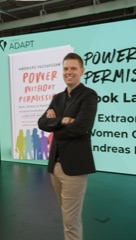

Leaders ADAPT on business freedom scaling without burnout: Business freedom means your company runs without consuming you. If every decision still routes through your laptop at 11 PM, you built yourself a job, not a company. The way out is systems: delegated outcomes, clear standards, and an operating rhythm that scales the business while giving you your life back.
I know exactly what your Tuesday looks like.
It’s 11:14 PM. The house is completely quiet. Your kids have been asleep for hours- you didn’t even see them awake today. Your laptop is wide open on the kitchen table, right next to a cold cup of afternoon coffee. You are typing a reply to the fourteenth email of the night. The one that “just can’t wait until tomorrow.”
Somewhere between two clicks, a sudden thought crosses your mind, and you instantly crush it: Didn’t I start all of this just to achieve true business freedom?
The Lie We Tell Ourselves
When I became the youngest independent CEO at Canon at age 37, I thought I had won the game. I was managing a team of 150 people and a platform processing over 100 petabytes of data monthly. From the outside, it looked like textbook success.
But what did it look like from the inside?
Every single decision had to go through me. I had to put out every single fire personally. Consequently, I was working harder than I did when the company was ten times smaller. The business became heavier, slower, and much more fragile.
Eventually, my health forced me to face reality. I ended up on the edge- literally. When you are lying in a hospital bed, no one asks you to approve a client proposal.
That was the exact moment I realized a brutal truth: the skills that got you here are now the ceiling keeping you down. You managed to survive through sheer willpower and hustle. However, you cannot scale a business on hustle alone. Hustle only leads to burnout, not growth.
Marko, 2 AM, and the Question That Changed Everything
Let me tell you about Marko. (The name is changed, but the story is entirely real.)
Marko runs a company making just under two million euros a year. When we first spoke, his very first words were: “Andreas, I don’t have a business problem. The business is growing. My problem is that I cannot step away from it.”
His last vacation was three years ago. Even then, he spent four hours a day “just checking emails.” His wife stopped asking when he would be home. In fact, she stopped asking altogether.
I asked him one simple question:
“What would happen to your company if you didn’t show up tomorrow?”
He stayed silent for a long time. Finally, he replied: “It would fall apart within two weeks.”
“In that case, Marko, you are not running a company. You are an employee in your own prison. And you are the one paying the rent.”
How to Scale a Business and Regain Freedom
To fix this, we didn’t focus on marketing, sales, or standard productivity hacks. Instead, we focused on three specific areas to achieve real business freedom:
First, a decision-making framework: We mapped out exactly which decisions the team could make without him. It turned out to be 80% of his inbox. Eighty percent!
Second, Delegating Ownership, Not Tasks: He stopped handing out tasks and started assigning specific ownership. When a task gets stuck, it bounces back to you. Ownership stays with the team.
Third, The Hardest Part (The Mirror): Marko had to admit that he was the bottleneck. It wasn’t the market, and it wasn’t the team. It was him. His need to control everything wasn’t dedication- it was fear.
Six months later, Marko sent me a message. It wasn’t a revenue report, even though his revenue grew by 40% that year. It was a photo. He was on a beach with his wife and kids. Ten days, phone on airplane mode.
Underneath the picture, he wrote: “The company didn’t even notice I was gone. But for the first time, I noticed that I actually have a life.”
An Uncomfortable Question for You
Here is what no one says out loud: most leaders do not need more advice. You have read the internet. You have thirty books sitting on your shelf right now.
What you actually need is someone who has sat in your chair. Someone who will tell you the truth quickly and directly. Vague kindness is the cruelest thing someone can offer you. People can handle honesty, but they cannot handle confusion.
Therefore, I am not going to convince you of anything. I am simply going to ask you the exact same question:
What would happen to your company if you didn’t show up tomorrow?
If the answer got stuck in your throat, that is your first data point.
Fortunately, you can get your second data point in just five minutes. I created a free test that shows how you actually lead- not how you think you lead. No credit card required, no obligations, and no sales calls afterward.
It takes five minutes. That is less time than you need to answer your next “urgent” email.
Your company will survive five minutes without you. After all, that is the whole point of long-term business freedom.
Frequently asked questions
Why does building a company end up consuming your life?
The post’s story is that founders start a company to gain freedom, then become the one thing holding it together, answering emails at 11pm and missing their kids. The business consumes your life when every decision routes through you and nothing runs without you. Freedom was the goal; being indispensable quietly replaced it.
What is the lie founders tell themselves about hustle?
The post calls it the lie that if you just work a little harder or a little longer, you will finally get free. But more hours deepen the dependency rather than ending it. The lie keeps you grinding toward a freedom that never arrives, because the problem is the design of the business, not your effort.
How do you scale a business and regain your freedom?
The post’s answer is to build a company that runs without you: document how you decide, delegate real ownership, and put systems in place so the business does not route every choice through the founder. Regaining freedom is an act of design, replacing yourself as the bottleneck, not simply working fewer hours by willpower.
What does business freedom actually mean for a founder?
Business freedom, in the post, is a company that produces results and makes decisions without depending on your constant presence. It is not walking away; it is being able to step back without everything stalling. The measure is whether the business can run for a week without you and still move forward.
How do you know your company owns you instead of the other way around?
The post points to the tells: you cannot switch off, every problem escalates to you, and time with family disappears into one more email. If the business cannot function without your constant input, it owns you. Naming that honestly is the first step toward redesigning it so you are the leader, not the load-bearing wall.
Can you scale a company without burning out?
The post argues yes, but only by changing how the business runs rather than how hard you push. Growth built on the founder’s stamina eventually breaks. Growth built on systems, delegation, and a team that can decide without you scales without the burnout, because the company no longer depends on one exhausted person.