

Quick answer: Leaders ADAPT puts executive coaching at $200 to $3,000 and up per hour in 2026, compiled from published industry pricing and the ICF Global Coaching Study. That spread is not one market. It is four tiers, and what moves a fee is broken down below, with the ROI math CEOs run before they invest.
By Andreas Pettersson, founder of Leaders ADAPT and a former Canon executive who has built and scaled multiple companies.
Understanding executive coaching cost before you commit is smart, here’s what the data actually shows.
Executive coaching costs $200 to $3,000+ per hour in 2026, with most engagements falling between $200 and $600 and a median around $500.
| Coaching Level | Hourly Rate |
|---|---|
| Early-career / Manager | $150 to $300 |
| Director / VP | $300 to $500 |
| C-suite / CEO | $500 to $3,000+ |
Where you land in that range depends on seniority, coaching format and engagement length. The full rate matrix, with monthly retainers and total 6-month program costs by level, is further down this page, and the calculator below prices your own situation.
What Is Executive Coaching?
Executive coaching is a one-on-one professional development partnership between a trained coach and a senior business leader. The coach helps the executive identify blind spots, develop leadership capabilities (which you can measure with a leadership assessment), and achieve specific business outcomes. Engagements typically run 6 to 12 months with structured sessions, accountability milestones, and measurable ROI targets. Increasingly the capability being built is human-centered leadership, leading through trust and judgment rather than command.
Executive coaching is a powerful investment in leadership growth, but how much does executive coaching cost, and what’s a fair price? In this comprehensive guide, we’ll explore the cost of coaching for executives and business owners, covering typical pricing models (one-on-one coaching, peer group programs, and mastermind groups) and key factors that influence price. Most importantly, we’ll emphasize why value matters more than price when it comes to coaching. The best coaches often have 5 to 10+ years of CEO-level experience and charge accordingly, but their impact can far outweigh the cost. By the end, you’ll know what drives business coach cost, understand ranges like executive coaching cost per hour, and be equipped to choose a coaching option based on outcomes, not sticker shock.
Cost of Coaching vs. Value: Why Price Isn’t Everything
Before diving into numbers, it’s crucial to frame cost in terms of value. Executive coaching fees can seem high, but the real question is: What results and ROI will you get? A less expensive coach who lacks experience may not deliver meaningful change, whereas a seasoned executive coach might justify a higher fee by driving significant improvements in leadership effectiveness or business performance. In fact, coaching is best viewed as an investment rather than an expense. Just as companies budget for leadership training or development programs, and knowing the difference between free assessment tools vs professional coaching helps with that, investing in a quality executive coach can yield returns like better decision-making, higher team engagement, and accelerated growth, outcomes that far outweigh the initial price.
Value Over Sticker Price: High coaching fees alone don’t guarantee quality, but there is often a correlation between experience level and cost. Coaches with a proven track record (especially former executives or CEOs) tend to charge more, yet they also bring deeper insights and networks. For example, globally, the average fee for a one-hour coaching session (across all types of coaches) was about $244 in 2022, and the 2025 ICF Global Coaching Study now puts the global average at $234 . Executive coaches typically charge above this average due to specialized expertise, but their clients also tend to see substantial gains. The key is to evaluate what you get for the price: personalized guidance, real-world business wisdom, and measurable progress toward your goals. Cost matters, but value matters more.
Tip: When comparing the cost of coaching, ask about the coach’s background and success stories. A coach with 5 to 10+ years of executive experience will likely command higher fees, but their strategic guidance can be transformative. It’s often better to pay for quality coaching that delivers results, rather than save money upfront only to see little benefit.
What Should Executive Coaching Cost You?
Three quick questions. Instant estimate, straight from our published 2026 rate research.
How Much Does Executive Coaching Cost?
One of the most common questions is, “How much does executive coaching cost?” The short answer: it depends. Executive coaching fees vary widely based on the coach’s experience, the scope of engagement, and the coaching format. However, we can outline some typical ranges and models to give you a clear picture.
The Full 2026 Rate Matrix by Seniority
| Coaching Level | Hourly Rate | Monthly Retainer | 6-Month Program |
|---|---|---|---|
| Early-career / Manager | $150 to $300 | $500 to $1,500 | $3,000 to $9,000 |
| Director / VP | $300 to $500 | $1,500 to $3,500 | $9,000 to $21,000 |
| C-suite / CEO | $500 to $3,000+ | $3,000 to $10,000+ | $18,000 to $60,000+ |
Typical Price Range: Executive coaches often charge anywhere from around $200 up to $3,000+ per hour for one-on-one coaching sessions, with a median of around $500 per hour among leading coaches . Many experienced coaches prefer to price per program or monthly retainer rather than just hourly. For instance, it’s common to see monthly coaching packages (including a certain number of sessions and on-call support) in the range of $2,000 to $10,000 per month for executive clientele . Some high-profile coaches who work with CEOs of large companies charge even more: $1,500 to $3,000+ per hour or premium monthly fees at the top tier of the market. According to industry data, most executive coaching engagements fall below those extremes: more than half of professional coaches charge under $500 per hour, while top-tier coaches charge $500 and above .
To summarize the executive coaching cost per hour and related metrics, here’s a quick overview:
| Pricing Basis | Typical Executive Coach Cost |
|---|---|
| Hourly Rate | ~$200 to $600 per hour ($1,500 to $3,000+ for top C-suite specialists). Median around $500/hour per the HBR coach survey. |
| Per Session | ~$300 to $750 per session (for a 60 to 90 minute 1:1 session; often similar to hourly rate adjusted for session length). |
| Monthly Retainer | ~$2,000 to $10,000 per month for regular coaching (e.g., 3 to 4 sessions + support) maxwellleadership.com. Higher for C-suite level, lower for mid-level. |
| 6 to 12 Month Program | Typically $10,000 to $40,000+ total for a comprehensive coaching program spanning half a year or more (often paid in installments). |
| Per Hour (Group Coaching) | Effective per-person rate is lower: coaches might charge $500 to $3,000 per group session maxwellleadership.com (total), which split among participants, can be <$500 each. |
| Mastermind/Peer Program | Usually a flat membership fee, e.g., $5,000 to $15,000 per year for CEO peer groups. Elite mastermind groups can range from $500 up to $100,000 annually CEO peer groups depending on the level of access and prestige. |
Table: Typical executive coaching cost ranges in different formats. Actual prices vary by coach and context.
As the table shows, executive coaching cost per hour tends to be higher than many other professional services because of the specialized, high-impact nature of the work. An average executive coach might charge around $300 to $400/hour, but if you engage them on a monthly retainer, you may pay a package price that includes support between sessions. For example, a coach might offer 4 sessions a month for $3,000 (which averages to $750/session). At the high end, some renowned CEO coaches command $15,000+ per quarter for intensive coaching packages. On the lower end, a newer executive coach (or one in a smaller market) might charge, say, $150/hour or $1,000/month for a lighter coaching engagement.
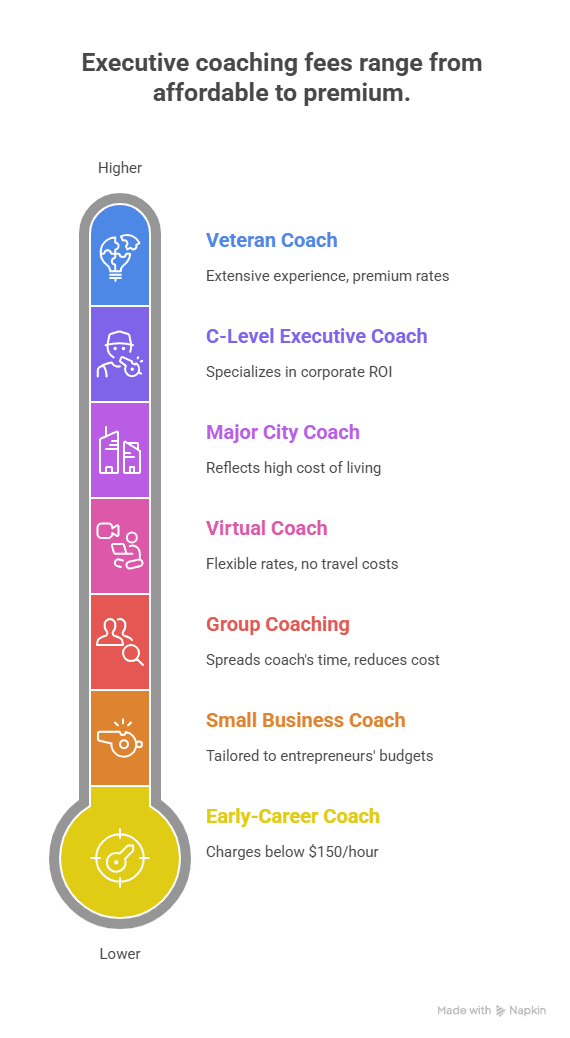
Why such a broad range? Several key factors affect the cost of executive coaching:
- Coach’s Experience and Credentials: Perhaps the biggest factor. Coaches who have extensive experience (especially those who were senior executives themselves) charge a premium. They bring hard-earned insights from 5, 10, or 20+ years in the trenches. A veteran coach with 15 to 20 years of experience coaching leaders might charge $300 to $500 per hour or $3,000+ per month , whereas an early-career coach might price below $150/hour . Higher credentials (like an ICF Professional Certified Coach certification, MBA, or past CEO roles) can also justify higher rates due to the value they signal.
- Geographic Location: Coaching rates often reflect the local cost of living and market demand. In major U.S. cities (New York, San Francisco, etc.), executive coaches commonly charge at the upper end (e.g. $300 to $500/hour). In smaller cities or regions with lower business spending, rates might be lower (perhaps $150 to $250/hour). However, virtual coaching has blurred these lines. An excellent coach can work with you remotely from anywhere, so you’re not limited to local options. Many clients are willing to pay big-city prices for the right coach regardless of location.
- Scope and Intensity of Engagement: The structure of the coaching arrangement will impact cost. A short-term one-off coaching session or assessment might be a flat fee (say $500 for a 90-minute session + debrief). In contrast, a long-term coaching program that includes bi-weekly sessions, 360-degree feedback surveys, and on-call support will cost more in total (several thousand dollars over months), but usually at a slightly discounted rate per session due to the commitment. Intensive engagements (e.g., coaching during a crisis or a leadership transition with daily access) will be on the higher end or billed via a larger retainer.
- Client’s Level and Industry: Coaches may price differently if they work primarily with C-level executives at large firms versus small business owners or mid-level managers. Executives at Fortune 500 companies often have bigger professional development budgets, so coaches specializing in that niche set higher fees (and often deliver significant corporate ROI). In contrast, a small business coach cost might be tailored to entrepreneurs or small enterprise budgets, possibly a bit lower on average. That said, many “business coaches” targeting entrepreneurs still charge professional rates, especially if they have proven success in scaling businesses. It ultimately comes down to the value delivered; for instance, helping a startup CEO double their revenue is as high-impact as helping a VP in a big company improve performance. Either scenario can justify a strong coaching fee.
- Format: Individual vs. Group: One-on-one coaching is the costliest per person because it’s entirely personalized. Group coaching or peer-group programs spread the coach’s time across multiple clients, reducing the per-person cost. We will discuss format differences in the next section, but note that if budget is a concern, joining a group coaching cohort or mastermind can lower the cost substantially while still providing value (albeit with less individual attention).
- In-Person vs. Virtual: Traditionally, in-person executive coaching (including on-site visits) might cost more to cover travel time and is limited to local clients. Nowadays, many coaches work virtually via video calls, which can sometimes come at slightly lower rates or allow more flexibility. Be sure to clarify if any travel or on-site work is included and how that impacts fees.
Key takeaway: Executive coaching fees are market-driven and value-driven. A combination of the coach’s pedigree, the client’s needs, and the format all play a role. It’s wise to get quotes or discuss fees with a few coaches to see how they structure pricing for similar services. Be prepared for premium pricing for top-tier coaches. Remember that their expertise can potentially yield huge benefits for your career or company, making it a worthwhile investment.
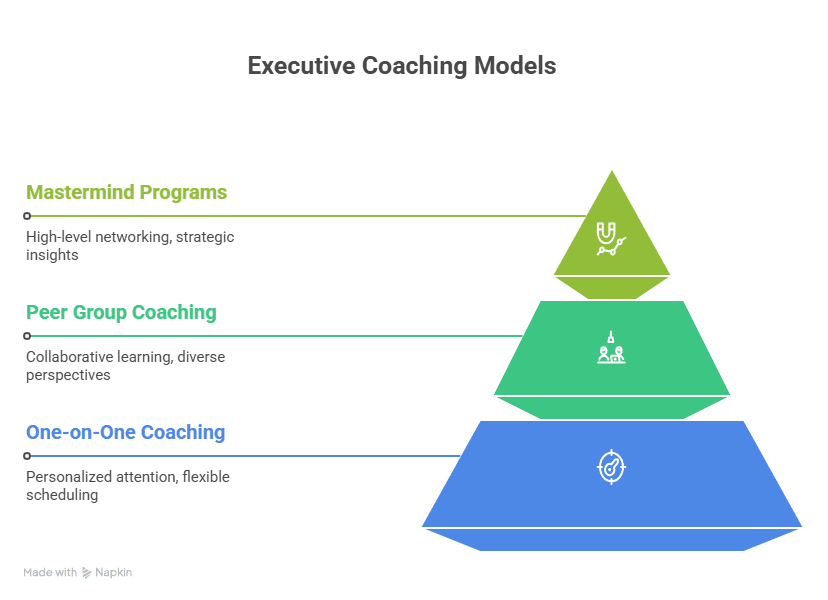
Executive coaching today comes in various formats and engagement models. The right format for you can depend on your learning style, budget, and goals. Here we compare three common models: one-on-one executive coaching, peer group coaching, and CEO mastermind programs, including how each is priced and the pros/cons of each approach.
One-on-One Executive Coaching (Private Coaching)
In 1:1 executive coaching, you work individually with a coach in private sessions (usually by phone or video, sometimes in person). This is the classic coaching format, offering highly personalized attention.
- Format & Frequency: Typically involves regular sessions (e.g., weekly, bi-weekly, or monthly) that last about 60 to 90 minutes. Some coaches also include brief check-ins or are available by email/text between sessions. Engagements often run for 3 to 6 months or longer to ensure lasting progress.
- Typical Cost: As discussed, one-on-one coaching rates are usually hourly or retainer-based. A mid-range scenario might be ~$350 per hour or a package of 6 sessions for a flat fee. High-end, experienced coaches may charge $5,000+ for a multi-month program. Some coaches scale pricing with the level of the client (for example, charging a corporation $10,000/month to coach one of their executives, vs. charging an individual entrepreneur $1,500/month for similar hours). Per-session costs can range from a couple of hundred dollars to thousands for celebrity-status coaches. For most, expect roughly $2k to $4k per month for a standard engagement with a seasoned executive coach.
- Pros: This format offers maximum personalization and confidentiality. The entire focus is on your specific challenges and goals. Scheduling is flexible, and the coach can tailor methods to your learning style. You also typically get the deepest level of insight and behavior change because everything is customized.
- Cons: One-on-one coaching is the most expensive option per person. It also relies heavily on finding the right coach fit. There’s no peer learning element, so you won’t directly hear experiences from others (though a good coach will share anonymized examples from their experience).
This model is best for leaders who want a personal mentor/guide to work through significant professional development goals or navigate high-stakes situations. If you value individualized feedback and can budget for it, one-on-one executive coaching provides unparalleled value and accelerated growth.
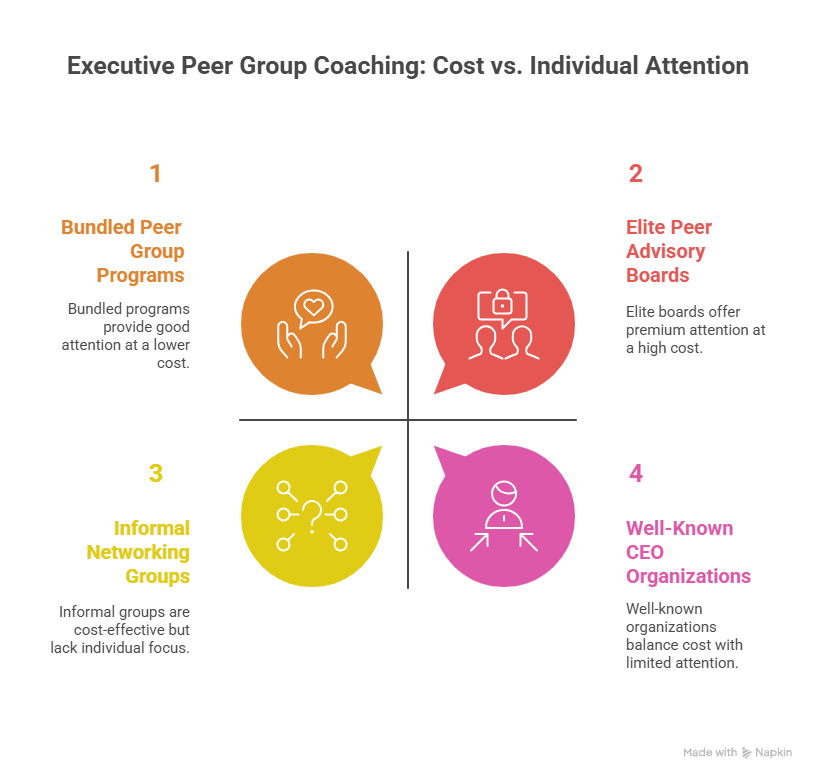
Peer group coaching brings together a small group of leaders (often 5 to 15 people) who meet regularly to coach each other under the guidance of a professional facilitator or coach. Examples include CEO roundtables, leadership circles, or organizations that form peer advisory groups for executives. Each member benefits from collective wisdom and accountability from the group, usually led by an experienced coach or chairperson who moderates discussions.
- Format: Groups might meet monthly or quarterly, often in half-day or full-day sessions. In a typical meeting, members take turns sharing pressing issues or goals, and the group (with the coach’s facilitation) brainstorms solutions and provides feedback. Some programs also include one-on-one coaching for each member in between group meetings (for example, a peer group program might bundle a monthly group meeting + a monthly private coaching session for each member).
- Cost: Peer group coaching is usually charged as a membership fee, either monthly or annually. Because the coach’s time is leveraged across the group, the per-person cost is lower than pure one-on-one coaching. For instance, a local executive peer group might charge around $500 to $1,500 per month per member, which might equate to ~$6,000 to $18,000 per year. Well-known CEO peer group organizations (which often include one-on-one sessions too) tend to fall in this range, e.g., some groups charge ~$12,000 or more annually for membership. There are also less formal networking/mastermind groups that might cost only a few hundred dollars a month. On the high end, certain elite peer advisory boards or invite-only forums could cost $20,000+ per year if they include premium retreats and high-caliber speakers. Generally, though, expect on the order of thousands per year rather than tens of thousands for group coaching membership, making it a cost-effective alternative to weekly private coaching.
- Pros: Peer learning is the biggest advantage. You gain perspectives from other leaders who might have faced similar issues. This can spark ideas and solutions you or a single coach might not think of alone. There’s also a camaraderie and networking component. You build a trusted network of peers. In terms of value, you often get a combination of coaching and consulting-like advice from multiple minds, at a lower cost per person. It also helps with accountability, as group members hold each other to commitments.
- Cons: The individual attention is divided. In a group of 10 executives meeting for 4 hours, each person might get a focused “hot seat” discussion for 20 to 30 minutes of that meeting on their issue. So, the depth of your personal challenges is less than in one-on-one coaching. Some issues may be too sensitive to share with a peer group (depending on confidentiality agreements). Additionally, the benefit you get can depend on the quality and experience level of the other members. If the group is not well-matched, it could be less useful. Scheduling group meetings can also be challenging for busy executives.
Peer group coaching is ideal if you want to learn from others in similar roles, prefer a more social, interactive development setting, and need to justify costs carefully. Many CEOs find peer groups immensely valuable, as they break the isolation at the top. It’s also a good middle-ground on cost, more affordable than weekly private coaching, but still guided by a professional. Ensure that any group you join has a skilled facilitator and a selection process so that members are a good fit and committed to growth.
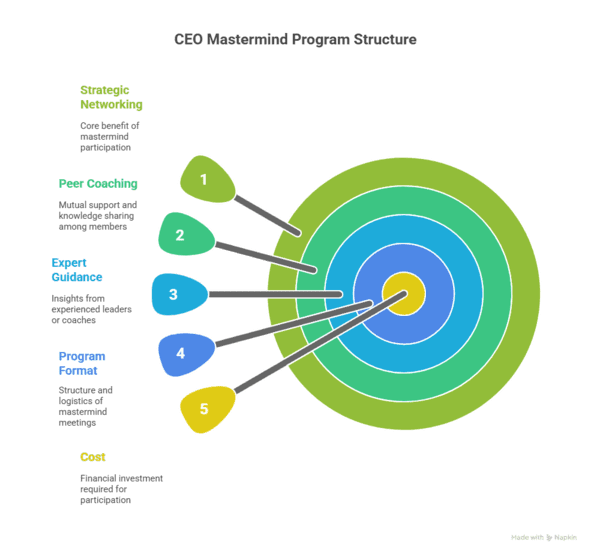
Mastermind groups are a specific type of peer group, often more focused on big-picture growth, networking, and mutual mentorship. The term “mastermind” can range from informal entrepreneur meetups to highly structured programs led by famous business mentors. In the executive coaching context, a CEO mastermind usually involves a curated group of high-performing leaders or entrepreneurs who meet to support each other’s success, share knowledge, and sometimes get access to expert guidance. Think of it as a hybrid between peer coaching and an exclusive club for personal and professional development.
- Format: Masterminds might meet in person a few times a year (e.g., multi-day retreats or quarterly meetings), supplemented by monthly video calls or an online community. Often, there is a program leader (who might be an experienced entrepreneur, investor, or coach) who coordinates the group, sets agendas, and brings in guest experts. The structure can vary widely. Some are time-bound (e.g., a 6-month mastermind program), others are open-ended memberships.
- Cost: Mastermind program costs vary enormously. On the lower end, you might find entrepreneur mastermind groups for a few hundred dollars per year (especially online communities). On the higher end, exclusive CEO masterminds can cost tens of thousands of dollars. For example, there are well-known masterminds that charge $10,000, $25,000, or even $50,000+ per year for membership, especially if they involve high-profile mentors or luxurious event components. According to one roundup, mastermind group fees ranged from as low as ~$500 annually to as high as $100,000 a year for elite groups . The extremely expensive ones often target founders of fast-growing companies or established business owners who are willing to invest heavily in networking with other top-tier leaders. In short, you can likely find a mastermind at almost any price point, but quality and deliverables will differ. A reasonable expectation for many CEO masterminds is on the order of $5,000 to $15,000 per year for a reputable program with a vetted group and a skilled facilitator.
- Pros: A mastermind offers strategic networking and a broad perspective. You aren’t just getting one coach’s input. You’re leveraging the collective experience of successful peers and potentially guidance from the program leader. The environment can be very motivating: you’re surrounded by high-achieving individuals, which can challenge you to reach new heights (the old saying, “you are the average of the five people you spend the most time with,” applies here). Masterminds often provide valuable business connections, partnerships, or opportunities that arise from member interactions. They can also be invigorating, big-picture focused, and less structured than formal training, ideal for idea generation and innovative thinking.
- Cons: Cost can be significant for top-tier masterminds, so you want to be sure the networking and learning payoff is worth it. Also, masterminds might not dive into detailed skill-building or personal behavioral change the way a dedicated coaching engagement would. The benefits are somewhat indirect, e.g., you might learn a new strategy from a peer or get inspired to pivot your approach, but it’s up to you to implement those insights. Some people also find that without the right mix of members, a mastermind can devolve into a social club or, conversely, be intimidating if other members are far ahead in scale. As with peer groups, confidentiality and trust are essential. You need to be willing to share challenges openly for it to work.
Masterminds are best for big-picture thinkers and those who value peer network as much as personal coaching. If you’re an entrepreneur or executive who learns from others’ experiences and you want to expand your network while working on your business or leadership skills, a mastermind can be a powerful catalyst. Just vet the group’s focus, membership criteria, and leadership before investing to ensure it aligns with your goals.
Comparison Summary: In choosing between one-on-one coaching, a peer group, or a mastermind, consider your budget, learning style, and desired outcomes. If you have specific personal development targets and prefer privacy, one-on-one executive coaching provides tailored guidance (but at a premium price). If you want community and a broader array of advice (and a lower cost per person), a peer coaching group or mastermind is attractive. Some executives even combine formats, for example, joining a peer group for networking and broad support, while also having a personal executive coach for deeper one-on-one work. The good news is that there are options at many price points, so you can find a solution that delivers value for your investment. The leadership model you’re building toward matters too; a leader moving to the Scandinavian leadership model coaches for delegation and trust rather than command and control.
It’s worth addressing business coach cost as well, since many people use “business coach” and “executive coach” interchangeably. In practice, an executive coach typically works with leaders within organizations (often executives, managers, or high-potential employees) to improve their leadership effectiveness, while a business coach might focus on advising small business owners or entrepreneurs on growing their business. The distinction is subtle, and there’s plenty of overlap, and so are the costs.
Similar Price Range: Generally, how much a business coach costs will be in a similar ballpark to executive coaching. For experienced business coaches (especially those who specialize in scaling companies, marketing strategy, etc.), you might see hourly rates from around $150 up to $500 or more, depending on their track record. Many business coaches also offer package deals or monthly retainers, e.g., a coach might charge $1,000-$2,000 per month to work with a small business client on an ongoing basis, which might include a couple of calls per month and email support. High-end business coaching (targeting businesses with high revenue potential) can rival executive coaching fees, sometimes reaching $5,000+ per month for intensive guidance.
Why the range? Just like with executive coaches, experience and results drive pricing. A business coach who is a seasoned entrepreneur or has taken companies from startup to success will charge more than someone new to coaching. There are also many part-time or “life coaches” branding as business coaches who may charge on the lower end (or even on a sliding scale for very small businesses).
One thing to note is that some business coaching programs are offered by consulting firms or franchises and have more standardized fees. For example, group coaching for small business owners or a group workshop might be a few hundred dollars a month per business. In contrast, a one-on-one business coaching relationship with a highly sought-after expert could easily be $10k+ for a multi-month engagement if they’re essentially acting as an advisor to your business.
Value Considerations: If you’re a business owner asking, “How much does a business coach cost, and is it worth it?” consider the potential ROI in terms of business growth. A good business coach can help you increase your revenue, improve operations, or avoid costly mistakes, so their fee should be measured against those gains. For instance, paying $1,500 a month might seem expensive, but if that guidance leads to securing a new client contract worth $50,000, it clearly pays off. As with executive coaching, you should vet a business coach’s background (have they successfully built or coached businesses similar to yours?) and make sure their expertise aligns with the areas where you need help (e.g., strategy, finance, leadership, etc.).
In summary, business coaching costs usually mirror executive coaching in structure: expect to invest a few hundred to a few thousand dollars per month for quality coaching. Don’t automatically go for the cheapest option. Focus on finding a coach who offers tangible value for your specific business goals.
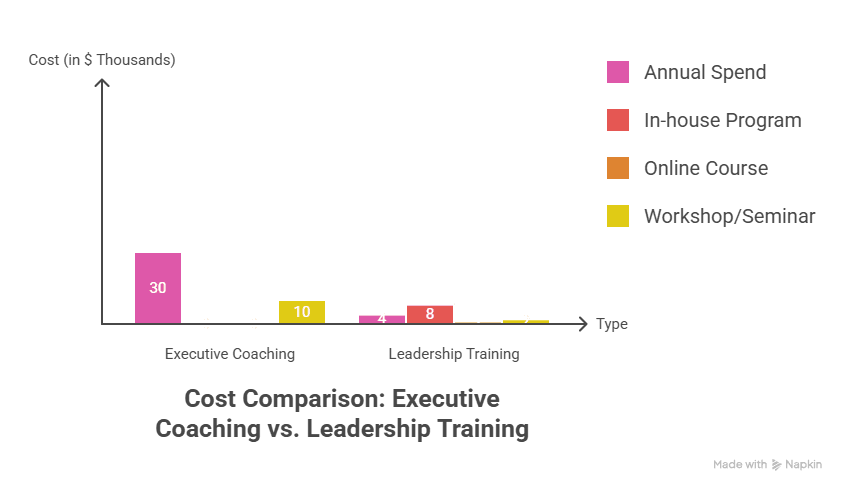
Organizations and individuals sometimes weigh the choice between paying for executive coaching versus investing in leadership training programs. These are complementary approaches: coaching is personalized, while leadership training (like workshops or courses) is typically delivered to a group, but it’s useful to compare their costs and benefits.
Cost of Leadership Training: Leadership training programs can range widely in price depending on format and prestige. For example, a one-off leadership workshop or seminar might cost $200 to $2,000 per participant for a multi-day event. An online leadership course could be relatively affordable, maybe $100 to $1000 for a self-paced program . At the higher end, intensive in-house leadership development programs (where a company brings in trainers or sends leaders to an institute) might run into the thousands per person. One provider notes that personalized leadership training for a group can cost $5,000 to $8,000 per leader for a comprehensive program .
The clearest public benchmark is Training Magazine's 2025 Training Industry Report, which puts average spend at $874 per learner across all training in 2025, up from $774 in 2024, with management and supervisory training taking 13 percent of the average training budget. That is company wide spend across every employee rather than a budget per leader, so read it as a floor rather than a like for like comparison with the coaching figures above. So, if you’re an individual considering your own development, attending a reputable leadership course or conference might cost a few grand plus travel, which is often less than a year of one-on-one executive coaching.
Cost of Coaching vs Training: Executive coaching, as we’ve detailed, might cost anywhere from $10k to $30k+ per year for an individual engagement. That is clearly a higher per-person investment than sending someone to a training seminar. However, the ROI and depth of impact can differ:
- A workshop might teach general leadership concepts or skills (communication, time management, etc.) to a cohort. It’s efficient for reaching many people, but can be generic. The cost per head is lower, but the training might not address each leader’s individual gaps or real-life challenges in implementation.
- Executive coaching is one-on-one and context-specific. It can adapt to the person’s environment and directly tackle issues in real time (e.g., preparing for your board presentation next week, or handling your specific team dynamics). This tailored approach often yields behavioral changes and performance improvements that generic training doesn’t achieve.
Thus, when comparing costs, consider that coaching and training serve different purposes. Many organizations actually do both: they might run a leadership development workshop for a group of managers (lower cost per person for broad skills) and provide coaches to select individuals for personalized growth. If budget is a concern and you have to choose, think about your learning style: do you thrive in a classroom/group setting, or do you need a custom approach to meet your goals?
From a pure cost perspective, you could likely send someone to a few good leadership seminars for under $5,000 total. That same budget might get only a couple of months of executive coaching. But the depth of insight and personal accountability in coaching might far exceed what a short course provides. It’s an investment vs. scale trade-off. High-potential leaders who are critical to an organization’s success may warrant the coaching investment. For developing larger groups of employees, structured training might be more economical.
Bottom line: How much does leadership training cost? Often, less than a dedicated executive coach, per person. Yet, how much value each yields will depend on the context. If possible, leverage both: use training for foundational skills and common knowledge, and use coaching to reinforce and apply those skills in a personalized way. When evaluating coaching vs training, consider not just the upfront price but the long-term benefits and the degree of customization needed.
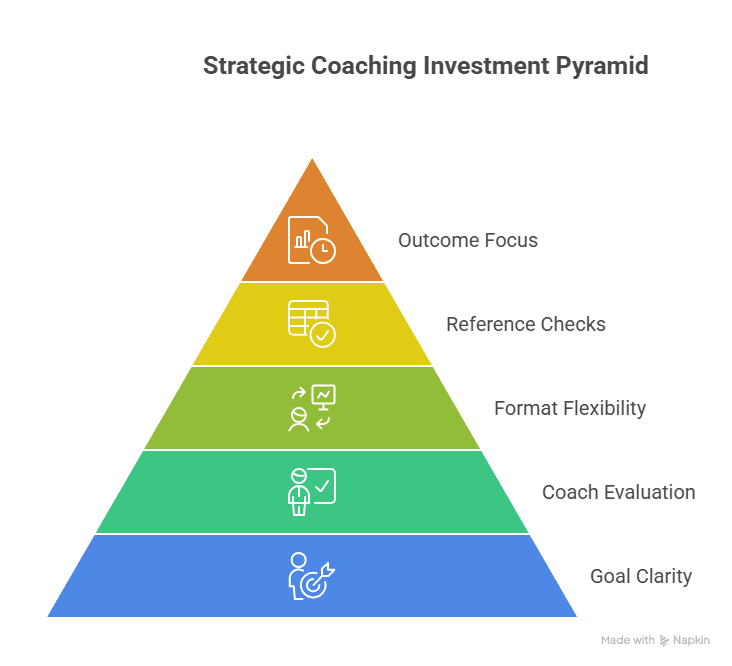
We’ve covered various aspects of executive coaching costs. Now, how do you decide what’s right for you or your organization? Here are some final guidelines to ensure you choose based on outcome potential, not just sticker price:
- Clarify Your Goals and ROI Expectation: First, be clear on why you’re considering coaching (or any development investment). Are you looking to improve specific leadership skills? Drive business growth? Prepare for a higher role? When you have defined outcomes in mind, it’s easier to assess whether a coach’s fee is worth it. For instance, if a coach charges $20k a year but can help you increase your company’s revenue by 10% or significantly improve team retention, the ROI justifies the cost. Approach coaching as you would any strategic investment: what is the potential return if this is successful?
- Evaluate Coach Experience and Fit: As emphasized, the best coaches often have 5 to 10+ years of executive/CEO-level experience themselves. Look for coaches who have walked the walk, perhaps they’ve led companies or coached leaders at your level before. This experience not only often correlates with higher fees, but with higher credibility and insight. During initial consultations, discuss their background and ask for examples of past client results. A coach who understands your industry or the pressures of executive roles can connect the dots faster. Remember that a higher fee for a coach with true expertise is usually a better investment than a bargain coach who is learning on the job. That said, fit matters too. You should feel comfortable and trust the person. The most expensive coach is not automatically the best for you if the chemistry isn’t there to foster openness and growth.
- Consider Format and Budget Flexibly: If one-on-one coaching seems out of budget, consider if a group coaching or mastermind format could achieve your goals. These can drastically reduce per-person cost and still deliver value (especially for gaining new ideas and maintaining accountability). On the other hand, if you need intensive support during a critical period (e.g. stepping into a C-suite role), allocate more budget for private coaching during that time. The cost may be high, but so are the stakes of success or failure in that transition. Some coaches or programs also offer tiered services; for example, a lower-cost online coaching program or a workshop as an entry point. You might start there and later invest in deeper coaching once you see the benefit.
- Look Beyond Price Tags: Check References and Results: When choosing, do your homework just as you would for any important hire or vendor. Ask the coach or program for client references or testimonials. Did their past clients achieve what they set out to? Many top coaches will have case studies (e.g. helped a new CEO reduce turnover by 30%, or coached a leader through a successful acquisition). These stories can help you gauge value. Also, clarify what exactly is included in the price: number of sessions, additional support, any assessments or resources, etc. A slightly more expensive package might actually be more comprehensive.
- Avoid False Economy: It can be tempting to choose a coach solely because they offer a low rate. But if that coach isn’t effective, it’s wasted time and money. It’s like buying a cheap tool that breaks. You end up spending more to fix the problem later. With coaching, ineffective guidance can even set you back or reinforce bad habits. This doesn’t mean you must always choose the highest bidder; rather, weigh cost against the likely quality. If a less expensive coach impresses you with their approach and has solid references, great. Just make sure cost-saving isn’t the only reason for your choice. Focus on who will likely provide the best outcomes.
- Think in Terms of Progress, Not Hours: Especially for one-on-one coaching, it’s helpful, especially when you’re developing a CEO mindset, to shift your mindset from “paying for X hours of someone’s time” to “paying for desired progress in leadership.” A coach might charge a flat fee for 3 months, during which they might spend many hours thinking about your business, responding to your emails, or prepping resources, beyond just the live sessions. The value accumulates over the relationship. If the coaching helps you become a more effective leader, that value compounds over your career. In contrast, a training course might be a one-and-done knowledge download. Coaching is a process. So, evaluate pricing in light of the sustained benefits you expect to gain.
When it comes to executive coaching cost, the most important thing to remember is that it’s an investment in growth. Whether you’re paying $5,000 or $50,000, the real measure is what you get in return: in performance, confidence, clarity, and results. The cost of coaching varies by model and coach, but the value of the right coach is practically incalculable in the long run. The right coach or program can help a leader make better decisions, avoid costly mistakes, foster stronger teams, and achieve goals faster. Those outcomes drive organizational success and personal career advancement, paying dividends well beyond the initial fee.
In summary, do your due diligence: understand the typical executive coaching cost per hour and per program, align on what format fits your needs (one-on-one vs group vs mastermind). If you are still comparing candidates, my guide on how to choose an executive coach gives you the full screening system. Ready to take the next step? Explore our 1:1 strategic advisory for CEOs and executives, and choose a coach based on experience and chemistry, not just price. If you focus on quality and potential ROI, you’ll be more likely to select a coaching solution that is worth every penny. Remember, value matters more than price. A great executive coach doesn’t just cost you money, they deliver money’s worth in value through improved outcomes. And that is the ultimate goal of investing in coaching.
Executive coaching cost versus a CEO mastermind: which is the better value?
Once you have the numbers above, the real question is not only what coaching costs, it is what delivers the most growth per dollar. One-to-one executive coaching is unmatched for private, tailored work on your specific blind spots. A CEO mastermind gives you something different, often for less than the price of a senior coach: a room of peers who have already solved the problem in front of you, real accountability, and many perspectives instead of one. A lot of leaders end up using both, coaching for the personal work and a mastermind for the compounding value of peers.
If you are weighing the investment, it is worth seeing what a high-trust peer group actually does before you decide. The CEO Mastermind at Leaders ADAPT is built for growth-focused founders and CEOs who want that room of peers and the accountability that drives real change. Membership is by application, which is what keeps the room high-caliber and the conversations honest. If that is the kind of leverage you are looking for, you can apply to join the CEO Mastermind here.
Weighing a coach against a peer room? Leaders ADAPT offers both: 1:1 CEO coaching, and a virtual CEO Mastermind of at most 14 members with one to one coaching included. Book a 20 minute fit call and I will tell you which one fits, including when neither does.
How much does executive coaching cost, and what drives the fees?
Most executive coaching fees fall between $200 and $500 an hour for individual coaches, while senior coaches working with C-suite leaders often charge $500 to $1,500 an hour or structure the work as a multi-month retainer. What you pay tracks three things: the coach’s track record, the seniority of the leader being coached, and whether the engagement is a short reset or a long transformation. The real question is rarely whether executive coaching is expensive. It is whether the cost is small next to the decision it improves.