
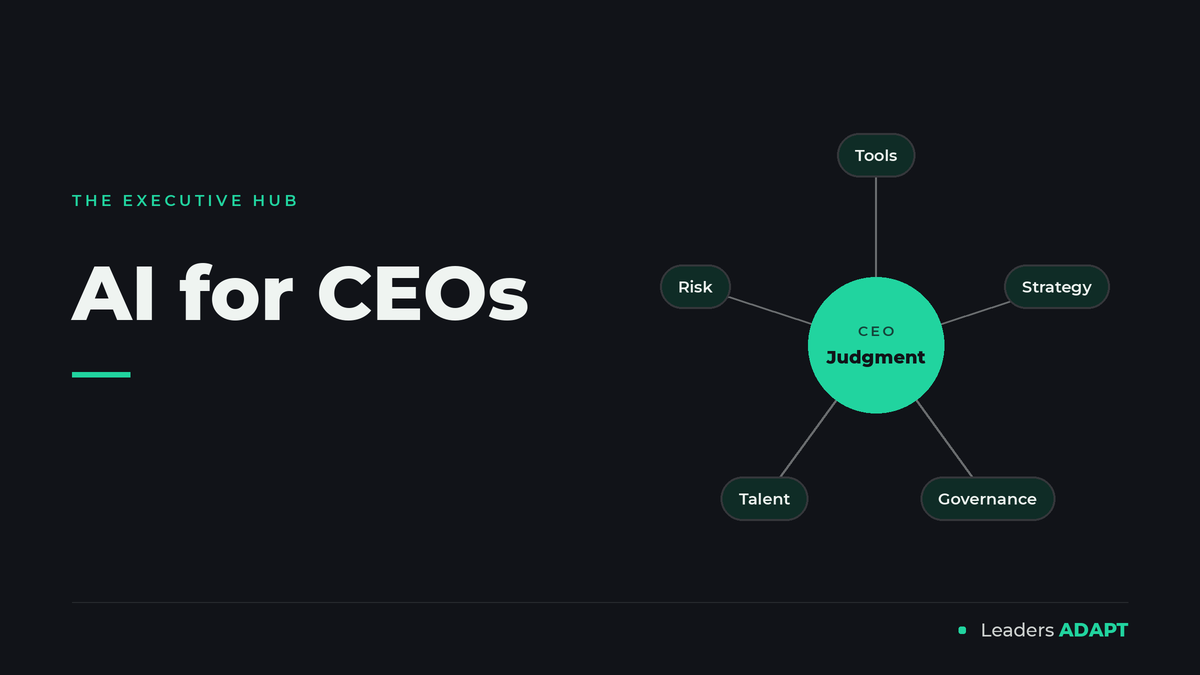
Quick answer: Leaders ADAPT teaches AI for CEOs as a placement problem, not a technical one. AI is a force multiplier: one unit of input, ten units of output, amplifying whatever you attach it to, good or bad. So your job is not technical. It is placement judgment. Where do you put the lever, and just as important, what do you refuse to multiply yet? An MIT study found that 95% of AI initiatives fail to turn a profit while 5% see fast revenue and profit acceleration, with the same tools available to everyone. The gap between those two groups is not technology. It is leadership. Stop asking your team for an "AI strategy." Demand a leverage map instead.
By Andreas Pettersson, founder of Leaders ADAPT and a former Canon AI executive who built and sold an AI company before ChatGPT existed.
Let me be direct. Most CEOs I talk to are quietly worried about the same thing. They know AI matters. They have spent money on it. And they still cannot say, in one sentence, what it is actually doing for the business.
That gap is not a technology problem. You don't have a technology problem. You have a leadership problem.
I have stood on both sides of this. When I was running Arcules, we built real machine learning and computer vision at scale, before ChatGPT made any of this a dinner-table topic. We grew from 3 people to 150 across five countries. We hired PhDs. We processed petabytes of training data every month. We sold the company for a nine-figure exit. Then I watched the market commoditize the exact thing we had spent years building from scratch. The hard AI got cheap. Anyone could rent it.
Here is what that taught me, and it is the spine of everything I now teach CEOs. The advantage was never the technology. The technology gets commoditized. The advantage was always judgment about where to point it. That part never commoditizes. Where others see headlines, I see signals. And the signal here is simple: the winners and the losers are using the same tools.
This is the page to start from. It is the most complete thing I have written on how a non-technical CEO leads AI well, with links to go deeper on each part.
What does "AI for CEOs" actually mean?
It means owning one decision: where to multiply force in your business.
Think about what AI actually is at your level. It is a force multiplier. One unit of input, ten units of output. A lever. And like any lever, it amplifies whatever it touches. Point it at a strong process and you get a much stronger one. Point it at a broken one and you scale the brokenness. Point it at the wrong corner of the business and you get a faster, more expensive version of nothing.
So the real work is not technical. The real work is placement. Where do you put the lever? And just as important, what do you choose not to multiply yet? That is a CEO decision. It cuts across functions. It touches your margins, your people, your competitive position. No IT department can make that call, because none of them is accountable for the whole business. You are.
This is why I tell CEOs to stop asking for an "AI strategy." That phrase invites a vendor shortlist and a governance policy. Ask for a leverage map instead: a clear picture of where multiplying force would actually change how the business operates, and where it would just add motion. The map is the work. Everything else is tooling.
Why do 95% of AI initiatives fail?
Because the leadership around the decision is weak, not the technology.
Here is the hook stat, and it is the one I want you to remember. MIT studied corporate AI and found that 95% of AI initiatives fail to turn a profit. The other 5% see rapid revenue and profit acceleration. Same models. Same tools. Same off-the-shelf availability for everyone. So the gap between the 5% and the 95% cannot be the technology, because the technology is identical. The gap is judgment about where to place it.
The corroboration is everywhere once you look. RAND found that more than 80% of AI projects fail, about twice the failure rate of regular IT projects. S&P Global reported that the share of companies abandoning most of their AI initiatives rose from 17% in 2024 to 42% in 2025. Read that again. Abandonment more than doubled in a single year, in the exact period when the tools got better and cheaper. That is not a model failure. That is a placement failure, repeated at scale.
So when a CEO tells me AI "didn't work," I already know the shape of the story. The technology was rarely the bottleneck. The bottleneck was a leader who delegated the thinking and hoped it would work out.
What are the 7 strategic AI traps?
Across the companies I advise and the work in my book, the same seven traps show up again and again. You do not need to memorize them. You need to recognize the one you are standing in right now. Each is a leadership choice. Each is reversible the moment you decide to own it.
1. The IT Delegation Trap
You hand AI to IT because it feels technical. But IT is built to secure, integrate, govern, and contain, and containment is the opposite of multiplication. Handing AI to IT traps it inside a function instead of multiplying force across the business. As I put it in the book: "AI isn't a technology decision. It's a decision about where to multiply force in your business." This is the deepest trap of the seven, so I gave it its own home in AI Strategy for CEOs.
2. The AI Activity Trap
Pilots, dashboards, adoption metrics, a Slack channel full of prompt tips. It all looks like progress. It feels like progress. But visible motion is not leverage. Scattered wins never compound into anything you can put on a P&L, and "we ran 14 pilots" is not an answer to "what changed in the business."
3. The AI Merchant Trap
When you let a vendor define your AI problem, you let them define your business. The demo is built to make their tool the hero, which means the problem gets reshaped to fit the product. The moment that happens, "you stop being the captain of your ship and become cargo on someone else's route." Your competitive edge is now whatever every other customer on that vendor's roadmap also gets.
4. The Local Optimization Trap
One team runs a genuinely good pilot. It works. So you celebrate and move on. But an isolated win improves one corner while the system around it never changes. A collection of slightly better tools is not a competitive advantage. The physics here matter: force multiplied in a silo stays in the silo.
5. The AI Culture Trap
This is the quiet one. A flawless rollout can erode human ownership without anyone noticing, because people slide from deciding to merely approving. The work still happens. The clicks still click. But judgment leaves the building one default at a time. The smoother the technology, the quieter the erosion, which is why the best rollouts are sometimes the most dangerous.
6. The Understanding Trap
Waiting until you fully understand AI before you act feels responsible. It is sophisticated procrastination. You will never understand it from the sidelines, because understanding comes from placing small bets and reading the results. Judgment enables understanding, not the other way around. Fast and 90% right beats slow and 95% right. For the failure patterns this produces, read Why AI Projects Fail.
7. The AI Project Trap
You treat AI as a finite 90-day project with a kickoff, a deadline, and a victory lap. But a force multiplier has no end date. The moment you declare victory and reassign the team, your competitors keep compounding. AI is not a project you finish. It is a capability you keep sharpening, or you fall behind the people who never stopped.
I go deep on all seven, and on exactly what the winning 5% do instead, in the book AI Leadership Mastermind. If you want the broader pattern of how smart leaders miss this, start with AI Leadership Blind Spots.
What is the AI MOMENTA framework?
Once you see AI as a lever, you need a way to decide where to place it, week after week. That is what AI MOMENTA is. It is not a checklist you complete once. It is a decision lens you hold up to every AI question that crosses your desk. Three questions, in order.
One. Where does leverage actually compound here? Not where is AI possible, but where does one unit of input return ten, and keep returning it. Compounding is the test. A one-time saving is nice. A loop that gets stronger every month is leverage.
Two. What must not be multiplied yet? This is the restraint question, and almost nobody asks it. If a process is broken, or the data is a mess, or nobody owns the outcome, multiplying it just scales the problem faster. Saying "not yet" to the wrong target is one of the highest-return decisions a CEO makes. It is also the one that separates the 5% from the 95%.
Three. What decision will this enable us to revisit faster? The deepest value of AI is rarely the output. It is the speed of the next decision. If a placement lets you re-decide pricing weekly instead of quarterly, or re-forecast in hours instead of days, you have bought tempo. Tempo compounds.
Run those three questions and you are doing the actual job. You are not chasing tools. You are choosing where force goes and where it does not. That is placement judgment, and it is the part that never gets commoditized.
If you do not have anyone in the room who can hold this lens with you every week, that is exactly the gap a Fractional Chief AI Officer fills: senior judgment on placement, rented rather than hired, until the capability is built in-house.
How should a CEO start with AI this quarter?
You do not need a transformation program. You need one good loop.
Pick one process that is slow, expensive, or inconsistent. Just one. Name a single owner, a real person, not a committee and not "IT." Run a short loop, a few weeks, not a roadmap. Then do one honest review: did leverage compound, or did we just add motion? Keep it or kill it, and say which out loud.
That is the whole motion. One slow or expensive process. One named owner. One short loop. One honest review. Do that three times and you will have learned more about AI in your business than a year of vendor presentations. Reasons aren't results, and a demo is a reason. A loop that compounded is a result.
For the tools that support this loop, see Best AI Tools for CEOs and the plain-language explainer in Generative AI for CEOs. For the full operating system, the move-by-move version is in The AI Playbook for CEOs.
What does this look like when it works, and when it doesn't?
Look at Borders and Amazon. Same decade, same technology available to both, opposite outcomes.
Borders treated the internet as "a technology to manage." So they delegated it. They handed their online ambitions off, ran pilots, and in 2001 they outsourced their entire online sales operation to Amazon. Think about that decision. They gave their digital future to the company that would eat them. Borders was gone within a decade. They had access to exactly the same internet Amazon did.
Amazon's leadership asked a different question. Not "how do we manage this technology," but "where does this multiply force." Where does speed compound. Where does reach multiply. Where does learning accelerate. Same tool, opposite question, and the gap between those two questions is the whole story of who survived.
Now make it real at your scale, because most CEOs assume this only applies to giants. Look at a roughly 20-person professional-services firm I know well. They used AI as a force multiplier to cover work that used to require a much larger team. They did not buy more tools than everyone else. They placed the lever where it compounded, and a small firm started operating like a bigger one. Same physics, smaller scale. If you run an 11 to 50 person company and think AI is a big-company game, that is the example to sit with. The force multiplier does not care how big you are. It cares where you point it.
What this all comes down to
The CEOs who win at AI are not the most technical people in the room. They are the ones who refuse to delegate the thinking.
AI is a lever. Your job is placement: where to multiply, and what to leave alone for now. Most leaders get this wrong because they reach for an "AI strategy" when they need a leverage map, and they reach for IT when they need to make a leadership call only they can make. The 5% who win are not smarter about technology. They are clearer about judgment. If your board is starting to ask harder questions about any of this, AI for Boardrooms is where that conversation lives.
Take the next step
If you want to lead AI in a room of CEOs solving the same problems, the AI Executive Mastermind is built for exactly that. If you want the 7 traps and the framework in full, the book AI Leadership Mastermind lays it all out. And if you want your team trained to run the loop above, that is what the Executive AI Program does.
From our own data: In the second half of 2024, none of 99 coaching and discovery conversations had the client raise AI. In the first half of 2026 it was 45% of 285 conversations. See What CEOs Bring to Coaching, updated monthly.
Frequently asked questions
What is AI for CEOs?
AI for CEOs is the leadership side of artificial intelligence: deciding where AI should multiply force in the business, what to leave alone for now, and who owns the outcome. AI is a force multiplier, one unit of input for ten units of output, so the CEO's job is placement judgment, not coding. The technical depth can be hired or rented. The judgment about where to point it cannot.
Do CEOs need to be technical to lead AI?
No. The leaders who get the most from AI are rarely the most technical. What matters is the ability to pick the right problem, decide what not to multiply yet, assign clear ownership, and judge a result honestly. An MIT study found 95% of AI initiatives fail to profit while 5% accelerate, with everyone holding the same tools, which means the gap is leadership, not technical skill.
What is the biggest AI mistake CEOs make?
Delegating the thinking. When a CEO hands AI to IT or lets a vendor define the problem, the company chases tools instead of outcomes and force never multiplies where it matters. RAND found more than 80% of AI projects fail, and S&P Global reported abandonment rose from 17% in 2024 to 42% in 2025. Almost all of those failures trace back to placement and leadership, not to the models.
What is a leverage map and how is it different from an AI strategy?
A leverage map is a clear picture of where multiplying force would actually change how your business operates, and where it would only add motion. An "AI strategy" usually produces a vendor shortlist, a governance policy, and a pilot running somewhere safe, which is a containment plan, not a growth plan. The leverage map starts from the business and asks where one unit of input returns ten, then asks what must not be multiplied yet.
Where should a CEO start with AI this quarter?
Start with one process that is slow, expensive, or inconsistent. Name one owner, run a short loop of a few weeks rather than a long roadmap, then hold one honest review and decide whether leverage actually compounded. One real problem and one short loop teaches more than any vendor demo, and you can repeat the motion three times in a quarter.
What are the 7 strategic AI traps for CEOs?
The post names seven traps that stall CEO AI efforts, starting with the IT delegation trap (handing AI to IT), the activity trap (mistaking motion for progress), the merchant trap (buying tools before strategy), the local optimization trap (improving pieces that do not move the business), and the culture trap. Each is a default mistake that makes AI look busy while changing nothing.
Sources
- MIT, The GenAI Divide: State of AI in Business 2025
- RAND, The Root Causes of Failure for AI Projects
- S&P Global Market Intelligence, Generative AI shows rapid growth but yields mixed results
Not sure where you stand yet? Start with AI readiness for leaders, or take the free AI Leadership Readiness Assessment to see your score across the four dimensions that decide whether AI pays off. A deeper AI readiness audit shows where the gaps actually sit.