

Quick answer: Vistage (about $16,500 a year) is the default pick for established mid-market CEOs, YPO and EO anchor the big global networks, Chief serves senior women executives, and Hampton serves tech founders past $3M in revenue. For growth-stage founders in the $1M to $20M range, a boutique mastermind such as the Leaders ADAPT CEO mastermind usually delivers more candid input per dollar. Here is how they all compare, on price, size, format, and who each one actually fits.
By Andreas Pettersson, founder of Leaders ADAPT and a former Canon executive who has built and scaled multiple companies.
CEO peer groups at a glance. The seven rooms this guide covers, side by side. Every figure is published or member reported pricing, sourced under the full table below.
| Group | Format | Typical cost | Best for |
|---|---|---|---|
| Vistage | Chair led local groups of 12 to 16, a full day monthly, plus one to one Chair coaching | About $16,500 a year in dues plus a $2,500 initiation fee | Established mid market CEOs, usually $5M+ revenue |
| YPO | Member led chapter forums of 8 to 10, monthly, plus global events | About $8,910 a year in dues plus an initiation fee around $12,650 | Chief executives under 45 at larger companies |
| EO | Member led chapter forums of 8 to 10, monthly meetings and events | Roughly $4,400 to $7,000 a year all in, plus initiation fees | Founders and owners past $1M in revenue |
| Chief | Curated core groups plus a large digital community and programming | Not published. $5,800 to $7,900 a year as reported in 2023 | Senior women executives, VP to C-suite |
| Hampton | Moderated groups of 8 meeting 10 times a year, plus a 1,000+ founder community | $8,500 a year, no initiation fee (member reported) | Tech founders at $3M+ revenue, $3M raised or a $10M+ exit |
| TAB and local roundtables | Facilitated monthly breakfasts or half day sessions, local | $600 to $900 a month, often month to month | Small and mid sized business CEOs who want a local room |
| Leaders ADAPT CEO Mastermind | Virtual groups of at most fourteen, led by a former CEO, 1:1 coaching included | By application. Pricing shared on a fit call | Growth stage founders and CEOs in the $1M to $20M range |
Still deciding between a group, a coach and a mastermind? Read executive coaching vs mastermind vs peer group first.
The Best CEO Peer Groups in 2026, Compared
Every cost figure below is published by the organization, taken from its fact sheets, or attributed to independent reporting. Where a group does not publish pricing, the table says so instead of guessing.
| Group | Best for | Typical cost | Format |
|---|---|---|---|
| Vistage | Established small and mid-market CEOs (revenue usually $5M+) who want chair-led structure | About $1,380 a month in dues (roughly $16,500 a year) plus a $2,500 one-time initiation fee | Local groups of 12 to 16, full-day monthly sessions, plus one-to-one coaching from your Chair |
| YPO | Chief executives under 45 at application, running larger companies | About $8,910 a year in combined dues plus a one-time initiation fee around $12,650 | Chapter-based, member-led forums of 8 to 10, monthly, plus global events |
| EO | Founders and owners past $1M in annual revenue | Roughly $4,400 to $7,000 a year all-in ($2,630 global dues plus chapter dues), plus one-time initiation fees | Member-led chapter forums of 8 to 10, monthly meetings and events |
| Chief | Senior women executives, VP to C-suite | Not published. Quote on application | Curated peer core groups plus a large digital community and member programming |
| Hampton | Founders of tech and internet businesses at $3M+ revenue, or $3M raised, or a $10M+ exit | $8,500 a year, no separate initiation fee (member-reported) | Moderated core groups of 8 meeting 10 times a year, plus a 1,000+ founder digital community |
| Leaders ADAPT CEO Mastermind | Growth-stage founders and small business CEOs in the $1M to $20M range | By application. Pricing shared on a fit call | Virtual groups capped at twelve, led by a former CEO, with one-on-one executive coaching included |
Cost sources, checked July 2026: Vistage dues per FirstPageSage’s independent review; YPO per the published Southern 7 chapter dues schedule; EO per EO’s own fact sheets; Hampton per member reports compiled by Long Angle; Chief does not publish current pricing.
Full disclosure: the last row is ours. The CEO Mastermind is a small virtual peer group I lead myself, and it is not for everyone: if you run a $100M company or want a big-brand network with prestige events, join Vistage or YPO instead. If you are a growth-stage founder who wants eight candid peers and a coach who has sat in your chair, work with me or read the program details.
Vistage: the biggest chair-led network
Vistage (founded 1957) is one of the oldest and largest CEO peer networks, with over 45,000 members across 40+ countries. Vistage operates through local chapters: groups of 12 to 16 CEOs, usually from non-competing industries, meet monthly, typically in day-long facilitated sessions. On top of the group meetings, Vistage adds one-to-one coaching from a Chair (the group leader) and a broad content library. What that role covers and how to judge a specific Chair is in our guide to the Vistage executive coach.
CEO membership runs roughly $16,500 a year in dues, per independent reviews, plus a one-time $2,500 initiation fee; small-business and key-executive groups pay less. For the seat below the CEO, see our guide to executive peer groups. Vistage also cites a Dun & Bradstreet analysis showing member companies grow about 2.2x faster than average (a company-commissioned figure). The trade-offs are time and threshold: a full day each month, and revenue requirements that typically start around $5 million. If you want the structure without the price tag, see our Vistage alternative comparison.
YPO: the global network for younger chief executives
YPO (Young Presidents’ Organization) is another major network, with over 38,000 members in more than 140 countries. YPO is targeted to younger CEOs: to join, you must typically be under 45 and be the chief executive of a qualifying sizable company. Members belong to a local chapter and are placed into small forum groups of around 8 to 10 that meet monthly. The forums are self-driven, often rotating facilitation among members, with personal and professional issues shared in strict confidence.
YPO adds global conferences and a vast alumni network. Entry costs match the prestige: the YPO Southern 7 chapter, one of the few that publish fees, lists $8,910 in combined annual dues plus a one-time initiation fee around $12,650. If you qualify on age and scale, few networks open more doors. If you do not, the forum format YPO made famous is now available in many other rooms.
EO: the founder-to-founder network
EO (Entrepreneurs’ Organization), founded in 1987, is aimed at business owners and founders, typically of small to mid-sized companies. EO has more than 18,000 members worldwide and requires that your company exceed $1M in revenue to join. It organizes local chapter forums similar to YPO’s, where 8 to 10 entrepreneurs meet monthly and share experiences in a structured format. The culture is peer-driven rather than professionally facilitated.
Costs are lower than Vistage or YPO but not trivial: EO’s global dues are $2,630 a year, chapter dues typically add $1,800 to $4,400 depending on the city, and new members pay one-time initiation fees on top. Most members land between $4,400 and $7,000 a year all-in. EO is a good fit for founders who want a room of fellow entrepreneurs in a less formal setting and do not need a coach at the table.
Chief: the network for senior women executives
Chief is a private network built for senior women leaders, from VP to the C-suite, and it grew fast enough after its 2019 launch to reach a $1 billion valuation within four years. The core of the experience is a curated peer group (Chief calls them Core Groups) that works like a personal board of directors, wrapped in a members-only community, events, and executive programming.
Chief does not publish current pricing; membership is annual, by application, and the company says a majority of members are sponsored by their employers. When Fortune reported on the company in 2023, dues ran $5,800 a year for VPs and $7,900 for C-suite executives, so budget in that range until you have a quote. It is the strongest option here for senior women executives who want peers at their level across companies, and it is executive-focused rather than owner-focused: founders running their own P&L usually get more from a founder-specific room.
Hampton: the vetted community for tech founders
Hampton is a private, heavily vetted community for founders of tech and internet businesses. The bar to entry: at least $3M in annual revenue, or $3M raised, or a prior exit above $10M, plus an interview process the company says fewer than 8% of applicants clear. The core product is a moderated group of eight founders that meets ten times a year, backed by a digital community of more than 1,000 members and local chapter events.
Hampton does not print its price on the site, but member reports put dues at $8,500 a year with no separate initiation fee, and the company offers a 60-day money-back guarantee. If you run an online business at that scale and want peers who talk real numbers, Hampton has the strongest founder culture of the newer groups. Outside tech or under the bar, you will not get in yet.
TAB and local CEO roundtables
TAB (The Alternative Board) and various local CEO roundtables round out the traditional landscape. These groups cater to small and medium-sized business CEOs in specific cities or regions, with monthly breakfasts or half-day sessions guided by a facilitator, often a former executive or coach. TAB typically runs $600 to $900 a month depending on tier, and commitments are often month-to-month. The experience depends heavily on the quality of the local facilitator and members, so meet both before you commit. Many local rooms are networking groups rather than advisory rooms; our guide to CEO networking groups explains how to tell which one you are joining.
Leaders ADAPT CEO Mastermind: the boutique option (ours)
The CEO Mastermind at Leaders ADAPT is a virtual peer group capped at twelve vetted executives, led by a former growth-stage CEO rather than a professional moderator working from a script. Sessions are structured and candid, built around each member’s real decisions, and every member also gets one-on-one executive coaching alongside the group work.
We select for stage and mindset instead of an arbitrary revenue cutoff, because a fast-moving $2M company often gets more from a peer room than a flat $10M one. Most members run companies between $1M and $20M.
Who it is not for: leaders who want a big local chapter scene, enterprise CEOs, and anyone shopping purely on price. Pricing is shared on a fit call, and if another room on this list fits you better, I will tell you so on that call. Work with me.
Traditional networks vs modern masterminds
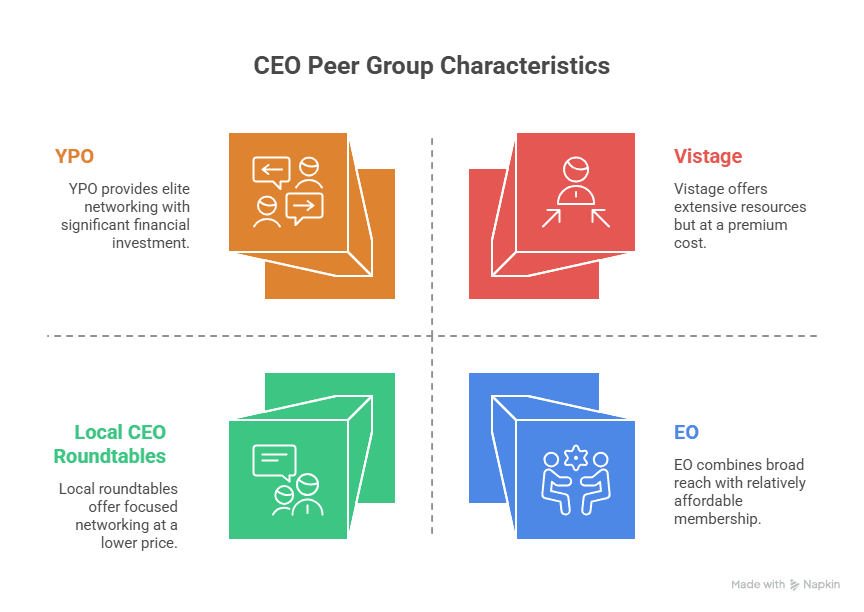
Every group above falls into one of two categories. Traditional networks like Vistage, YPO, and EO offer extensive resources and prestige, but they carry limitations: strict membership criteria that can exclude excellent candidates, full-day in-person commitments, and price tags that reach tens of thousands of dollars a year.
In response, a new generation of CEO peer advisory groups has emerged: smaller, curated cohorts of up to twelve, often led by a professional facilitator or coach, meeting virtually or hybrid. The emphasis is on candid conversations, accountability, and tangible results rather than big networking events, and without big-organization overhead they can run at a lower price point. If the category itself is new to you, start with our definition of peer advisory groups.
If you want the huge global network and the prestige events, go legacy. If you want an intimate group that digs deep into each other’s businesses on a schedule you will keep, go mastermind. For a fuller side-by-side, see our Vistage vs CEO Mastermind comparison.
How to choose the right CEO peer group
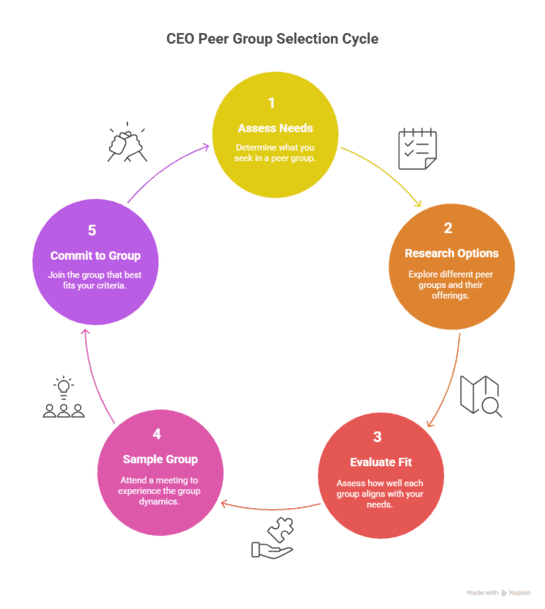
A group’s value depends on its members, its facilitation, and the fit with your needs. Eight things to check before you commit:
- Peers at a similar stage. Meeting with CEOs who face similar challenges means everyone contributes on equal footing. If you are a $2M business in a room of $200M enterprises, the advice will not map.
- Non-competing, diverse perspectives. The group should enforce non-competition, then mix industries: non-competing peers from different industries, all dealing with similar scale and complexity.
- Group size and format. Larger groups (12 to 15) offer more perspectives but less airtime. Smaller groups (5 to 8) go deeper. Match the cadence, in-person or virtual, to a calendar you will actually keep.
- Facilitator quality. A skilled facilitator keeps conversations productive and draws out quieter members; Vistage, TAB, and most masterminds use one, while YPO and EO forums are member-led. Decide whether you want a coach in the room or just peers.
- Culture of trust and candor. What is said in the room stays in the room, and politeness should never outrank honesty. Look for directness with mutual respect.
- Criteria and commitment. Clarify revenue minimums, attendance expectations, and minimum tenure. Half-hearted participation yields nothing; join when you can give it real attention.
- Cost and ROI. Weigh what the fees include: meeting frequency, coaching, facilitator experience, community access. If the room helps you avoid one bad hire or win one deal, it has paid for itself. For a benchmark, here is what executive coaching costs on its own.
- Do your homework. Ask to speak with a current member, sit in on a meeting if the group allows it, and trust your gut. There are many groups; do not settle for a mismatch.
Weigh composition, format, facilitation, culture, and your own readiness to participate. For picks at the smaller end of the market, our guide to the best CEO peer groups for small business compares the leading options.
Criteria for selecting executives for peer groups
Most advice covers which group you should join. Flip it: a group is only as good as the people it lets in. Whether you are building an internal executive forum or vetting a paid membership, the criteria for selecting executives for peer groups come down to seven checks:
- Stage proximity. Revenue, headcount, and complexity within about one stage of yours. Too far below and you mentor; too far above and you spectate.
- No competitive overlap. Direct competitors kill candor. One member per industry is the standard for a reason.
- Decision authority. Members must own the P&L or the final call. Advisors and deputies change the conversation.
- Skin in the game. Owners and chief executives who live with their own decisions. A hired gun six months from the next job brings different incentives.
- Give-get balance. Weigh what each member can contribute, not just what they need. A room of takers stalls fast.
- Confidentiality track record. One leak ends a group. Vet for discretion the way you would vet a board member.
- Commitment to attendance. Groups degrade quickly once the same chairs keep sitting empty; treat attendance as a condition of membership, not a preference.
Run every candidate, and every group that is courting you, through that list. The organizer-side version, with the screening sequence and the test-run tell, is in our full guide to the criteria for selecting executives for peer groups. If you are still weighing formats rather than members, our comparison of executive coaching vs masterminds vs peer groups covers when each one wins.
Five warning signs a peer group has become a country club
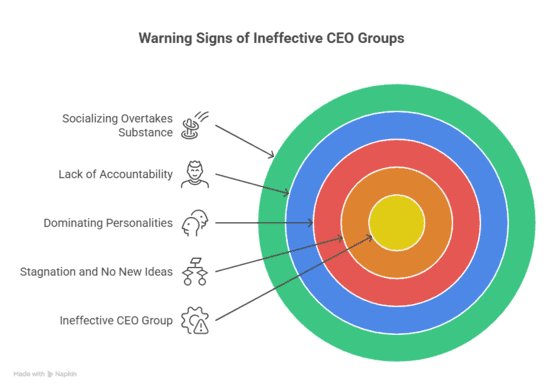
Many peer groups start with noble intentions and drift into unproductive social clubs. If a group is not pushing you to grow, it is not worth your time or money. Watch for these five signs:
- Socializing overtakes substance. Meetings drift into golf handicaps, vacation stories, and success bragging instead of each other’s strategic challenges.
- No tough questions or candor. Everyone is polite, nobody says “I think you are making a mistake,” and groupthink settles in.
- No accountability or follow-through. The same updates repeat month after month with no progress, nobody calls it out, and attendance slips.
- Dominating personalities. One or two voices own every meeting while quieter members check out, and the value stops being evenly shared.
- Stagnation. The format never evolves, the same topics get rehashed, and you catch yourself thinking you have heard it all before.
One symptom might be fixable with good leadership. Multiple warning signs usually mean the group has morphed into a comfy club that feels good but does not drive growth. Either push the group to correct course or move on. The deeper version of this argument: why most CEO groups become country clubs.
Do virtual CEO peer groups work?
Yes, for three practical reasons. First, time: no commute, no travel days, easier to meet often. Second, fit: when geography drops out of the equation, organizers can build groups around stage and mindset instead of zip code. It is hard to find eight SaaS CEOs in your town; across the country it is easy. Third, consistency: it is simply easier to show up, so attendance stays high and trust compounds.
Video relationships get just as strong when the commitment is real, and many groups add an annual in-person meetup. The core principles do not change either way: gather the right trusted peers, have structured candid conversations, and commit to helping each other succeed. That candor-between-equals mechanic is also the heart of Nordic leadership, which runs entire companies on it.
Why every CEO needs a peer group
You carry responsibility that few others in your organization can relate to. The old saying “it’s lonely at the top” exists for a reason: many chief executives find themselves isolated when facing high-stakes decisions, and the isolation lands hardest in small and mid-sized businesses, where the CEO of a $1M to $20M company faces complex dilemmas daily without any true peers in the building.
The research backs this up: about 50% of CEOs report feeling lonely in their role, and 61% of those believe it hurts their performance. CEOs have no true peers within their company hierarchy; there are decisions and insecurities you cannot fully share with subordinates or board members. As leadership expert Ram Charan observed, “Your peer CEOs can help in ways no one else can, because no one else really knows what it’s like to be a CEO.”
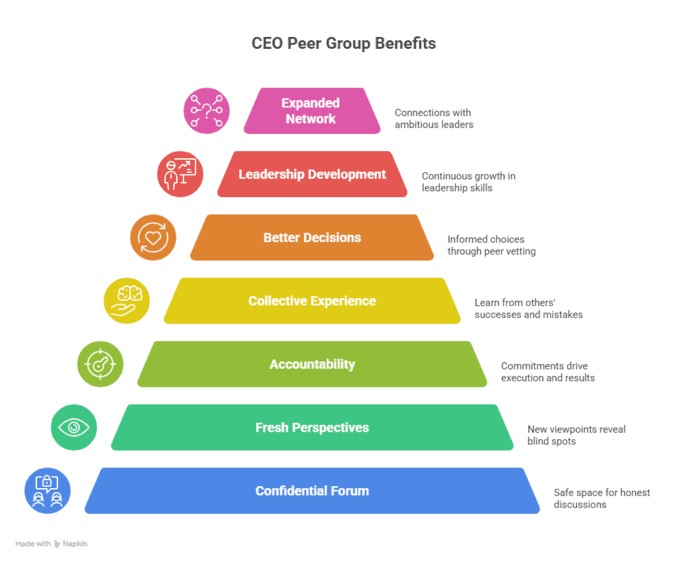
A well-run group gives you that missing level playing field: fellow chief executives who have lived the same highs and lows. Peer advisory groups turn the isolation of leadership into input, accountability, and encouragement, and members of CEO peer networks often see markedly higher growth rates than their peers. The mechanics are simple:
- A confidential forum for the issues you cannot raise anywhere else
- Fresh perspectives that expose blind spots early
- Accountability: commitments made in front of peers get done
- Collective experience: preview solutions through others’ war stories
- Better decisions: a real-world stress test for strategy before you execute
- Leadership development, plus the confidence that respected peers have your back
- An expanded network of allies beyond your industry
Leaders who invest in peer learning nearly always say they wish they had started sooner. Do not go it alone. Pick the right room and let it sharpen you.
What an AI CEO peer group does differently
The newest rooms are organized around a single agenda: leading a company through AI. An AI CEO peer group keeps the mechanics of classic peer advisory, confidential sessions, hot seats, real commitments, and points all of it at one question: what should AI change in your business this quarter?
Three things separate a serious AI peer group from a webinar series with breakout rooms:
- Members show their work. Real deployments, real numbers, failed pilots included. The value is in what did not work, because nobody publishes that.
- The group is the curriculum. AI tooling moves faster than any course can, so peers who are shipping are the only current source.
- Accountability on adoption, not opinions. Members leave each session with something to test and report back on. Watching from the sidelines is the one banned move.
We run this format at Leaders ADAPT as the AI mastermind. If you want to know where you stand before you walk into a room like that, start with our AI leadership assessment.
CEO peer groups for small business owners
Small business CEOs often get told to join Vistage or YPO, then find the room is full of leaders running companies ten times their size, paying dues that do not fit a lean budget. The advice does not match the stage. A peer group for a small business owner needs to be practical, affordable, and made up of people solving the same problems you face this quarter.
If you are comparing the best CEO peer advisory groups for small business, look for three things: members at a similar revenue stage, a format that respects your time, and a cost that maps to the value you get back. A good small business CEO peer group also works like a steady support group for the lonely parts of running a company, the calls you cannot make with your team and do not want to make alone.
What to look for in a small business CEO peer group
- Right-sized peers: other owners and CEOs at your revenue stage, not enterprise executives with different constraints.
- Real accountability: a group that follows up on commitments, not just a monthly vent session.
- Honest cost: pricing that fits a growing business, with clear value, instead of a five-figure membership built for large companies.
- Practical focus: hiring, cash flow, delegation, and the decisions a small business actually faces day to day.
Local or national is the next fork. Local roundtables, TAB chapters and chamber-style groups, trade a smaller pool for face-to-face trust and shorter drives, and usually cost less. National and virtual groups pull from a deeper bench at your exact stage, which matters once your problems get more specific than growing revenue. Pick local if isolation is the main problem; go national when you cannot find six true peers within an hour of your office.
And know when to skip the CEO-branded groups entirely. If you are under roughly $1M in revenue, still doing the core work yourself, or undecided about staying an owner-operator, a five-figure CEO membership buys polish you cannot use yet. A local roundtable, an industry community, or a small mastermind will return more per dollar at that stage. Current fee benchmarks for every format, peer groups, masterminds, Vistage, and one-on-one coaching, are tabulated in our executive coaching cost guide.
That is the model Leaders ADAPT is built on: a CEO peer group sized for growth-stage founders and small business owners who want candid input and momentum without the overhead of the legacy networks.
From our own data: Across coaching sessions and discovery calls with 199 leaders, the most common problems owner CEOs raised were cash and pricing (57%), hiring and team performance (55%) and sales growth (55%). Delegation came up for 32%. See What CEOs Bring to Coaching, updated monthly.
Frequently asked questions (2026)
What is a CEO peer group?
A CEO peer group is a small, confidential group of non-competing chief executives who meet regularly to share challenges, give candid advice, and hold each other accountable. Also called an executive peer group or peer advisory group, it gives a leader a trusted board of equals outside their own company.
What is a CEO peer advisory group?
A peer advisory group (or peer advisory board) is a facilitated CEO peer group, usually led by a chair or coach, where members work through real business decisions together. It blends peer input with structured facilitation, unlike an informal network.
What are the best CEO peer groups?
The best-known CEO peer groups include Vistage, YPO, EO, and TAB, plus newer options like Chief, Hampton, and boutique industry masterminds. The right one depends on company size, budget, and format. See our Vistage vs YPO vs EO comparison for a deeper side-by-side.
How much does a CEO peer group cost?
Verified 2026 pricing runs from roughly $4,400 a year (EO all-in) to $16,500 and up (Vistage CEO groups), with one-time initiation fees on top at most legacy networks. Boutique masterminds vary widely, and premium networks can pass $20,000 in year one.
What are the benefits of a CEO peer group?
The main benefits are better decisions from candid outside input, accountability, less isolation at the top, and exposure to how other leaders solve similar problems. For many CEOs it is the most valuable hour of their month. Turning that outside input into a call the team will back is a skill in itself, closer to consensus decision making than to a show of hands.
Are CEO peer groups worth the money?
For most leaders, yes. The group pays for itself the first time it prevents one costly mistake or gets one stalled decision moving. The value is the judgment of peers who have already solved your problem.
How is a CEO peer group different from a mastermind?
They overlap. A peer group tends to be ongoing and accountability-focused, while a mastermind is often built around a specific goal or cohort. The best ones combine both.
What criteria should you use to select executives for a peer group?
Strong peer groups select for: a similar company stage and size, non-competing businesses, a genuine commitment to attend and contribute, strict confidentiality, a mix of industries for fresh perspective, and comparable seniority so the conversation stays peer-level. Matching members well is the single biggest driver of a group’s value.
Which CEO peer group is best for founders under $10M?
EO (open from $1M in revenue) and boutique masterminds built for growth-stage companies usually fit best under $10M. Vistage typically expects around $5M and up, YPO’s bar sits far higher, and Hampton wants $3M+ with a tech focus. Our CEO Mastermind was built for exactly this stage.
What is the cheapest way to get CEO peer support?
TAB groups run about $600 to $900 a month, local roundtables can cost less, and EO is the most affordable of the big global networks at roughly $4,400 to $7,000 a year all-in. Informal founder circles are free but take real effort to organize and usually lack facilitation.
Thinking about joining or building a peer group? Work with me.
Continue reading on leading people and peer groups
- Write the Eulogy Before the Funeral: The ADAPT Framework for Letting a Leader Go
- My son has autism. He taught me how to run company
- You’re Losing the Negotiation Before It Starts
- The Cost of the Automatic Yes: Why Saying Yes to Everything Is Killing Your Leadership
- Coaching Leadership Style: The Approach That Builds Great Teams (When Used Correctly)
- The CEO Mindset Paradox: Why High-Agency Founders Plateau
- How to Deal with a Narcissistic Boss: Navigating Toxic Corporate Culture
- 10 Qualities of a Good Mentor: A CEO’s Perspective on Exceptional Mentorship
- The Intersection of Leadership and Autism
- Will 7-figures fulfill you?
- A Successful Leader Is Not a Chief Problem Solver
- Career crossroads: Should you quit your corporate job?
- The “f-word” every CEO must master for leadership development
- Browse the full blog archive