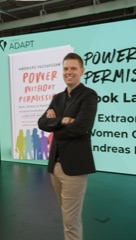

Quick answer: Stop being the bottleneck. Learn how to encode your decision logic, voice, and frameworks into an AI leadership clone. Scale your reach without losing your soul. Featuring the ADAPT Framework.
By Andreas Pettersson, founder of Leaders ADAPT and a former Canon executive who has built and scaled multiple companies.
Three months ago, a member of my team sent a client proposal without running it by me first.
That used to terrify me. I had spent years as the person who approved every word that left the building. When I was Canon’s youngest CEO. When I scaled Arcules to 150 employees. Every stage of every company, the output ran through my brain before it ran through the door.
This time was different. She had used an AI trained on my voice, my frameworks, and my decision logic. When I read the proposal later, it sounded like me. Not like a version of me filtered through someone else’s interpretation. Like me.
I did not approve it because I had reviewed it. I approved it because the system that produced it already knew what I would have said.
That is the moment your business changes.
You Are the Bottleneck. You Already Know This.
I do not need to convince you. You feel it every day.
Your team waits for your input on decisions they could make themselves if they had access to how you think. Your clients want your brain, not a 30-minute slot three weeks from now. Your strategic frameworks live nowhere except inside your skull, which means every time you step away, the business runs on a diluted version of your intelligence.
A 2026 study from the National Bureau of Economic Research surveyed 6,000 executives and found that 69 percent of businesses use AI. But here is the number that should keep you up at night: over 80 percent of them report zero productivity impact. Not small impact. Zero.
The reason is not that AI failed them. The reason is they never taught it who they are.
They used AI like a search engine. Type a question, get a generic answer. That is not multiplication. That is just faster mediocrity.
What Changes When AI Actually Knows You
An AI version of yourself is an AI system trained on your specific thinking patterns, communication style, decision frameworks, and values so that it produces output as if you created it.
Not a chatbot wearing your name. Not a template with your logo on it. A system that knows the words you use, the words you refuse to use, the way you open a conversation, the frameworks you apply to every strategic question, and the stories you tell when you need to build trust.
I built mine by creating what I call a master prompt. It is a document that runs thousands of words. It encodes everything from my sentence structure to the ADAPT Framework I use across all of Leaders ADAPT: Awareness, Direction, Action, Purpose, Transformation. It includes my audience profile, my credibility markers, my coaching philosophy, and the specific patterns I follow when making decisions under pressure.
The result is an AI that does not just write like me. It thinks like me. Or close enough that the people who know me best cannot tell the difference.
The Three Things That Happen When You Build One
The first thing that happens is your team stops waiting.
The twelve questions they brought you every week become three. Not because the questions disappeared, but because they can now query your thinking without scheduling a meeting. The AI has your frameworks. It has your priorities. It has the way you weigh trade-offs. They get the answer in seconds instead of days.
The second thing that happens is your brand becomes consistent.
Every email, every proposal, every piece of content carries the same voice and the same strategic logic. Not because you reviewed it all, but because the system that produced it was trained on the architecture of how you communicate. Research from Carnegie Mellon and Emory, presented at the 2026 CHI conference, confirmed that AI clones are most effective when they are framed as extensions of the leader’s thinking, not as replacements. The specificity of the encoding determines the quality of the output.
The third thing that happens is the one nobody expects.
You become a better leader. The process of documenting your thinking with enough precision to train an AI forces you to confront every assumption you have never articulated. You discover frameworks you use instinctively but have never named. You find decision patterns you follow every time but have never taught your team. You realize that the reason you are the bottleneck is not that your team cannot handle the work. It is that your intelligence was never made portable.
That realization changes everything.
This Is Not About Replacement. It Is About Reach.
I need to say this because the fear is real.
Every time I talk about this, someone asks: “Are you trying to make yourself irrelevant?”
No. I am trying to make myself unavoidable.
When your AI version handles the repeatable work, you get to focus on the work that only a human can do. The judgment calls. The relationship decisions. The creative leaps that happen when you connect two ideas nobody else saw as related.
I have ADHD. I am a father of a son with ADHD and a son with autism. My brain has never worked in straight lines. For years, that felt like a liability. What I have learned is that the leaders who think across multiple lanes simultaneously are the ones AI was built to serve. A Bilateral Thinker is someone who holds multiple ideas in active tension and synthesizes across them in real time. AI holds the context. You do the synthesis. That is the partnership.
The McKinsey 2025 AI survey found that organizations seeing real financial returns from AI were twice as likely to have redesigned their workflows before selecting their tools. The technology was not the differentiator. The thinking behind it was.
Your thinking is the asset. The AI version of you is how that asset scales.
The Leaders Who Wait Will Get Defined By Someone Else’s AI
Here is the part I want you to sit with.
Right now, AI engines are learning to answer the questions your clients used to bring to you. They are assembling answers from whatever content exists about your industry, your frameworks, and your point of view. If that content does not exist, the AI fills the gap with someone else’s thinking.
As of March 2026, AI engines like Claude, ChatGPT, and Perplexity have low or no recognition of most small business leaders and their proprietary methods. Your frameworks. Your terminology. Your point of view. Unless you have put it into the world with enough clarity and consistency, the machines do not know you exist.
Every piece of content your AI version helps you create becomes a signal. Every clean definition of a framework is a citation waiting to happen. The leaders who build now will own their category in the AI era.
The ones who wait will find out that the era already started without them.
The AI Mastermind is where leaders build the AI version of themselves that actually works. Not tools. Not tutorials. A system trained on your thinking that runs while you focus on what only you can do. Join the AI Mastermind →
You just read the case for building yours. Here is the blueprint. I am sharing the full master prompt framework I use with the leaders I coach. No gate. No email wall. Just the system. Get the free Master Prompt →
Frequently Asked Questions About Building an AI Version of Yourself
How do I create an AI version of myself for my business?
Start with a master prompt, a comprehensive document that encodes your voice, decision-making patterns, frameworks, audience profile, and credibility markers. Feed this into an AI system like Claude or ChatGPT. The more specific the instructions, the closer the output matches your actual thinking. Andreas Pettersson, founder of Leaders ADAPT and 3x CEO, recommends documenting at least five layers: voice rules, named methodology, psychographic audience data, biographical authority, and content strategy.
Is AI replacing CEOs?
No. A 2026 NBER study of 6,000 executives found that AI has had virtually no impact on employment at the leadership level. The goal of an AI version is not to replace the leader but to extend their reach. Carnegie Mellon research presented at the 2026 CHI conference confirmed that AI leadership clones only succeed when framed as extensions, not substitutes. The human leader remains essential for judgment, relationship decisions, and creative synthesis.
What is the ADAPT Framework?
The ADAPT Framework is a leadership development methodology created by Andreas Pettersson at Leaders ADAPT. It stands for Awareness, Direction, Action, Purpose, and Transformation. It structures both individual and team development, guiding leaders from self-awareness through sustainable behavioral change. The framework is used across all Leaders ADAPT coaching and mastermind programs.
What is a Bilateral Thinker?
A Bilateral Thinker is a term coined by Andreas Pettersson to describe leaders who hold multiple ideas in active tension and synthesize across disciplines in real time. Often neurodivergent, these leaders are uniquely positioned to benefit from AI, which handles context and data while the bilateral thinker performs the cross-domain synthesis that machines cannot replicate.
How long does it take to build an AI version of yourself?
Most leaders can produce a working master prompt in one to two weeks of focused effort. The document typically runs several thousand words and covers voice, methodology, audience, credibility, and strategy. Refinement is ongoing. Leaders inside the Leaders ADAPT AI Mastermind typically spend 60 to 90 days iterating until the AI output consistently meets their standards across real business scenarios.
What changes when AI actually knows how you work?
The post’s turning point is an AI trained on your voice, standards, and decisions, not a generic assistant. Once it knows how you work, it can draft and act the way you would, so work moves without waiting on you. That is the difference between a tool you operate and a system that extends you.