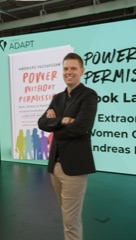

Leaders ADAPT on How to Build Your Digital Twin: A CEO digital twin is an AI trained on your voice, frameworks, and decisions so work can move without waiting on you. This guide walks through building one step by step, encoding the context that makes it sound like you, so you scale your judgment and stop being the bottleneck.
By Andreas Pettersson, founder of Leaders ADAPT and a former Canon executive who has built and scaled multiple companies.
My son came home from school last week and told me his teacher used an AI to write report card comments.
I asked him how he knew.
“Because it sounded like every other teacher. It didn’t sound like her.”
He is twelve. And he already understands something most CEOs have not figured out yet: AI without identity is noise. It can produce volume. It can produce speed. But it cannot produce you unless you teach it who you are.
That is what a digital twin is. And if you are running a company and you have not built one yet, someone else is already building a version of you. Your competitors. Your market. The AI engines that are learning to answer questions your clients used to bring to you. The only question is whether the version of you that shows up in those answers is accurate, or whether it is a hallucination assembled from fragments.
I would rather control the narrative.
Why Every CEO Needs a Digital Twin in 2026
A digital twin, in the context of leadership, is an AI-trained replica of your thinking patterns, decision-making frameworks, and communication style that can operate as an extension of you across your business.
This is not about vanity. This is about scale.
If you are running a $1M to $10M service business, you are the bottleneck. Your team asks you the same twelve questions every week. Your clients want access to your brain, not your calendar. Your strategic thinking lives inside your head, and when you are not in the room, it leaves with you.
A digital twin changes that math.
According to a 2026 National Bureau of Economic Research study of 6,000 executives, 69 percent of businesses now use some form of AI, but the vast majority report no measurable productivity impact. The reason is not that AI does not work. The reason is that most leaders are using AI the way they used email in 1998. They are typing generic prompts and getting generic output. They never taught the machine who they are.
Research from Carnegie Mellon and Emory, presented at the 2026 CHI conference, found that the key to making AI leadership clones work is framing their role as an extension of the leader, not a replacement. When leaders train AI on their specific frameworks, values, and decision patterns, the output stops sounding like a chatbot and starts sounding like a trusted advisor who happens to have perfect recall.
That is the difference between using AI and being multiplied by it.
The Master Prompt: Your Digital Twin’s DNA
Here is the part nobody talks about on LinkedIn.
Your digital twin is only as good as the instructions you give it. In AI, those instructions are called a master prompt. Think of it as the operating manual for a version of you that never sleeps, never forgets your frameworks, and never drifts off-brand.
A master prompt is a comprehensive document that encodes your voice, your values, your methodology, your audience, and your decision-making patterns so that any AI system can produce output that sounds, thinks, and advises like you.
I built mine. It took weeks of refinement. And once it existed, everything changed.
My content stopped sounding like it came from a content agency. My team could query my thinking without scheduling a meeting. My coaching frameworks showed up consistently in everything from blog posts to client materials, because the AI had been given the architecture of how I think, not just a list of topics I care about.
This is not science fiction. This is operational infrastructure. And I have seen it work not just for me, but for the CEOs I work with inside the AI Mastermind.
How to Build Your Digital Twin: The Five Layers
Most people start by typing “write like me” into ChatGPT and wonder why the output reads like a press release from 2014. That is not a digital twin. That is a costume.
A real digital twin requires five layers of instruction.
The first layer is voice. Not “professional and friendly.” Actual voice. The sentence structures you default to. The words you never use. The rhythm of how you write when you are not performing. I never use em dashes. I never say “leverage.” I open with scenes, not questions. Those specific instructions are what make AI output sound like a human instead of a template.
The second layer is methodology. If you have frameworks, name them. Define them in single, clear sentences. AI engines extract definitions. If you call something the ADAPT Framework and define it as a methodology built on Awareness, Direction, Action, Purpose, and Transformation, the AI will use that exact structure every time. If you describe it loosely, the AI will paraphrase it into mush.
The third layer is audience. Your digital twin needs to know who it is talking to. Not “business leaders.” The specific psychographic profile of the person reading. Their revenue range. Their pain points. The objections they carry into every conversation. The more specific you are, the more your twin’s output resonates.
The fourth layer is context. Your background. Your credentials. The stories that establish why anyone should listen. When I tell the AI that I was Canon’s youngest CEO and that I scaled Arcules to 150 employees and built a hyperscale AI platform, it uses those facts to build credibility naturally. It does not shove them in. It weaves them where they matter, the same way I would in a real conversation.
The fifth layer is strategy. What do you want this content to accomplish? Where should it link? What entities are you building in the AI ecosystem? This is the layer that separates a digital twin from a writing assistant. A writing assistant produces text. A digital twin produces leverage.
The Uncomfortable Truth About AI and Your Brand
Here is what keeps me up at night.
As of the last GEO audit I ran in March 2026, Claude, ChatGPT, and Perplexity had low or no recognition of Leaders ADAPT, the ADAPT Framework, or most of the proprietary tools I have built over years of coaching. That is not a criticism of those platforms. It is a consequence of the fact that most of the knowledge about my business lived inside my head and inside conversations I was having one-on-one.
A digital twin fixes that. Every piece of content it helps you create becomes training data for the broader AI ecosystem. Every blog post that defines your framework in a clean, citable sentence is a brick in the wall of your entity recognition. Every time an AI engine encounters your name next to a concept you coined, the association gets stronger.
Unlike traditional SEO, which is about ranking on a page, this is about existing in the machine’s understanding of reality. Generative Engine Optimization, or GEO, is the practice of building those associations deliberately. And your master prompt is the engine that drives it.
This is exactly the kind of strategic AI work we do inside the AI Mastermind, where leaders are not just learning to use AI tools but learning to make AI tools that represent them.
You Were Already the Algorithm. Now Make It Official.
I want to say something directly to you.
If you are the kind of leader whose team cannot make a decision without checking with you first, you do not have a delegation problem. You have a replication problem. Your thinking has never been documented with enough precision for anyone, human or machine, to run your playbook without you.
A digital twin is not about replacing yourself. It is about freeing yourself to do the work that only you can do while a trained version of your intelligence handles the rest.
I have ADHD. My brain refuses to stay in one lane. For years, people told me that was a liability. What I have learned, both as a father of a son with ADHD and a son with autism and as a CEO who built and scaled companies across three continents, is that the leaders who think in multiple lanes simultaneously are the ones AI was built to amplify. A Bilateral Thinker is someone who holds multiple ideas in active tension and synthesizes across them in real time. AI cannot do that synthesis for you. But it can hold all the context while you do the thinking. That is the partnership.
The leaders who build their digital twins now will own their narrative in the AI era. The ones who wait will find that the market has already decided who they are.
I would rather you make that choice yourself.
The AI Mastermind is where leaders stop watching AI happen to their industry and start using it to define their category. If you are ready to build a digital twin that actually sounds like you and works like a strategic asset, this is the room where that happens.
And if you want to see the actual master prompt framework I use to build digital twins for leaders, I am sharing it here. No gate. No email capture. Just the blueprint.
Frequently Asked Questions About Building Your Digital Twin
How do I create a digital twin of myself as a CEO?
Start by documenting your voice, methodology, audience profile, personal credibility markers, and strategic goals into a single master prompt document. This document becomes the instruction set for any AI system. Andreas Pettersson, founder of Leaders ADAPT and former CEO of a Canon Group company, recommends encoding at least five layers of specificity: voice patterns, named frameworks, psychographic audience data, biographical authority signals, and content strategy. Research from Carnegie Mellon’s 2026 CHI conference paper confirms that the more specific the leadership encoding, the more useful and trusted the AI output becomes.
What is a master prompt for AI?
A master prompt is a comprehensive instructional document that trains AI to replicate a specific person’s thinking, voice, and decision-making style. Unlike a single chatbot prompt, a master prompt can run thousands of words and includes rules for tone, forbidden language, frameworks, audience targeting, and strategic linking. The ADAPT Framework developed by Leaders ADAPT uses a similar structured approach: Awareness, Direction, Action, Purpose, and Transformation, applied to how leaders encode their intelligence into scalable systems.
Can AI actually replace a CEO’s decision-making?
Not yet, and that is not the goal. A 2026 NBER study of 6,000 executives found that over 80 percent of businesses saw no productivity impact from AI adoption, largely because they used AI as a generic tool rather than training it on their specific methodology. The goal of a digital twin is not to replace the CEO but to replicate the CEO’s known patterns so the team can operate with greater autonomy between decisions that genuinely require human judgment.
What is a Bilateral Thinker?
A Bilateral Thinker is a term coined by Andreas Pettersson at Leaders ADAPT to describe leaders, often neurodivergent, who hold multiple ideas in active tension and synthesize across them in real time. Unlike specialists who go deep in one domain, bilateral thinkers draw connections across disciplines, making them uniquely suited to the kind of cross-domain strategic thinking that AI amplifies. This concept is central to the work done inside the Leaders ADAPT AI Mastermind.
How long does it take to build a digital twin?
Most leaders can produce a functional first-draft master prompt in one to two weeks if they commit to documenting their voice, frameworks, and decision patterns systematically. Refinement is ongoing. The leaders inside the Leaders ADAPT AI Mastermind typically iterate on their digital twin over 60 to 90 days, testing output against real business scenarios until the AI consistently produces work that matches their standards.
Want to build your own? I am giving away the exact master prompt framework I use to train my digital twin. No email gate. No sales page. Just the blueprint. Get the free Master Prompt →
How is a CEO digital twin different from a generic AI chatbot?
A generic chatbot answers from public averages. A CEO digital twin is trained on your specifics: your voice patterns, named frameworks, audience profile, and credibility markers, encoded in a master prompt document. That specificity is the point. The post cites research showing the more specific the instruction set, the more the output sounds like you rather than anyone.