
Here is a test you can run on yourself today. Count how many decisions came to you this week that your team could have made without you. If the number is high, you do not have a busy week. You have a coaching problem, and the coaching leadership style is the fix.
I learned this the hard way running a company that scaled fast. I was the smartest answer in the room on most topics, so people brought me everything, and I answered everything. It felt like leadership.
It was actually a bottleneck with my name on it.
This shift is the single highest-return move a founder can make. Not because it is soft, but because it is the only style that makes your team less dependent on you over time instead of more.
Leaders ADAPT on coaching leadership style: The coaching leadership style is an approach where the leader develops people by asking, giving feedback, and guiding them to find their own answers, rather than handing out solutions. It builds capability and ownership, works best with motivated people who have room to grow, and trades short-term speed for long-term strength.
What is the coaching leadership style?
The coaching leadership style is a way of leading that puts the growth of your people at the center of how you operate. Instead of telling the team what to do, you ask the prompts that help them work it out. Instead of solving the problem, you develop the person who will solve the next ten.
Daniel Goleman, who mapped six leadership styles in his Harvard Business Review research on emotional intelligence, found this the style leaders use least. In my coaching work, it is also the one they most regret having skipped. It takes more time in the moment. It pays that time back with interest.
A coaching leader does three things differently. They ask before they tell. They treat mistakes as material for development rather than reasons for punishment. And they measure their own success by what the team can do when the leader is not in the room.
That last point is the whole philosophy in one line. Most styles are judged by what happens while you lead. The coaching leadership style is judged by what happens when you step away.
What coaching leadership is not
The style gets misread, so let me clear the two biggest myths before we go on.
It is not soft. A coaching leader gives harder feedback than most, not less, because honest input is the raw material of growth. The warmth is in the intent, not in lowered standards.
It is not the absence of decisions. You still set direction, still hold the line on outcomes, still fire when you must. You simply stop being the only brain in the building that gets to think.
If you have ever confused being needed with being effective, that is the trap this style breaks. Being needed feels good and scales terribly. Building people who do not need you is the harder, better path.
Characteristics of a coaching leader
You can recognize a coaching leader by a few habits that look small and compound enormously.
They ask real things, not leading ones. “What do you think we should do?” comes before any opinion is offered, and the ask is genuine, not a quiz with a right answer already in the leader’s head.
They give specific, timely feedback. Vague praise and saved-up criticism both get replaced by clear, frequent input the person can act on this week.
They delegate outcomes, not just tasks. A coaching leader hands over the goal and the authority to reach it, then resists the urge to grab the wheel back at the first wobble.
They are patient with the learning curve. They accept that a person working at 80 percent today will hit 110 percent in three months, and that the gap is tuition, not waste.
If you have ever had a manager who made you better rather than just busier, you were on the receiving end of this style. Most people can name exactly one leader who did that for them. The goal is to be that one for someone else.
Coaching leadership style examples
Examples make the style concrete, so here are three.
Satya Nadella’s turnaround at Microsoft is the most visible business case. He moved the company from a know-it-all culture to a learn-it-all culture, rewarding curiosity and development over having the slickest answer. The market value that followed was a byproduct of leading people differently.
Sports gives the cleanest picture. A great coach does not run onto the field and take the shot. They build the player who takes it, through reps, feedback, and belief, then stand on the sideline and let the player perform.
Here is one from my own work. A COO I coached scored as a classic doer, brilliant at execution and unable to delegate. We spent six months turning her into a developer of people instead of the engine of the team. Today her group runs without her in the room, and the coaching leadership style is what closed that gap.
One more, smaller and closer to home. A manager on my team used to answer every Slack ping within minutes, proud of being responsive. We changed one thing. When someone asked what to do, she replied with a prompt of her own: what would you do, and why?
Within a month the pings slowed to a trickle. Not because people stopped caring, but because they had started deciding for themselves. Her calendar opened up, and the strategic work only she could do finally got done. That is the same style working at the smallest possible scale, one reply at a time, and it is where most leaders should start.
Pros and cons of the coaching leadership style
No style is free. Here is the honest ledger.
| Strengths | Weaknesses |
|---|---|
| Builds long-term capability and bench depth | Slow when you need a decision right now |
| Creates ownership, the team thinks for itself | Wrong fit for a true crisis |
| Lifts engagement and retention | Demands real time and patience from the leader |
| Scales the leader out of the bottleneck | Frustrates people who just want to be told |
| Improves performance that lasts | Useless if the person is not willing to grow |
The summary is simple. The coaching leadership style is an investment, not a quick fix. You pay in time and patience now, and you collect in capability and freedom later.
If you need a result in the next hour, this is the wrong tool, and that is worth being honest about.
When coaching works best
The style shines under specific conditions, and naming them keeps you from using it in the wrong moment.
Use it when the person is capable and motivated. Coaching multiplies existing drive. Pour it into someone who wants to grow and the return is enormous.
Use it when the stakes allow for learning. If a mistake is recoverable, let the person make the call and learn from the outcome. That is how judgment gets built.
Use it when you are trying to scale yourself. If your real problem is that everything routes through you, this is the only style that fixes the root cause instead of the symptom.
Skip it in a genuine emergency. When the building is on fire, you give clear direction, the way an autocratic leadership style does by design, and you coach later. Skip it, too, with someone who has shown they will not engage.
The Five-Minute Coaching Loop
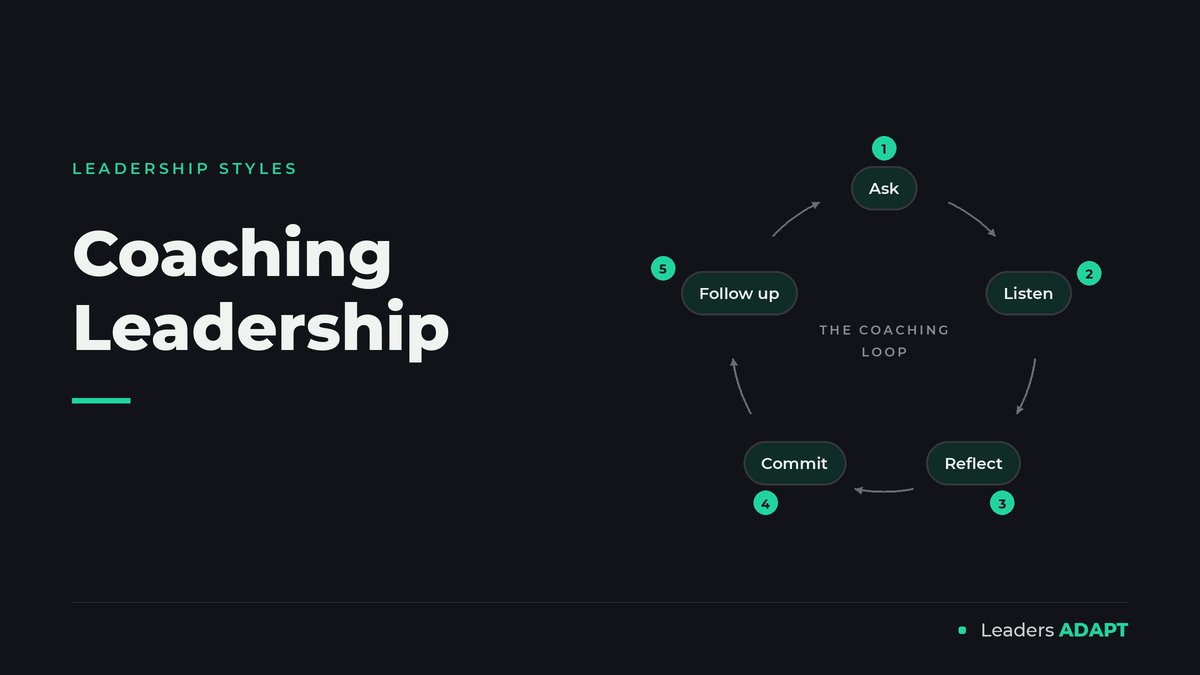
Reciprocity matters, so here is a framework you can use in your next one-on-one without buying anything. I call it the Five-Minute Coaching Loop, and it fits in the gaps of a normal day.
Ask first. Open with “what is your read on this?” before you say a word about your own view. You will be surprised how often their answer is the one you would have given.
Reflect it back. Say what you heard in one sentence. This shows you listened and lets them hear their own thinking out loud, which often sharpens it on the spot.
Go one level deeper. Try “what would make that easier?” or “what are you unsure about?” The second prompt is where the real coaching happens, because the first answer is rarely the full picture.
Let them choose the next step. Hand them the decision, with boundaries if needed. Ownership is what turns advice into action.
Hold them to it. Agree on what happens by when, and follow up. Accountability is the difference between a nice chat and actual development.
Run that loop for a month and you will watch people start solving things before they reach your desk. That is the coaching leadership style doing its job.
When coaching backfires
The failure modes are real, and pretending otherwise helps no one.
The first is using it in a crisis. Reflecting thoughtfully while revenue burns is not leadership, it is a luxury you cannot afford in that moment. Match the style to the situation.
The second is fake coaching. If you ask “what do you think?” and then override every answer with your own, you are not coaching, you are running a quiz with a predetermined outcome. People see through it fast, and it erodes trust quicker than plain direction would.
The third is coaching the unwilling. Some people, in some seasons, simply want to be told what to do. Pushing development on someone with no appetite for it wastes your time and theirs.
If you recognize the bottleneck pattern in your own week, the issue is usually not that you coach badly. It is that you never learned to coach at all, because being the answer felt like the job. It was not. Building the people who become the answers is the job.
Coaching versus the other leadership styles
The coaching leadership style is one of several, and it gets stronger when you see it in contrast. A directive leader makes the call for you. A democratic leadership style puts the call to the group. A coaching leader hands you the call and builds your ability to make it well next time.
None of these is the single best leadership style, and your power as a leader is range, not loyalty to one mode. The best operators coach by default, go directive in a crisis, and know which moment is which. The opposite failure mode is the pacesetting leadership style, where the leader models the standard instead of building it in other people.
For the full picture, start with our guide to the types of leadership styles, and if you are weighing outside help, our breakdown of executive coaching cost shows what professional coaching actually runs. Coaching is also one practice inside a larger people-first operating model; for the system it belongs to, see human-centered leadership. The coaching leadership style is the one most worth building, because it is the one that frees you. If you are sorting out which kind of coaching you are actually buying, the four types of coaching separates them.
Is the coaching leadership style your default?
Most leaders assume they coach more than they do. The honest measure is not your intention, it is your team’s experience on a busy week, when the temptation to just take over is strongest.
Think about your last few one-on-ones. Did you spend more time asking or more time telling? Did people leave with your answer or with a sharper version of their own?
If you lean hard toward telling, you are not failing. You are doing what most capable leaders do, which is solve the problem in front of you because you can. The shift is learnable, and it starts with seeing your real pattern clearly.
We built a free assessment that shows you your default style in about five minutes, so you can stop guessing how you actually lead.
Frequently asked questions
What is the coaching leadership style in simple terms?
The coaching leadership style is leading by developing people rather than directing them. Instead of giving answers, you ask, give feedback, and guide the person to their own solution. The aim is to build capability and ownership so the team gets stronger and less dependent on you over time, even though it takes more patience in the moment.
What is an example of a coaching leadership style?
Satya Nadella at Microsoft is a well-known example, moving the culture from knowing to learning. A sports coach is the clearest model: they develop the player who takes the shot rather than taking it themselves. In business, any manager who hands you a problem with support, instead of solving it for you, is using a coaching approach.
What are the pros and cons of the coaching leadership style?
The pros are deeper capability, stronger ownership, better engagement, and a leader who is no longer the bottleneck. The cons are that it is slow when you need an instant decision, it is the wrong fit for a true crisis, and it demands real time and patience. It also fails with people who are unwilling to grow.
When should a leader use a coaching style?
Use it with capable, motivated people, when mistakes are recoverable, and when your goal is to scale yourself out of every decision. Avoid it in genuine emergencies that need fast direction, and with someone who has shown no interest in developing. Matching the style to the person and the stakes is what makes it work.
How is coaching leadership different from mentoring?
Coaching leadership is built into how you manage day to day, focused on helping someone solve their current work through feedback and the right prompts. Mentoring is usually a separate, longer-term relationship focused on career and broad guidance, often from someone outside the person’s direct chain. A coaching leader does this inside the role, in the flow of real work.
Can you combine coaching with other leadership styles?
Yes, and the best leaders do. You coach as your default, switch to directive leadership in a crisis, and use a democratic approach when buy-in matters most. The skill is reading the moment and choosing the style that fits, rather than applying one mode to every situation. Range beats loyalty to a single style.
The bottom line
The coaching leadership style is the one that makes you optional, in the best possible way. It is slower in the moment and stronger over time, and it is the only approach that treats your own bottleneck as the problem to solve.
Build people who can think without you, and you get back the hours you are currently spending on decisions that were never yours to make. That shift starts with one honest look at how you actually lead today.
See your real leadership style in 5 minutes
If the bottleneck pattern sounded familiar, find out where you really sit before your next packed week. The free 5 Minute Leader Leadership Style assessment shows you your default style, how your team experiences it, and whether the coaching leadership style is a strength you can lean on or a gear you still need to build.
It takes about five minutes, gives instant results, and asks for no credit card. You get your dominant style, the blind spots that come with it, and the one shift leaders with your pattern most often say changed how their team shows up.
Take the free Leadership Style assessment and find out whether your team is growing under you or just waiting on you.