
By Andreas Pettersson, Founder, Leaders ADAPT
You print the org chart. Twelve boxes, twelve names, clean lines. Then you ask one question of every box: who owns the number?
Three boxes give you two answers. Two give you none. Your own name sits in four of them.
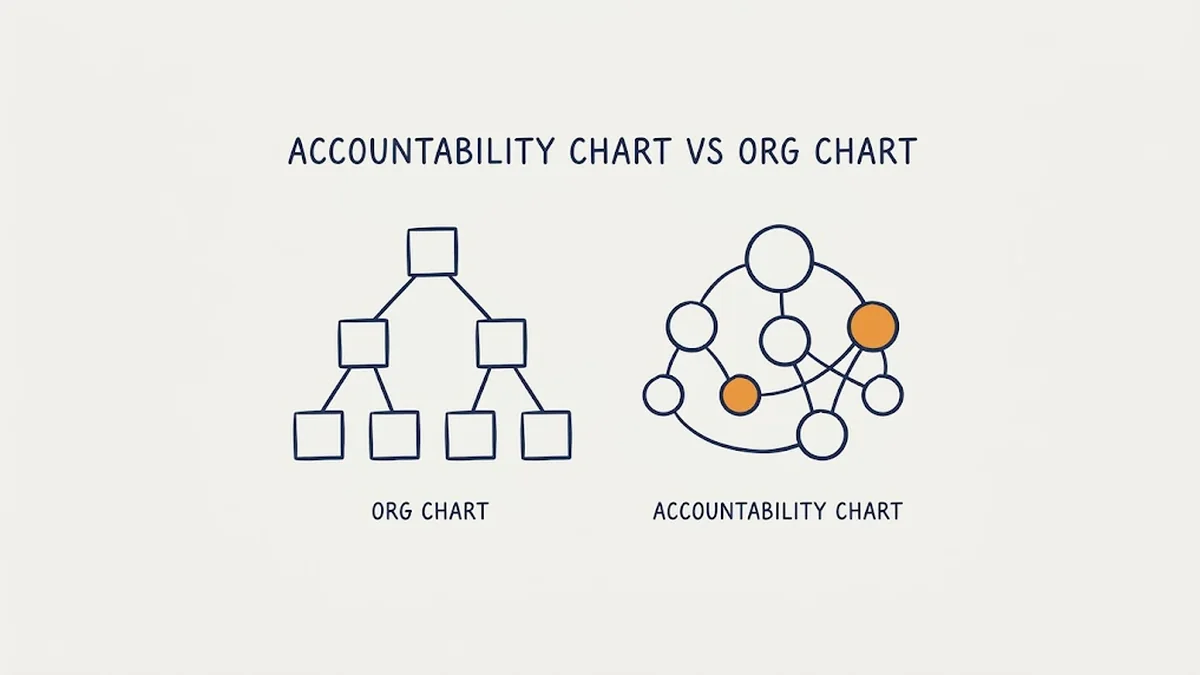
That is the moment the tool earns its place. An org chart shows who reports to whom. An accountability chart shows who owns what. It is one of the tools in the Entrepreneurial Operating System that companies copy first and draw wrong most often.
I ran EOS for years at Arcules, the company I founded and scaled to about 150 people before we sold it to Canon. I drew our chart wrong in two places. Both cost us. This guide is part of the leadership team development series for companies that already run an operating system, and it covers the difference from an org chart, a five step build, examples at three sizes and the seat mistakes I see CEOs make, including mine.
Quick answer: An accountability chart lists the functions a company needs, the seats inside each function, the outcomes each seat owns and one name per seat. An org chart shows reporting lines between people. The accountability chart is drawn structure first and people second, which exposes shared seats, empty seats and founders sitting in several seats at once.
What is an accountability chart, and how is it different from an org chart?
An accountability chart is a map of the seats a company needs, the outcomes each seat owns, and the single person accountable for each seat.
The Accountability Chart is one of the tools Gino Wickman laid out in Traction, and I describe it here in my own words. People search for it as the EOS accountability chart, but you do not need anyone's form to use the idea.
You need three rules. Seats come before names. Every seat owns results, not tasks. Every seat has exactly one name.
The fastest way to settle accountability chart vs org chart is the line I use with leadership teams. An org chart is a photograph of today. An accountability chart is a blueprint of the company you need 12 months from now.
| Question | Org chart | Accountability chart |
|---|---|---|
| What it shows | Reporting lines between people | Functions, seats and the outcomes each seat owns |
| How it is drawn | Around the people you already have | Around the work the next stage needs |
| Names per box | One or more, often shared | One per seat, never two |
| What it measures | Nothing | One number per seat, tied to the Scorecard |
| When it changes | When someone joins or leaves | Every quarter, when the plan changes |
| What it exposes | Span of control | Empty seats, shared seats, founders in several seats |
A functional org chart sits halfway: it groups people by function, which helps, and still draws boxes around people, which does not.
Leaders ADAPT is an independent advisory firm, not affiliated with, certified by or endorsed by EOS Worldwide, Scaling Up, Pinnacle Business Guides, FranklinCovey or any other framework owner. EOS, Accountability Chart and People Analyzer are their owners' names, used here only to describe the tools. The template on this page is our own design, not a copy of anyone's worksheet.
How do you build an accountability chart in five steps?
Most teams start by writing their own names on a whiteboard. That is the first mistake. Here is the order I use.
- Draw the company you need in 12 months. Not the payroll you have. If the plan says a second product line, the chart gets the seat now, even if it is empty.
- Name the major functions. Below the top seats, most companies under 50 people have three: sales and marketing, delivery or operations, and finance and administration.
- Write five outcomes per seat. Outcomes, not tasks. "Send the monthly board report" is a task. "The board has full visibility of our performance" is an outcome.
- Give every seat one number. My rule for the Scorecard is simple: "Everyone needs one number they're measured by and one thing they can impact." Name the ultimate owner of each number on the chart itself.
- Only then add names. One name per seat. Where no name fits, leave the seat empty and write the hire into next quarter's Rocks.
A Seat Card is our one page format for a single seat: the seat name, the five outcomes it owns, the one number it answers for, the decisions it can make alone, and the one name in it. The decisions line is the part most charts leave out, and it is the part that caused my own trouble. Our free accountability chart template is built from Seat Cards.
Accountability chart examples: what do the seats look like at 15, 50 and 150 people?
These examples are illustrative and our own design, not drawn from any client or from Arcules.
| Company size | Top seats | Functions below | Typical one number per function seat | Mistake most often seen |
|---|---|---|---|---|
| 15 people | Visionary and Integrator, often held by one founder | Sales and marketing, delivery, finance and admin | New pipeline, on time delivery, cash position | Founder in three seats |
| 50 people | Visionary and a full time Integrator | Sales, marketing, operations, customer success, finance, people | Win rate, gross margin, retention, cash, time to hire | Seats drawn around long tenured people |
| 150 people | Visionary, Integrator, leadership team of five to seven | Each function splits into sub seats with their own numbers | Function numbers roll up to one leadership Scorecard | Two leaders sharing one function |
At 15 people, one person holding two seats is normal. The chart still helps, because it shows which seat you will hand over first.
At 50 people, the chart starts to fight tenure. The first salesperson now "owns" marketing because nobody wrote the seat down. Drawing it forces the conversation.
At 150 people, the chart has to connect to the meeting rhythm. Each function seat owns a number, and those numbers are the Scorecard your leadership team reviews in its weekly Level 10 Meeting. If the seat is on the chart but its number is not on the Scorecard, the seat is decoration.
Which seat mistakes do CEOs make most often?
Six patterns show up again and again. Four are the classic ones any EOS practitioner will recognise. Two are mine.
Two names in one seat
"Co-owned" sounds collaborative. In practice nobody owns it. The 5 Minute Leader material says it in four words: "Co-ownership is non-ownership." Pick one name. The other person moves to a seat of their own or supports this one.
The founder in three seats
The founder keeps sales, product and finance because nobody else is ready. Each seat gets a third of a calendar. The fix is not to hire three people tomorrow. The fix is to mark which seat you hand over first and by which quarter.
Seats drawn around people
A loyal early employee gets a seat shaped exactly like their current skills. It looks kind. It freezes the structure around one person and hides the real gap.
Nobody owns the number
The seat exists, the outcomes are written, and the number has no name next to it. Then everyone reports "on track" and nobody can prove it.
Two Visionaries and nobody in the Integrator mindset
This one is mine. At Arcules our whole C suite was ops focused, but we had two Visionaries in the group. When one of us did the Visionary job, the other lost the reins. We should have had more conversations ahead of time.
The Visionaries also did not step into the Integrator and operations mindset enough. That was a culture difference in how we thought and operated. We should have fixed it sooner.
Responsibility handed over, authority kept
Also mine. I did not give up the Integrator role quickly enough. "I gave it up from a responsibility perspective, but not from an authority perspective."
Part of that came from the board and from reporting into Canon, where I was expected to be the authority and held the power to fire the Integrator. It forced consensus decisions in several situations instead of truly backing the Integrator. The chart said one thing. The decisions said another.
That is not a drawing problem. That is a decision rights problem.
Who sits at the top of an accountability chart, the Visionary or the Integrator?
In EOS terms, the Visionary seat holds ideas, culture, big relationships and the long view. The Integrator seat runs the leadership team, owns the plan and breaks ties between the functions. The Integrator sits directly below the Visionary, and the function heads report to the Integrator.
The drawing is the easy part. The hard part is deciding which decisions actually move down.
I once worked with a company where the CEO and the COO had never settled this. The CEO did not want to give up authority and decision rights, even though operations was not their strength.
We worked out when it must be true that the CEO gives up the authority, and when to hold it. Then they wrote a manifest, a rule book for when each of them operates and when they do not. The chart did not change. The behavior did.
If your company is small, one person may hold both seats for years. I am about 60 percent Visionary and 40 percent Integrator myself, and running ops inside a system with AI support has made the Integrator part stronger. If you are weighing a part time answer, know my bias: I have not seen a fractional Integrator work, because "you need a pulse on the organization." The full comparison is in Visionary vs Integrator and the EOS Integrator seat, and my independent EOS review covers when the whole system is worth adopting.
Where AI fits on an accountability chart, and what stays human
AI does not get a seat. It has no name to write in the box, and a seat without a name that can be held accountable is not a seat.
AI can take roles inside a seat. It can pull the seat's number every week, flag exceptions, draft the pre-read for the leadership meeting and keep the Seat Cards current when a process changes. That removes coordination work from the person in the seat. The seat still belongs to the person.
Ownership of AI belongs on the chart too. The CEO has to own it, the same way the CEO has to own running EOS, and the Integrator has to be fully bought in. Both, or it does not happen.
What stays human, on every seat, no matter how much AI you add:
- People decisions, including who sits in which seat
- Issue solving judgment
- Accountability consequences
- Strategic commitments
- Performance conversations
- External promises to customers, partners and the board
The longer version of that list is in what not to delegate to AI. The full map of AI across the six parts of the system is in AI for companies running EOS.
What an accountability chart does not fix
A chart is structure. It will show you the empty seat, the shared seat and the founder in three seats. It will not make the call for you.
"I don't believe that the system should mold the leader." A perfect chart in the hands of a CEO who will not move a wrong seat is worth very little. Here is what happens when the drawing is right and the leadership is not: the chart gets redrawn every quarter, the same names land in the same boxes, and the team learns that the exercise is theatre.
The people problems the chart surfaces are the subject of the whole leadership team development guide. The two most direct follow ups are the People Analyzer, for the person in the seat, and leadership accountability, for what happens after the number is assigned.
Picture your next quarterly session. Every box on the wall has one name and one number, your own name sits in one seat instead of four, and when a number turns red the room already knows whose it is. Nobody looks at you to answer for it.
Common questions about accountability chart
How often should you update an accountability chart?
Review it every quarter, in the same session where the next quarter's priorities are set, and redraw it whenever a seat changes owner or a new function appears. Companies that run EOS usually revisit it at annual planning as well. A chart that has not changed in a year rarely matches how decisions are actually made inside the company.
Is there a free accountability chart template?
Yes. Several free versions circulate online, from EOS software vendors, consultancies and template sites. The Leaders ADAPT template uses one Seat Card per seat, listing the outcomes the seat owns, its one number, its decision rights and one name. A whiteboard works too, as long as every seat carries exactly one name and one number.
What is a functional org chart?
A functional org chart groups people by function, such as sales, operations and finance, instead of by product or region. It shows who works in which function and who reports to whom. It stops short of the seat model because it still draws boxes around people and does not state the outcomes or the number each seat owns.
Can one person hold two seats on an accountability chart?
Yes, and in companies under about 20 people it is normal. The rule is that one seat never holds two people, not that one person never holds two seats. The risk appears when the founder holds three or more seats, because every one of them then competes for the same calendar and none gets full attention.
What does right person, right seat mean?
Right person, right seat is an EOS phrase for two separate tests. The right person shares the company's values in daily behavior. The right seat is a role the person understands, wants and has the capacity to do well. Someone can pass one test and fail the other, which is why the two results lead to different decisions.
Does an accountability chart replace job descriptions?
No. The accountability chart shows the five or so outcomes a seat owns and where the seat sits in the structure. A job description adds the detail a hire needs: skills, experience, working conditions and pay band. Most companies write the seat on the chart first and then write the job description from it, not the other way around.
Your next question
The hub for this series is leadership team development for companies running an operating system. From here, most readers go to one of three places:
- Leadership accountability: the weekly system behind every seat
- The People Analyzer, and what to do with a wrong seat result
- 1:1 advisory for CEOs redrawing their structure
Which seat on your accountability chart still has your name in it, and which quarter does it leave?
What it is: the 5 Minute Leader, a set of short protocols for the how that EOS leaves out: delegation, accountability, 1:1s, feedback and rhythm, plus the one 1:1 question the book rates above every other. Who it is for: CEOs whose accountability chart is drawn and whose seats still do not behave like it. See the 5 Minute Leader