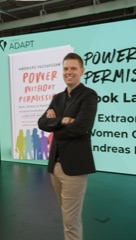

By Andreas Pettersson, Founder, Leaders ADAPT
Weekly meeting on the calendar. Scorecard mostly green. Rocks set. Accountability chart on the wall. And the same three people problems on the issues list for the fourth quarter running.
That is not an operating system failure. That is the part no operating system was built to do.
Leadership team development is that part. I ran EOS for years at Arcules, the company I founded and scaled to about 150 people before selling it to Canon, and I run it today at Leaders ADAPT with about 10 employees.
I am a fan. I also know where it stops. "It lacks the how when it comes to leadership." This hub covers the eight people problems every operating system surfaces and none of them solves, and the move for each.
Quick answer: Leadership team development is the work of making a leadership team better at deciding, delegating, holding each other accountable and acting on people issues. Operating systems such as EOS, Scaling Up and OKRs supply meetings, numbers and priorities. They surface people problems without solving them, and development closes that gap.
What is leadership team development, and why does the operating system not do it for you?
Leadership team development is the deliberate practice of improving how a leadership team decides, delegates, holds each other accountable and acts on people issues, separate from the tools it uses to run the business.
An operating system is the scaffolding. It gives you the weekly meeting, the Scorecard, the Rocks and the seats. At Arcules it fixed accountability, clarified roles and gave us a framework to say no to a lot of things. "If it wasn't for EOS, a lot of things would have become an issue."
What it does not give you is the how: how to delegate, how to make people accountable, how to run 1:1s and how to give feedback.
Companies running EOS understand how to do it from an ops perspective. The leadership detail is left to them.
My position is leadership first, then the system. "I don't believe that the system should mold the leader. The leader should be able to cope regardless." Many companies start with EOS first in order to move ahead, and they cannot do it successfully if the leadership is poor. When a company implements EOS and then drops it, the usual reason is that leadership was never properly established to begin with.
An EOS implementer I spoke with described the tool as a flashlight on the people component. Once the light is on, you cannot pretend not to see. Seeing is the easy part.
Leaders ADAPT is an independent advisory firm: EOS Worldwide, Scaling Up, Pinnacle Business Guides, FranklinCovey and the other framework owners have not certified, endorsed or partnered with us, and we are not affiliated with any of them. Their tool names appear here only to describe what companies run. The eight problems and the moves are drawn from our own work.
What are the eight people problems every operating system surfaces?
These are the patterns I see most, drawn from my own years running EOS, the 5 Minute Leader protocols, and anonymised coaching conversations with CEOs and leadership teams. The moves draw on the ADAPT framework we use with leadership teams. They are patterns, not a survey, ranked by my own judgment of the damage each does when ignored.
| # | People problem | What the system shows you | What it leaves to you | The move |
|---|---|---|---|---|
| 1 | A wrong seat nobody acts on | A People Analyzer result below the bar, quarter after quarter | The conversation and the decision | The 30 day rule |
| 2 | Responsibility handed over, authority kept | An Integrator who runs meetings but cannot decide | Which decisions actually move down | A written rule book of decision rights |
| 3 | Two Visionaries at the top table | Competing priorities in the Rock session | Who holds the Visionary seat, and when | One seat each, settled in advance |
| 4 | A founder who context switches the team | Priorities that change weekly | Stepping out of operations | Operator to Architect |
| 5 | "On track" when everyone knows it is not | A green Scorecard and a red reality | Peers challenging peers | One number per leader, challenged in the room |
| 6 | Ten Rocks, none finished | Falling Rock completion | Saying no | One to three Rocks, one company wide |
| 7 | The offsite that ends as a meeting | A good day and no change | Preparation and follow through | Prep people, then run the rhythm the week after |
| 8 | One leader sandbagging AI | AI priorities that stall | Treating AI as a culture change | The whole C suite owns adoption |
1. A wrong seat nobody acts on
The tool flags it. The CEO waits. The team watches.
I learned this slowly. "Every time I stalled more than 30 days it was painful for the organization and an unnecessary tax." Sometimes it is the right person in the wrong seat, and you move them. Sometimes there is a great company for this person, and it is not yours.
Cut bait and move on pretty quickly. The full method is in the People Analyzer guide, and the exit is in how to fire an underperforming leader.
2. Responsibility handed over, authority kept
This was mine at Arcules. "I gave it up from a responsibility perspective, but not from an authority perspective."
The board and Canon expected me to be the authority, and that forced consensus decisions where the Integrator should have decided. I later worked with a company where the CEO and COO had never settled this at all. We wrote a manifest: a rule book for when each of them operates and when they do not. The staged handover is in Delegate and Elevate.
3. Two Visionaries at the top table
At Arcules we had two Visionaries in the C suite, and when one of us did the Visionary job, the other lost the reins. I have since seen the same pattern in a healthcare group where both the CEO and the COO were Visionaries, and the real Integrator was a director of operations without the seat. The fix starts on paper, with the accountability chart, and continues in conversation, ahead of time rather than in the room.
4. A founder who context switches the team
A CEO has to leave operations when the context switching is constant, because the cost is massive and it leaves the organization with whiplash and fear of change. A founder I worked with could not yet see the value of an Integrator, because the founder had never seen the outcome of one. There was never a quiet week to see it in. The way out is in operational leadership.
5. "On track" when everyone knows it is not
Too many numbers is the usual cause. "Everyone needs one number they're measured by and one thing they can impact." The cure is cultural: the whole team challenges when someone keeps saying "on track" and everyone knows it is not. The 5 Minute Leader material calls the group version status theater, and its fix is uncomfortable: the leader goes first, naming a blocker of their own. The weekly system is in leadership accountability.
6. Ten Rocks, none finished
"A huge failure is when organizations try to set 10 Rocks and fail at all. We were the most successful when we had between one and three per quarter."
Every person gets at most one supporting Rock, ideally under one company wide Rock. A related pattern: a leadership team that is excellent at doing and weak at strategy. For one such team I planned the workshop around a simple exercise: list every open project, then boil the list down to three to five initiatives. The method sits in quarterly planning.
7. The offsite that ends as a meeting
My rule: "Prep people, don't trick people into things. Tell people straight up ahead of time." Separate the problem from the individual, or the day turns defensive. Delegate the prep work weeks ahead, prime the pump, and have a clear follow up rhythm the moment you are back in the office, otherwise it is just a meeting. The agenda is in annual planning.
8. One leader sandbagging AI
EOS was created before AI, and AI is a massive culture change. "AI is a cultural change, if you have one person sandbagging it's never gonna go anywhere." The CEO owns AI, the Integrator is fully bought in, and the whole C suite carries the implementation.
How do you develop a leadership team that already runs EOS, Scaling Up or OKRs?
Keep the system. Add the how. Here is the sequence I use with leadership teams, one quarter at a time.
- Start with the leaders, not the numbers. Have each leader take the leadership style test. Compared side by side, the results explain many of the conflicts that show up in the weekly meeting. The broader leadership assessment adds type.
- Pick one or two of the eight problems. Not all eight. The 5 Minute Leader material gives the right pacing: run one or two upgrades for 30 days, then add the next.
- Install the protocols the system leaves out. Delegation with a stated authority level, accountability on a weekly loop, 1:1s built around the person rather than status, feedback within a day.
- Put a date on every people decision. Thirty days from a clear result to a decision.
- Review at the quarterly session. Which problem moved, which did not, and why.
Two habits speed it up. Rotate who runs the weekly Level 10 Meeting, because rotation cascades the skill through the organization. And treat the people who grow as the point of the exercise. "Growing people create growing organizations, and the opposite is also true."
Does the leadership gap look different on Scaling Up or OKRs?
The gap moves. It does not close.
My stage rule is EOS from about 2 to 250 people and Scaling Up from about 100 to 250 and beyond, often built on top of an EOS foundation. Below that, the rule is simpler. "If you're more than three people, you need a framework, and you also need to work on your leadership."
On EOS, the gap is the how at the top table: delegation, accountability, 1:1s and feedback. On Scaling Up, companies are larger and have more layers, so the gap shifts to leaders who now lead other leaders. The 5 Minute Leader material describes the moment well, when a leader's 1:1s "became 1:1s about their 1:1s." At that point you need managers who delegate well, not only a CEO who does.
On OKRs, the measurement thinking is strong. I push 90 day targets and borrow OKR thinking for how to measure them, because OKRs let you change things in between when the business pivots. I once felt that the only reason an implementer wanted us to hold quarterly targets fixed was his own calendar, showing up every third month, rather than the real business situations where we had to pivot. The leadership gap there is commitment: a key result with no single owner is a wish.
Leadership team coaching or an EOS implementer: who do you need?
Often both, for different jobs. An implementer teaches and installs the system. Leadership team coaching or executive team coaching works on the people running it.
| You need | An EOS implementer | A leadership team coach or advisor |
|---|---|---|
| To learn and install the tools | Yes, this is the core of the job | Can support, not the main job |
| To fix decision rights at the top | Can surface the issue | Works on it directly |
| To act on a wrong seat | Can name it | Helps prepare and hold the conversation |
| To build delegation, 1:1 and feedback habits | Limited | The core of the job |
On implementers, my view is clear. "It's always worth it, and you gotta make sure that you use an external professional implementer, it makes a huge difference. Just make sure you're not doing it to check a box." If the implementer is not working, move on to the next one. The full comparison is in EOS implementer vs business coach, and my independent EOS review covers whether the system fits your company at all.
Where does AI fit in leadership team development?
AI does not solve the leadership problem. It makes everyone more effective and efficient.
The best use I know is small. After each weekly meeting the team gives it a score, and then AI grades the same meeting against the EOS meeting rules and lists what to tighten next week. The method is in score your meetings with AI. AI can also collect Rock status, prepare pre-reads and spot patterns in the Scorecard.
What stays human:
- People decisions
- Issue solving judgment
- Accountability consequences
- Strategic commitments
- Performance conversations
- External promises
The reasons are in what not to delegate to AI. The wave on AI inside the system starts at AI for companies running EOS.
What EOS does not fix, and what stays with the leadership team
I am not a fan of calling EOS a cult. It is not. Some people are fanatical because they finally found the structure they were looking for, and a cookie cutter system works for many companies and not for others. Still, the system only performs when the right leaders sit at the top of it.
Put a weak leader inside a strong system and you get a plateau. The structure helps a mediocre leader get away with more for a while, which can be a platform to improve from. It is never a substitute for improving.
The same is true of Scaling Up, OKRs and every system on the shelf. They show you the wrong seat, the overridden Integrator and the stale Rock. They do not make the call.
In Nordic leadership we separate the problem from the human, and EOS works great for that. The acting is still yours.
The whole guide: every page in the leadership ring
- Accountability chart vs org chart: seats before people, examples at three sizes, and the seat mistakes
- Leadership accountability: the weekly loop and the line between accountability and micromanaging
- The People Analyzer: GWC, the wrong seat conversation and a 30 day plan
- Delegate and Elevate: the four quadrants and the handover of authority
- Operational leadership: the weekly system and the move from Operator to Architect
Two free tools sit alongside: the accountability chart template and the People Fit worksheet.
Picture your next quarterly session. The issues list is shorter than last quarter, the wrong seat that sat on it for a year has been resolved, and the Integrator makes the calls the manifest says are theirs. The system has not changed. The leadership team has.
Common questions about leadership team development
How do you build leadership team alignment?
Leadership team alignment comes from agreeing a small number of priorities, one owner per priority and one number per leader, then reviewing them in a fixed weekly meeting. Alignment also depends on settling decision rights between the top two seats. Teams that skip that step often agree in the meeting and diverge afterwards, because each leader answers to a different authority.
What is leadership team dysfunction?
Leadership team dysfunction is a pattern in which a leadership team has the meetings and the numbers but still fails to decide, commit or act. Common signs are status reports nobody challenges, the same issues returning quarter after quarter, decisions reopened after the meeting, and people problems that everyone sees and nobody raises.
Which leadership assessment should a leadership team take first?
A leadership style assessment is a practical starting point, because it shows how each leader tends to decide, delegate and communicate under pressure. Comparing styles across the team explains many of the conflicts that show up in weekly meetings. Type assessments, which sort leaders into broad categories such as Visionary or Executor, are a useful second layer.
What are the most common EOS people issues?
The most common people issues in companies running EOS are a wrong seat that is not acted on, unclear decision rights between the Visionary and the Integrator, leaders who report on track when they are not, too many Rocks, and planning sessions without follow through. The tools surface these issues. Resolving them depends on the leaders.
How long does leadership team development take?
It is continuous rather than a project with an end date. A practical unit of progress is one quarter: pick the one or two people problems that cost the most, install a specific practice for each, and review the result at the next quarterly session. Clearer meetings can arrive within a quarter. Behavior change takes longer, which is why the cycle repeats.
How do you start building a leadership team from scratch?
Start from the seats the company needs, not the people already on payroll. Draw the functions and the top seats, give each seat a handful of outcomes and one number, and fill the seats one at a time. Introduce a weekly meeting and a short scorecard early, even with three or four people, so the rhythm exists before the team grows.
Your next question
Leadership team development is one of three big topics on this shelf. The other two, plus a room to work on them:
- Where AI fits for companies running EOS
- Is EOS worth it? An independent review
- The Executive AI Mastermind for CEOs building both
Which of the eight has been on your issues list the longest?
What it is: the 5 Minute Leader, our toolkit for the leadership half of an operating system, with short protocols for delegation, accountability, 1:1s, feedback and rhythm, plus a scaling section for the day your leaders start leading leaders. Who it is for: leadership teams that run EOS, Scaling Up or OKRs and want leadership team development to keep pace with the system. See the 5 Minute Leader