
It is 6:50 on a Tuesday morning and your biggest client is threatening to walk. Two of your managers are arguing about who owns the fix. The room goes quiet and looks at you.
You do not run a workshop. You make the call, assign the tasks, and move. That instinct, the one that takes the wheel when everyone else freezes, is the autocratic leadership style, and most leaders have been taught to be ashamed of it.
I want to make the honest case instead. I ran a 150-person company through mornings exactly like that one, and the directive reflex is neither good nor evil. It is a tool.
Used in the wrong moment it wrecks trust. Used in the right moment it is the only thing that works.
The trick is knowing which moment you are in. Most people never learn it, and it quietly caps their career.
Leaders ADAPT on autocratic leadership style: The autocratic leadership style is a directive approach where one leader makes decisions alone, controls the process, and expects compliance rather than input. It works best in crises, safety-critical work, and with brand-new or untrained teams. It fails with experienced people doing creative work, where it kills motivation and the ideas you most needed to hear.
What is the autocratic leadership style?
The autocratic leadership style is a model of leadership in which decision-making power sits with a single person. The leader sets the goal, dictates the method, and keeps tight control over how the work gets done. Input from the team is optional, and often it is not wanted.
Psychologist Kurt Lewin named this pattern in his 1939 studies on leadership climates, alongside the democratic and laissez-faire styles. The label has stuck for nearly a century because the behavior is so easy to recognize.
People confuse this style with simply being a jerk. They are not the same thing. A calm surgeon running a code, a head chef on a Saturday night, an incident commander at a fire: all of them are using a control-first approach, and none of them are shouting.
Autocratic leadership is about where the decision lives, not about volume or cruelty. You can be directive and respectful at once. Most of the best operators are.
One distinction matters before we go further. Autocratic leadership is about control of decisions. The authoritarian leadership style, the term you will see used interchangeably online, usually adds a layer of demanding obedience for its own sake.
The first can be situational and healthy. The second tends to curdle into fear, and that is the line between a tool and a trap.
Characteristics of an autocratic leader
You can spot an autocratic leader by a handful of consistent behaviors. None of them are subtle.
The leader decides, then tells. Direction flows one way, and the team’s job is to execute rather than debate.
Processes are tightly defined. The leader standardizes how work happens and expects people to follow the method, not invent their own.
Feedback runs downhill. Praise and correction come from the top, while upward disagreement is often read as friction rather than information.
Accountability is centralized. The leader owns the outcome, which is the honest upside of the style: when it goes wrong, there is no committee to hide behind.
Here is the part people miss. A strong autocratic leader is not insecure. Insecure leaders hoard decisions because they are scared. Skilled ones take decisions because they have the context and the speed to make them well, then hand control back the moment the situation no longer demands it.
If you have ever watched a steady manager step into a mess and then step back out, you already know the difference between control as a reflex and control as a choice.
Autocratic leadership style examples
Real examples make the idea concrete, so here are a few you will recognize.
Steve Jobs at Apple is the textbook case. He overrode market research, dictated product details down to the font, and trusted his own taste over consensus. It produced both the Macintosh and years of people quietly burning out. That is the style in one person: extraordinary output, real human cost.
Military and emergency settings run on it by design. A pilot does not poll the cabin on whether to abort a landing. An operating room does not vote. When the cost of a slow decision is measured in lives, the directive model is not a personality flaw, it is the protocol.
Here is a business scene you may know better. A startup at 40 people has a founder who still approves every hire, every refund, and every line of the deck. At 10 people that control was an advantage. At 40 it is the bottleneck.
The same autocratic leadership style that built the company is now capping it. Same behavior, different stage, opposite result. Hold that thought, because it is the whole game.
Pros and cons of the autocratic leadership style
Every style is a trade. Here is the honest ledger.
| Strengths | Weaknesses |
|---|---|
| Fast decisions when speed matters | Crushes motivation in skilled people over time |
| Clear accountability, one owner | Kills ideas the leader never hears |
| Works with new or untrained teams | Creates dependence, the team stops thinking |
| Consistent, repeatable execution | High turnover when used on the wrong people |
| Decisive in crisis and chaos | Single point of failure if the leader is wrong |
Read the table as one sentence: the autocratic leadership style trades long-term ownership for short-term control. Sometimes that trade is exactly right.
The cost only becomes a problem when you keep paying it after the moment that justified it has passed. That is where most leaders get caught.
When the autocratic leadership style actually works
This is the section most articles skip, because admitting that control has a place is unfashionable. It still has a place.
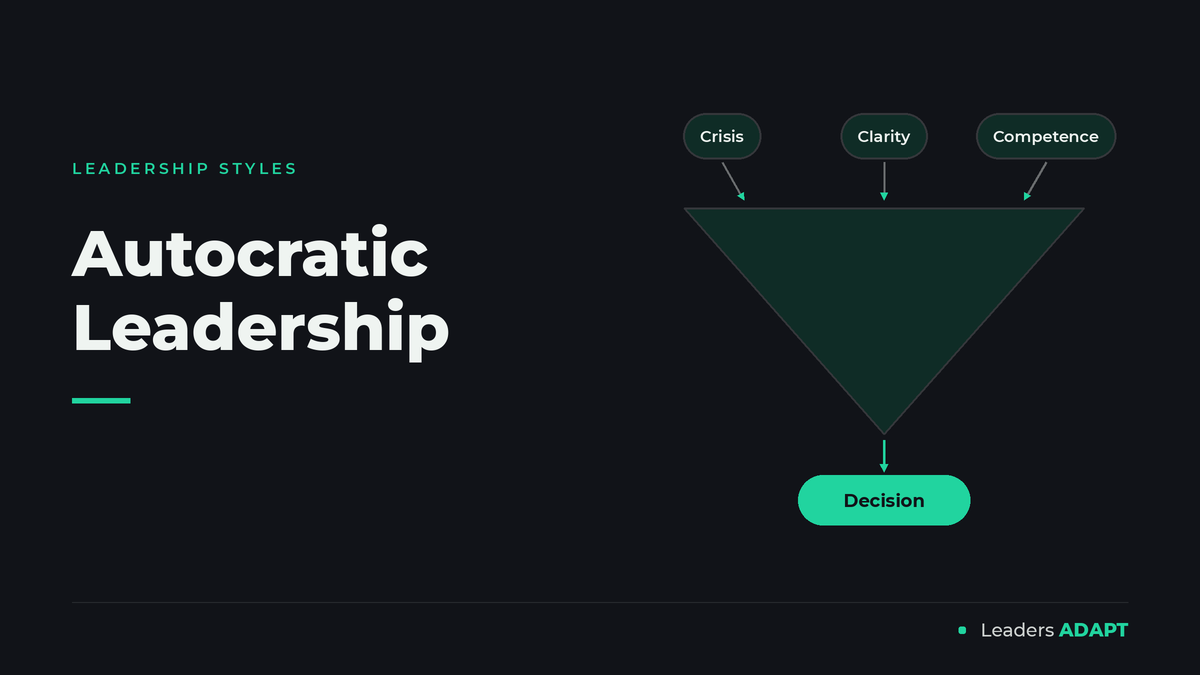
I use a simple filter to decide, and I will give it to you to keep. I call it the Crisis, Clarity, Competence test. Run a decision through three questions before you go directive.
Crisis: is the cost of a slow decision higher than the cost of a wrong one? In a true emergency, a fast adequate call beats a perfect call that arrives too late. If yes, lean directive.
Clarity: do you genuinely have context the team does not? If you can see the whole board and they cannot, taking the decision is leadership, not ego. If they actually know more than you, going directive is just you being loud.
Competence: is the team new, untrained, or in unfamiliar territory? People learning a job need direction, not a blank canvas. A brand-new team usually wants you to be more directive, not less, until they find their feet.
Two or three yeses, and the autocratic leadership style is probably the right call for that decision. Zero or one, and you are about to spend trust you did not need to spend.
Try it on a real example. Your payment system goes down on a Friday afternoon. Crisis, yes. Clarity, yes, you can see the revenue bleeding.
Competence, the team is capable but rattled. Three yeses, so you take command, assign roles, and sort out the feelings on Monday. The test makes the call obvious in about ten seconds.
The point is that it runs per decision, not per personality. You are not an autocratic leader or a democratic one. You are a leader who reads the moment.
When the autocratic leadership style backfires
Now the failure mode, because it is brutal and common.
Apply tight control to experienced people doing creative work and you get three things in order: first compliance, then silence, then departure. Skilled people read control as a message that their judgment is not trusted. They stop offering the idea that would have saved you, because the last three got overruled.
The smartest person on your team becomes the quietest, and you never learn what you lost.
The second failure is dependence. Make every decision and your team learns to bring you every decision. You wanted leverage and you built a queue with yourself at the front of it. Every month you stay in that pattern costs you the two best hours of your day, the hours only you can spend well.
The third failure is the blind spot. One decider means one point of view, which means the mistake nobody was allowed to flag sails straight through. This style removes the friction that catches errors. In a crisis that speed is worth it. On a normal Tuesday it is just risk.
How to stay decisive without going cold
You can keep the speed of directive leadership and lose most of its cost with three small habits.
Decide fast, then explain. Make the call in the moment, and within a day tell the team the why behind it. People will follow a decision they did not get to vote on if they understand the reasoning, and the explanation is what separates respected control from resented control.
Build one channel for dissent. Tell your team you want the one objection nobody is saying out loud, and thank the person who raises it. A single standing question, asked before you commit, catches most of the errors a lone decider would miss.
Timebox the debate. For decisions that are not a true crisis, give the discussion ten minutes, then decide. You get a slice of the input a democratic approach would gather, without surrendering the speed that makes you useful when it counts.
These three habits are also the bridge out of the trap. They keep your directive gear sharp while quietly building the others, which is exactly what range looks like in practice.
If you recognize your own company in any of that, you are not a bad leader. You are using a crisis tool in a non-crisis season, which is the most common mistake I see in founders who scaled past the point their instincts were built for.
Autocratic vs democratic and the other leadership styles
This style is one of several, and the comparison is what makes it useful. A democratic leader pulls the decision into the group and trades speed for buy-in. A coaching leadership style develops the person instead of just directing the task. A servant leader starts from what the team needs to win. At the opposite end of the line Lewin drew sits the laissez-faire leadership style, which hands the decisions over almost entirely.
None of these is the best leadership style in the abstract, and anyone who sells you one as the answer is selling you something.
The real skill is range. The strongest operators I know can run directive in a crisis on Monday and genuinely democratic in a strategy session on Wednesday, and their team trusts both because the style fits the moment.
If you want the full map of the options, start with our guide to the types of leadership styles, then take the leadership style test to see your own default. The goal is not to abandon the autocratic leadership style. It is to stop using it on autopilot.
How to tell if the autocratic leadership style is your default
Most leaders cannot accurately name their own style. They describe the leader they intend to be, not the one their team actually experiences on a hard week. The gap between those two is where careers stall.
Picture your last five real decisions. Not the calm ones, the messy ones. How many did you open for genuine input, and how many did you just make and announce?
If the honest answer leans hard toward make-and-announce, control is your default, and the question is whether that is a choice you are making or a reflex you have never examined.
You do not have to guess. We built a free assessment that shows you your real pattern in about five minutes, which is the fastest way I know to see yourself the way your team sees you.
Frequently asked questions about the autocratic leadership style
What is the autocratic leadership style in simple terms?
The autocratic leadership style is when one leader makes the decisions and the team carries them out, with little or no group input. The leader controls both the goal and the method. It is built for speed and clarity, which makes it strong in a crisis and weak for everyday creative work with experienced people who need a voice.
Is the autocratic leadership style ever good?
Yes. It is the right call in genuine emergencies, in safety-critical work like surgery or aviation, and with brand-new or untrained teams that need clear direction. The problem is not the style itself, it is using it in calm, complex situations where experienced people should be heard. Matched to the right moment, it is the most effective option available.
What is an example of an autocratic leader?
Steve Jobs is the most cited example, making product decisions by personal conviction rather than consensus. Emergency settings supply cleaner ones, like a pilot or an incident commander who directs without debate. In business, any founder who personally approves every decision is running a directive, control-first style: helpful early and limiting at scale.
What is the difference between autocratic and authoritarian leadership?
Autocratic leadership is about control of decisions and can be situational and healthy. The authoritarian leadership style usually adds demanding obedience for its own sake, which tends to create fear rather than performance. Autocratic can be a tool you pick up and put down, while authoritarian is a posture that rarely serves the team.
What kind of work suits the autocratic leadership style?
Repetitive, safety-critical, time-pressured, or low-experience work suits it best: manufacturing lines, emergency response, military operations, and onboarding of new staff. Creative, strategic, or expert work is the worst fit, because that is where suppressing input costs you the most. Match the style to the task, not to your mood.
How do I move away from a purely directive style?
Start with one recurring decision and hand it to the team with clear boundaries, then resist taking it back. Ask for one dissenting view in your next meeting before you give your own. The aim is range, not a total switch, so you keep the directive gear for the moments that need it while building the others.
The bottom line
Control is not the enemy. Control on autopilot is. The autocratic leadership style is the right tool for a crisis, a safety-critical task, or a green team, and the wrong tool for skilled people doing work that needs their brains.
The leaders who win do not pick a side in the styles debate. They can tell, in the moment, which gear the situation is asking for, and they have the range to shift. That self-awareness is the whole job.
See your real leadership style in 5 minutes
If this hit close to home, find out where you actually sit before your next hard week. The free 5 Minute Leader Leadership Style assessment shows you your default style, how your team likely experiences it, and the exact situations where the autocratic leadership style helps you or hurts you.
It takes about five minutes, gives instant results, and asks for no credit card. You get your dominant style, the blind spots that travel with it, and the one shift that leaders with your pattern say changed how their team shows up. Most people are surprised by which style actually runs the room when the pressure is on.
Take the free Leadership Style assessment and lead the next crisis on purpose, not on reflex.