
The phrase sounds soft. Servant leadership. It brings to mind a leader who says yes to everything, protects everyone’s feelings, and never makes anyone uncomfortable. That version of the servant leadership style is not the real thing. That version is a doormat with a title.
Real servant leadership is one of the most demanding styles there is, because it asks you to put your team’s success ahead of your ego while still holding them to a high bar. I have watched it build teams that would run through walls, and I have watched a weak imitation of it quietly sink a company because the founder confused serving people with sparing them.
This guide covers what the servant leadership style actually is, the principles behind it, where it wins, and the exact line where it goes wrong. From someone who has both used it and misused it.
Leaders ADAPT on servant leadership style: The servant leadership style is an approach where the leader’s main job is to serve the team: to develop people, remove obstacles, and put their growth and success first. It builds loyalty, engagement, and strong long-term results, but it fails when serving becomes avoiding the hard decisions that leadership requires.
What is the servant leadership style?
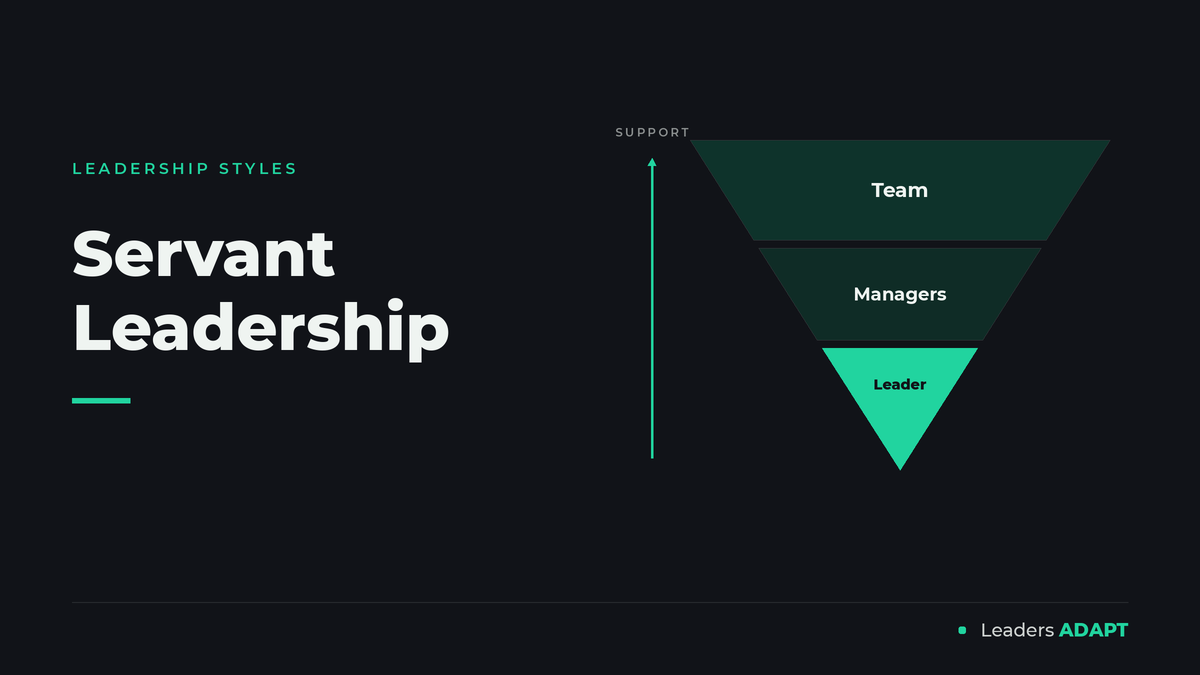
The servant leadership style flips the usual picture of leadership upside down. Instead of the team existing to serve the leader’s goals, the leader exists to serve the team’s ability to do great work. You lead by making other people more capable, not by making yourself more important.
Robert Greenleaf coined the term in his 1970 essay The Servant as Leader. His test was simple and still cuts deep: do the people you serve grow as people? Do they become healthier, wiser, more autonomous, more likely themselves to serve? If the answer is no, you are not doing it, whatever you call yourself.
The servant leadership style is not about being nice. It is about being useful to your people in the ways that actually help them win, which sometimes means support and sometimes means a hard truth they did not want to hear.
The core principles of servant leadership
The servant leadership style rests on a handful of principles that show up again and again in the research and in practice.
Listening first. The servant leader treats understanding as the job before deciding. They ask and absorb before they direct.
Empathy without excuse-making. They genuinely understand where people are, and they still hold the standard. Those two things are not in conflict.
Removing obstacles. A large part of the role is clearing the path: the blocker, the unclear priority, the missing resource. The leader’s calendar fills with unblocking, not controlling.
Developing people. The servant leader measures success by who their people become, not by how indispensable the leader stays.
Stewardship. They hold the mission and the team in trust, making decisions for the long-term health of both rather than their own short-term comfort or credit.
If you have ever worked for someone who made you better and expected more of you at the same time, you have felt this style done right. It is rarer and harder than the soft version people imagine.
Servant leadership style examples
Examples make the style concrete.
Herb Kelleher at Southwest Airlines is the classic business case. He built a company culture around serving employees first, on the theory that people who feel cared for take better care of customers, and the results held up for decades.
The military, of all places, teaches a sharp version. The best officers eat last, literally, after their soldiers, and they carry responsibility for the people under them before their own advancement. That is servant leadership with real stakes.
Here is one from my own experience. A leader on my team had a report who was struggling, and instead of managing the person out quietly, she spent a month clearing the specific obstacles in the way, then held a direct conversation about the bar that still was not being met. The person turned it around. Serving them did not mean lowering the standard. It meant removing what was blocking them from reaching it.
Pros and cons of the servant leadership style
Every style is a trade. Here is the honest ledger for the servant leadership style.
| Strengths | Weaknesses |
|---|---|
| Builds deep loyalty and trust | Slower to produce results early |
| High engagement and retention | Can be mistaken for weakness |
| Develops capable, autonomous people | Risks avoiding hard decisions |
| Strong long-term culture | Demands emotional maturity from the leader |
| People do their best work | Fails if the leader has no standards |
Read the table as one line: the servant leadership style pays enormous dividends in loyalty and capability over time, and it demands a leader secure enough to serve without needing the credit. Its whole risk lives in one place: mistaking kindness for the absence of accountability.
When the servant leadership style works best
The style shines under specific conditions.
Use it with skilled, motivated people. Serving a team that wants to do great work multiplies them. The support meets real drive and compounds.
Use it when you are building for the long term. Servant leadership is an investment in culture and capability that pays off over years, not weeks, so it fits when you are building something durable.
Use it when retention and trust matter most. Teams led this way stay, and they bring their whole effort, which is decisive in work that depends on discretionary energy.
Be careful in a turnaround crisis where speed and hard cuts are the job of the hour. You can still lead as a servant in spirit, but the moment may call for the directness of an autocratic leadership style first, with the serving expressed through protecting the people who remain.
The line: serving vs avoiding
This is the section that matters most, because this is where the servant leadership style goes wrong.
Serving your team means removing what blocks them from doing great work. It does not mean removing the expectation that they do great work. Those are opposites, and weak leaders blur them constantly.
Here is the tell. When someone on your team is underperforming, a servant leader asks what is getting in the way and then, if the obstacle is cleared and the bar still is not met, has the hard conversation. A leader hiding behind the word servant asks what is getting in the way and then uses the answer as a permanent excuse to avoid the conversation.
The first builds a strong team. The second builds a comfortable one that slowly loses its best people, because your top performers will not stay on a team where the standard is optional. Serving people includes telling them the truth. Radical candor is a servant act, not a violation of one.
I have made this mistake myself. Early on I confused being liked with being trusted, and I let a talented but coasting manager slide for two quarters because confronting it felt unkind. My best engineer quit over it. On her way out she told me that watching the standard slip was worse than any hard conversation would have been, and she was right. Sparing one person’s discomfort often costs you the people you most wanted to keep, which is the opposite of service.
If you lead this way and your team is happy but not improving, you have probably drifted from serving into sparing. The fix is not to become harsh. It is to add the accountability back to the care.
How to practice servant leadership this week
You do not adopt the servant leadership style with a mission statement. You adopt it in small, repeatable acts. Here are four you can run this week.
Ask each report one unblocking question. In your next one-on-one, ask what is slowing them down that you could clear, then actually clear one thing before the next meeting. Nothing signals serving faster than a removed obstacle.
Speak last in one meeting. When the leader gives their view first, the room calibrates to it and the real thinking stops. Holding your opinion until the end is a small act of service that changes what you learn.
Give the credit away. When something your team did goes well, name them, not yourself, in the room that matters. Servant leaders bank trust every time they hand credit down.
Have the conversation you have been avoiding. Find the one person you have been sparing instead of serving, and give them the honest feedback plus the support to act on it. That single conversation is servant leadership in its truest form, and it is the one most leaders skip.
None of these takes budget or a title change. They take the security to put your people’s growth ahead of your comfort, which is the whole style in miniature.
Does servant leadership actually drive results?
The skeptic’s question is fair: does serving people make money, or just make everyone feel good? The honest answer is that it drives results, but on a delay.
The logic is not complicated. People give discretionary effort, the extra energy no job description can demand, to leaders who invest in them. Herb Kelleher built decades of Southwest performance on the idea that employees treated well treat customers well, and the Gallup Q12 meta-analysis, the largest engagement study of its kind at more than 180,000 teams, consistently ties higher engagement to lower turnover and higher productivity.
The delay is the catch. This style does not spike this quarter’s numbers the way a directive push can. It compounds. The loyalty, the retention, and the people who grow into roles you would otherwise hire for all show up over years, not weeks.
So the style is not a soft alternative to performance. It is a long-term performance strategy that happens to also be humane. If you need a number this month, reach for a different gear. If you are building something that lasts, this is how you keep the people who build it.
Servant vs the other leadership styles
The servant leadership style is one of several, and the contrast sharpens it. An autocratic leader directs from the top. A democratic leader shares the decision. A coaching leadership style develops the individual through questions, which overlaps heavily with servant leadership and pairs with it naturally. A collaborative leadership style shares ownership across teams the leader does not control, which is where serving stops being enough and a named decider matters.
None of these is the single best leadership style, and treating servant leadership as morally superior is its own trap. It is a tool with a job, not a badge of virtue. Serving the team answers how you lead; the visionary leadership style answers where you are leading them, and strong leaders need both.
For the full map, start with our guide to the types of leadership styles, then take the leadership style test to see your own default. The goal is range: serve by default, and keep the directness for the moments that need it.
Is the servant leadership style your default?
Most leaders who admire servant leadership assume they practice it. The honest test is Greenleaf’s: are the people around you actually growing, and do you still hold them to a real standard?
Think about your team. Are your best people getting stronger and more autonomous under you, or just more comfortable? Have you had a hard, caring conversation recently, or have you been avoiding one in the name of being supportive?
The answers tell you whether you are serving or sparing. You do not have to guess about your default. We built a free assessment that shows you your real pattern in about five minutes.
Frequently asked questions about the servant leadership style
What is the servant leadership style in simple terms?
The servant leadership style is an approach where the leader’s primary job is to serve the team: to develop people, clear obstacles, and put their growth and success ahead of the leader’s ego. Coined by Robert Greenleaf in 1970, its test is whether the people you lead grow more capable and autonomous. It is demanding, not soft, because it pairs real support with a high standard.
What are the principles of servant leadership?
The core principles include listening first, empathy without lowering the bar, removing obstacles for the team, developing people so they become more capable and autonomous, and stewardship of the mission and the team over the long term. Greenleaf’s underlying test ties them together: the people you serve should grow as people, becoming wiser, healthier, and more likely to serve others themselves.
What is an example of a servant leader?
Herb Kelleher at Southwest Airlines built a company by serving employees first, on the logic that cared-for people care better for customers. In the military, strong officers eat after their soldiers and carry responsibility for their people before their own advancement. In business, any leader who clears a struggling employee’s obstacles and then still holds the standard is practicing servant leadership.
What are the disadvantages of the servant leadership style?
It is slower to show results early, it can be mistaken for weakness, and it demands real emotional maturity from the leader. Its biggest risk is drifting into avoiding hard decisions, where serving becomes sparing and the standard quietly disappears. Without accountability underneath it, the style produces a comfortable team that loses its best performers over time.
Is servant leadership effective?
Yes, when it is done fully. Served well, teams show high loyalty, engagement, retention, and strong long-term performance, because people do their best work for a leader who invests in them. It is less effective in a fast crisis that demands immediate directive action, and it fails entirely when a leader uses the label to justify having no standards.
How is servant leadership different from coaching leadership?
The two overlap and pair well. Coaching leadership focuses on developing the individual through feedback and the prompts you ask in the flow of work. Servant leadership is broader: it puts the whole team’s success and growth first, including clearing obstacles and stewarding the mission. A coaching approach is often one of the main tools a servant leader uses to develop their people.
The bottom line
The servant leadership style is not the soft option. It is the demanding work of putting your team’s success ahead of your ego while still holding a high bar, and it builds the most loyal, capable teams there are when you get it right.
The whole discipline lives on one line: serve your people by clearing their path and telling them the truth, never by lowering the standard. Hold that line, and this becomes the style people follow for years.
See your real leadership style in 5 minutes
If you lead this way, or think you do, find out whether you are serving or quietly sparing. The free 5 Minute Leader Leadership Style assessment shows you your default style, how your team experiences it, and whether the servant leadership style is a genuine strength or a comfortable blind spot.
It takes about five minutes, gives instant results, and asks for no credit card. You get your dominant style, the blind spots that come with it, and the one shift leaders with your pattern most often say changed how their team shows up.
Take the free Leadership Style assessment and lead your team on purpose.