
You have been in the meeting. Someone smart runs it, wants everyone’s input, and asks the room what it thinks. An hour later you have twelve opinions, three action items nobody owns, and a decision that got pushed to next week. That is the democratic leadership style with the brakes left on.
It is also, done right, the style behind some of the best decisions I have ever watched a team make. The difference between those two outcomes is not the style. It is whether the leader knew what they were doing with it.
I ran a company where getting this wrong cost me weeks and getting it right won me a team that would run through walls. This guide covers what the democratic leadership style actually is, where it shines, where it fails, and how to use it without drowning in your own meetings.
Leaders ADAPT on democratic leadership style: The democratic leadership style is an approach where the leader makes decisions with input from the team rather than alone. It raises buy-in, surfaces better ideas, and lifts engagement, but it is slower than directive leadership and can stall when speed matters. It works best for complex, high-stakes decisions where the team’s commitment matters.
What is the democratic leadership style?
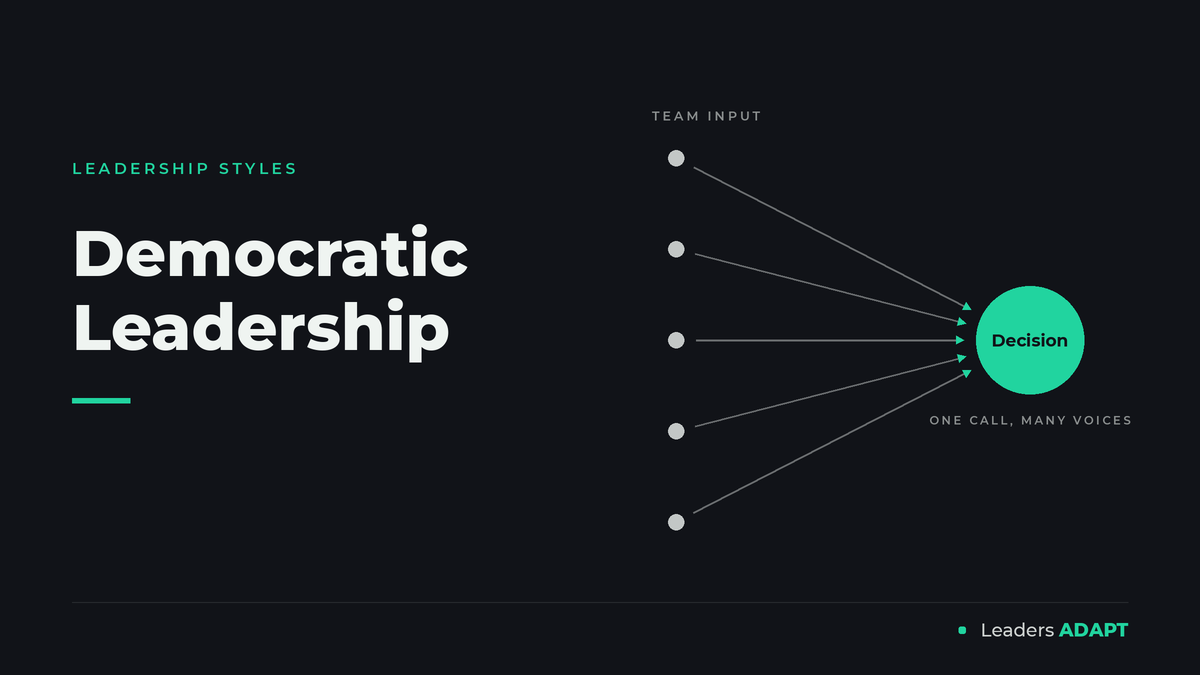
The democratic leadership style, sometimes called participative leadership, is a way of leading where the leader invites the team into the decision. You gather input, weigh it openly, and often let the group shape the final call. The leader still owns the outcome, but the thinking is shared.
Kurt Lewin named this pattern in his 1939 research, setting it against the autocratic and laissez-faire styles. In his studies, groups under democratic leadership were more motivated and produced higher-quality work than autocratic groups, even when they were a little slower.
The key word is participative, not permissive. A democratic leader is not avoiding the decision or hiding in consensus. They are deliberately using the team’s intelligence to make a better call, then making it.
Characteristics of a democratic leader
You can spot the democratic leadership style by a few clear behaviors.
The leader asks before deciding. Input is gathered on purpose, not as a courtesy, and it genuinely shapes the outcome.
Information is shared openly. People cannot contribute to a decision they do not understand, so a democratic leader over-explains context rather than hoarding it.
Debate is welcomed. Disagreement is treated as useful data, and the leader protects the quieter voices so the loudest person does not win by volume.
The decision still gets made. This is the part weak imitators miss. After the input, the democratic leader closes the loop and commits, rather than letting the discussion run forever.
If you have ever left a meeting feeling both heard and clear on the decision, you were probably watching this style done well. That combination is rarer than it should be.
Democratic leadership style examples
Real examples make the style concrete.
Modern tech companies lean on it heavily. Google’s long habit of gathering data and input across teams before major product calls is democratic leadership at scale, and it produced both better products and the occasional painful delay.
Sports has clean versions too. Coaches who involve senior players in setting team standards get more buy-in than coaches who dictate them, because people defend what they helped build.
Here is a business scene you may recognize. A founder facing a hard pricing decision brings the three people closest to customers into the room, lays out the full picture, and lets the debate run for a focused forty minutes before deciding. The call is better for the input, and the team executes hard because they helped shape it. That is the democratic approach earning its keep.
Pros and cons of the democratic leadership style
Every style is a trade. Here is the honest ledger.
| Strengths | Weaknesses |
|---|---|
| Better decisions from diverse input | Slower than deciding alone |
| High buy-in and ownership | Can stall into decision paralysis |
| Lifts engagement and morale | Struggles in a fast-moving crisis |
| Surfaces risks the leader missed | Can drift toward design by committee |
| Develops the team’s judgment | Frustrates people who want a clear call |
Read the table as one line: the democratic approach buys you better decisions and real commitment, and it pays for them in time. When the decision is big and reversible-only-at-cost, that is a bargain. When the building is on fire, it is a luxury you cannot afford.
When the democratic leadership style works best
The style shines under specific conditions, and naming them keeps you from using it in the wrong moment.
Use it for complex, high-stakes decisions. When the call has many moving parts and no obvious answer, more good minds genuinely produce a better outcome.
Use it when buy-in matters as much as the decision. A merely good plan the team owns often beats a perfect plan they resent. Change efforts live or die on this.
Use it when you have capable people close to the problem. Their input is only valuable if they know things you do not, which is usually the case if you hired well.
Skip it in a genuine crisis. When speed is everything, switch to a directive gear, the way an autocratic leadership style does by design, and return to participation once the fire is out.
How to run democratic leadership without the stall
This style fails most often not because it is wrong, but because it is run loosely. Three habits keep it sharp.
Set the decision rule up front. Tell the room whether this is a vote, a consultation where you decide, or a true consensus. Most stalls come from people thinking they had a vote when you meant to gather input.
Timebox the input. Give the debate a real limit, forty minutes, one meeting, whatever fits, and hold it. Open-ended discussion is where good participation goes to die.
Close the loop out loud. State the decision, name who owns what, and thank the people whose input changed your mind. That last part is what makes people keep bringing you their best thinking.
Do these three and you keep the upside of the style, the better call and the ownership, without paying the paralysis tax.
A democratic decision, start to finish
Here is what the style looks like run with discipline, using a decision most founders face: whether to raise prices.
You open by naming the decision rule. You tell the room this is a consultation, not a vote, and that you will make the final call by Friday. Nobody leaves confused about how the decision gets made.
You share the full picture. Margins, churn, what customers have said, what competitors charge. People cannot give useful input on a decision they only half understand, so you front-load the context.
You run the debate inside a timebox. Forty focused minutes. Your head of sales argues against the increase, your finance lead argues for it, and a support rep raises a customer segment you had not considered.
You decide and close the loop. You raise prices, but you carve out the segment the support rep flagged, and you say plainly that their point changed your mind. Then you name who owns the rollout and by when.
The whole thing took one meeting. You got a better decision than you would have made alone, and the team executes hard because they helped build it. That is participative leadership doing exactly what it is for.
When the democratic leadership style backfires
The failure modes are worth naming plainly.
The first is decision paralysis. Endless input, no decision, and a team that slowly learns nothing gets decided here. This is the most common way the style rots.
The second is false democracy. You ask for input, then do exactly what you were always going to do. People notice within about two meetings, and it costs you more trust than if you had just decided alone.
The third is design by committee. Every voice gets equal weight regardless of expertise, and the result is a watered-down compromise that satisfies no one. Democratic does not mean every opinion counts the same. It means the right people are heard.
If your meetings feel busy but nothing ships, you are probably running the style without the discipline that makes it work. The fix is the three habits above, not abandoning the style.
Democratic leadership in a remote and hybrid team
Remote work makes participation harder and more important at the same time. The hallway conversations where input used to happen are gone, so if you do not build participation on purpose, you drift directive by default without meaning to.
Two adjustments keep the style alive across a screen. First, gather input asynchronously before the meeting, not just during it. A shared doc where people add their thinking ahead of time beats a video call where the same three extroverts talk, because it gives the quieter and the differently-timezoned an equal shot.
Second, make the close of the loop visible in writing. In an office, people absorb a decision by osmosis. Remotely they do not, so the decision, the owner, and the reasoning have to be written down where everyone can see them.
Get those two right and a distributed team can be more genuinely participative than a co-located one, because the input is captured rather than lost to whoever spoke loudest in the room. Get them wrong and remote quietly erodes the style until you are deciding alone and calling it collaboration.
Democratic vs autocratic and the other leadership styles
The democratic leadership style is one of several, and the contrast is what makes it useful. An autocratic leader decides alone and moves fast. A coaching leadership style develops the individual rather than polling the group. A servant leader starts from what the team needs to succeed. Push participation one step further and you reach the laissez-faire style, where the group decides without the leader in the room at all.
None of these is the single best leadership style, and treating one as the answer is the mistake. The strongest leaders run democratic on the big, complex calls and switch to directive when the clock is the constraint.
For the full map, start with our guide to the types of leadership styles, then take the leadership style test to see your own default. The goal is range, not loyalty to participation for its own sake.
Is the democratic leadership style your default?
Most leaders believe they are more democratic than their team would say. The honest measure is not whether you value input, it is whether input actually changes your decisions.
Think about your last five real calls. How many did you genuinely open to the team, and how many did you decide first and socialize after? The gap between those two numbers is the gap between the leader you think you are and the one your team experiences.
There is a simple tell. Watch what happens when someone disagrees with you in a meeting. If the room tenses and people glance at you to gauge your reaction, you are more directive than you think, whatever your intentions. If the disagreement just continues as normal conversation, you have built the safety this style needs.
Your calendar is another tell. Genuinely participative leaders leave room for input before decisions, so their week holds thinking meetings, not just announcing ones. If every meeting exists to inform people of calls already made, the style is an aspiration, not a practice.
You do not have to guess. We built a free assessment that shows you your real default in about five minutes.
Frequently asked questions about the democratic leadership style
What is the democratic leadership style in simple terms?
The democratic leadership style is when a leader makes decisions with input from the team rather than alone. You gather perspectives, weigh them openly, and often let the group shape the call, though the leader still owns the outcome. It raises buy-in and decision quality, at the cost of speed, which is why it fits complex decisions better than fast-moving crises.
What is an example of a democratic leader?
Leaders at data-driven tech companies who gather cross-team input before major product decisions are practicing democratic leadership. A sports coach who involves senior players in setting team standards is another example. In business, a founder who brings the people closest to the customer into a pricing decision, then decides with their input, is using the style well.
What are the pros and cons of the democratic leadership style?
The pros are better decisions from diverse input, strong buy-in, higher engagement, and a team whose judgment improves over time. The cons are that it is slower than deciding alone, it can stall into decision paralysis, it struggles in a crisis, and it can drift into design by committee if every voice is weighted equally regardless of expertise.
When should a leader use a democratic style?
Use it for complex, high-stakes decisions where diverse input improves the outcome and where buy-in matters as much as the call itself, such as change initiatives. Use it when capable people are close to the problem. Avoid it in genuine emergencies that demand speed, where a directive style serves the team better until the pressure passes.
What is the difference between democratic and autocratic leadership?
Autocratic leadership means the leader decides alone and the team executes, which is fast and clear but can silence good ideas. Democratic leadership brings the team into the decision, which is slower but produces more buy-in and often better calls. Neither is universally better. The skill is matching the style to the stakes and the speed the moment requires.
Is democratic leadership the same as participative leadership?
They are essentially the same style under two names. Participative leadership emphasizes that the team takes part in the decision, while democratic leadership emphasizes shared input and, sometimes, a vote. In practice both describe a leader who gathers and genuinely uses the team’s input before committing to a decision they still own.
The bottom line
The democratic leadership style is one of your most powerful gears and one of the easiest to run badly. Used with discipline, a clear decision rule, a timebox, and a real close, it produces better decisions and a team that owns them. Used loosely, it becomes the meeting that never ends.
Know when the moment calls for participation and when it calls for a fast, directive call. That judgment is the actual skill, and it starts with knowing your own default.
See your real leadership style in 5 minutes
If you are not sure whether you run democratic by design or by habit, find out. The free 5 Minute Leader Leadership Style assessment shows you your default style, how your team experiences it, and where the democratic leadership style helps you or slows you down.
It takes about five minutes, gives instant results, and asks for no credit card. You get your dominant style, the blind spots that come with it, and the one shift leaders with your pattern most often say changed how their team shows up.
Take the free Leadership Style assessment and lead your next big decision on purpose.