
Every leader has a default. Under pressure, on a bad Tuesday, when the decision cannot wait, you fall back to one way of leading without thinking about it. That default is your dominant style, and until you can name it, you cannot choose anything else.
I spent years not knowing mine. I ran a company to 150 people leading on instinct, and my instinct was right often enough that I never questioned it, until the moments it was badly wrong and cost me people I wanted to keep. Learning the types of leadership styles was what finally gave me a choice in the moment instead of a reflex.
This guide walks through the main types of leadership styles, where they come from, when each one works, and when it quietly costs you. No jargon, no personality-label trivia. Just the map, from someone who has used most of these styles in real rooms with real stakes.
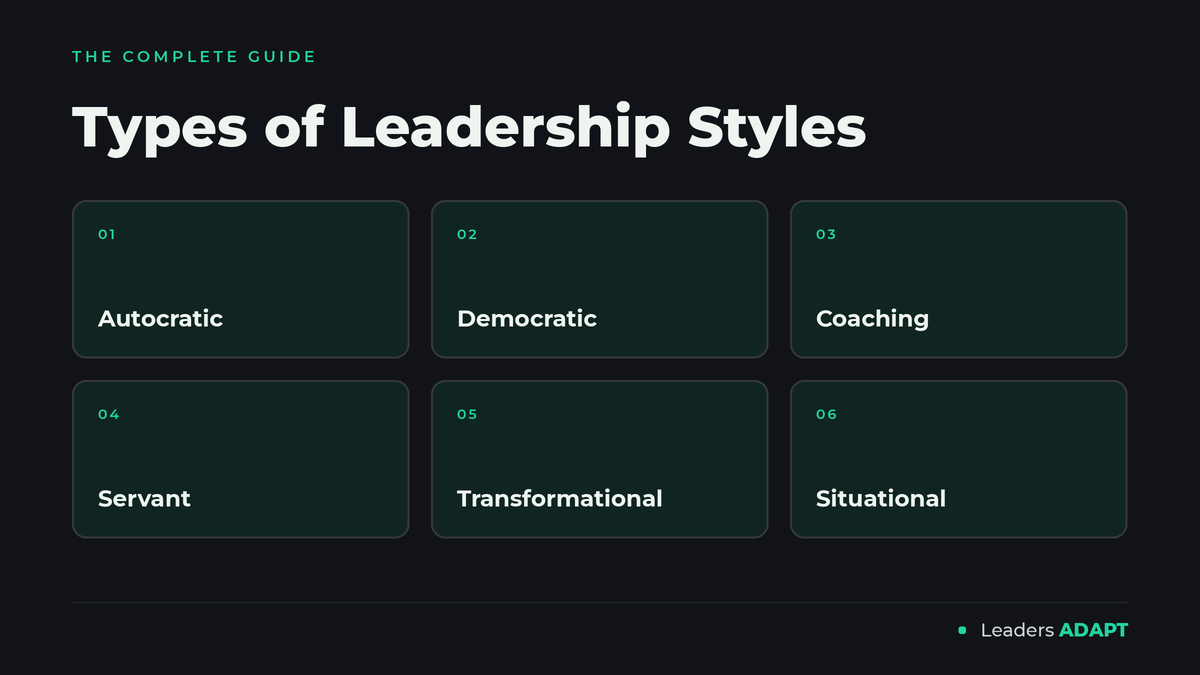
Leaders ADAPT on types of leadership styles: The main types of leadership styles are autocratic, democratic, transformational, servant, coaching, laissez-faire, transactional, visionary, bureaucratic, and situational. Five more appear in longer lists: affiliative, pacesetting, participative, collaborative, and delegating. No single style is best. Strong leaders match the style to the moment and can shift between them, which is the skill a leadership style quiz or the leadership style test can help you see.
What is a leadership style?
A leadership style is the pattern of how a leader makes decisions, communicates, and treats the team; it is behavior, not personality. That difference matters, because behavior can change once you can see it, while personality mostly cannot.
It helps to separate style from type. Your type is how you are wired underneath, the Visionary or Executor in you, and it is fairly fixed. Your style is how you show up, and it should flex with the situation. When people search the types of leadership styles, they are usually asking a practical question: how do I lead, and is it working?
The honest answer is that most leaders use two or three styles by habit and never touch the rest. Widening that range is where the growth is.
Where the leadership styles come from
The types of leadership styles are not one neat model. They come from decades of research stacked on top of each other, and knowing the sources keeps you from treating any single list as gospel.
Kurt Lewin, in 1939, ran the original study and named three climates: autocratic, democratic, and laissez-faire. That is still the backbone.
Later work added more. Bernard Bass developed transformational and transactional leadership. Robert Greenleaf named servant leadership in his 1970 essay The Servant as Leader. Daniel Goleman, drawing on emotional intelligence research in his Harvard Business Review study Leadership That Gets Results, described six styles including coaching, visionary, and pacesetting. The pacesetting leadership style, leading by example and expecting everyone to match your pace, is the one founders slip into without ever choosing it. Paul Hersey and Ken Blanchard built situational leadership, which argues you should switch styles based on how ready your team is.
Put together, these give the ten types of leadership styles most people mean today. Here they are at a glance, then one by one.
The main types of leadership styles at a glance
| Style | Core move | Works best when | Main risk |
|---|---|---|---|
| Autocratic | Leader decides, team executes | Crisis, safety-critical, new teams | Kills input and motivation |
| Democratic | Decisions made with the group | Complex calls needing buy-in | Slow, can stall |
| Transformational | Inspire through vision | Change, turnarounds | Vision with no execution |
| Servant | Serve and unblock the team | Skilled, mission-driven teams | Can dodge hard calls |
| Coaching | Develop people through questions | Capable people with room to grow | Slow, wrong for a crisis |
| Laissez-faire | Hands off, high autonomy | Expert, self-directed teams | Becomes absence |
| Transactional | Clear rewards and consequences | Repeatable, target-driven work | No loyalty or creativity |
| Visionary | Point to a compelling future | Early stage, need for direction | Ignores present detail |
| Bureaucratic | Follow rules and process | Compliance, high-risk fields | Rigid, slow to adapt |
| Situational | Switch styles by readiness | Mixed teams and stages | Demands high self-awareness |
| Affiliative | Build bonds and belonging first | Healing a team after conflict or layoffs | Harmony replaces standards |
| Pacesetting | Lead by example, expect the same pace | Short sprints with a skilled team | Burns the team out |
| Participative | Collect input, then decide | Complex calls where the team holds the expertise | Input mistaken for a vote |
| Collaborative | Share ownership across teams | Cross-functional work, partnerships | Nobody named to decide |
| Delegating | Hand over the outcome, verify on schedule | Proven, committed people | Delegating before readiness |
The 10 types of leadership styles, one by one
Autocratic leadership
The autocratic leader makes the call and the team carries it out. It has a bad reputation, and it earns that reputation when it is overused, but in a genuine crisis or with a brand-new team, directive leadership is the correct tool.
Think of a surgeon running a code or a pilot aborting a landing. Nobody takes a vote. Use it when speed matters more than input and when the team is still learning. Avoid it with skilled people doing creative work, where it silences the ideas you needed most. The full breakdown is in the autocratic leadership style guide.
Democratic leadership
The democratic leader pulls the decision into the group and leads by consensus. You trade speed for buy-in, which is a strong trade for complex, high-stakes calls and a poor one when the building is on fire.
Its failure mode is decision paralysis: endless input and no decision. Use it when the quality of the call depends on many perspectives and when you need the team to own the outcome. Avoid it in emergencies. The democratic leadership style guide covers when the trade is worth making.
Transformational leadership
The transformational leader moves people through vision and meaning. It is the style behind most real turnarounds, because it changes what people believe is possible. Satya Nadella’s rebuild of Microsoft is the textbook case.
The risk is inspiration with no system underneath it, which burns people out chasing a future that never gets operationalized. Use it to drive change and lift ambition. Pair it with an executor who makes the vision real, or it stays a speech. The transformational leadership style guide shows what that pairing looks like in practice.
Servant leadership
The servant leader starts from what the team needs to win and removes the obstacles in the way. Done well it builds fierce loyalty and strong results, because people do their best work for someone who clears the road for them.
Done poorly it becomes an excuse to avoid the hard decisions leadership requires. Use it with skilled, mission-driven teams. Watch the line where serving turns into abdicating, which the servant leadership style guide covers in detail.
Coaching leadership
The coaching leader develops people by asking rather than telling, building capability so the team needs them less over time. It is the highest-return style for scaling yourself out of the bottleneck.
It is also slow, and it is the wrong tool in an emergency. Use it with capable people who have room to grow and when your real problem is that everything routes through you. The coaching leadership style guide has a framework you can run in your next one-on-one.
Laissez-faire leadership
Laissez-faire means hands off. The leader sets the goal and gets out of the way. With a team of experts who want autonomy, it produces remarkable work, which is why it shows up in research labs and senior creative teams.
With anyone who needs direction, it curdles into absence, and absence is not leadership. Use it only with self-directed experts. The moment people start guessing what you want, it is the wrong style. It is a scalpel, not a default. Our full guide to the laissez-faire leadership style covers where the line between delegation and abdication actually sits.
Transactional leadership
The transactional leader runs on clear exchanges: hit the target, get the reward; miss it, face the consequence. It is effective for repeatable, measurable work like sales floors and production lines, where the goal is consistent output.
It does not build loyalty or creativity, because people optimize for the metric and nothing more. Use it to drive defined, short-term results. Do not expect it to inspire anyone. It is a floor, not a ceiling. For the honest limits of the transactional leadership style, including where it caps out, we break it down in full.
Visionary leadership
The visionary leader points to a compelling future and rallies people toward it. Goleman found it the most broadly effective of the six styles he studied, because people want to know where they are going.
Its blind spot is the present. The visionary can miss the operational detail that turns the vision into something real. Use it at the early stage or when a team has lost the plot and needs direction. Back it with people who own the execution. Our deep dive on the visionary leadership style shows how to develop it rather than hope you were born with it.
Bureaucratic leadership
The bureaucratic leader leads by rules, roles, and process. In compliance-heavy or high-risk fields like aviation, healthcare, and finance, that rigor keeps people safe and organizations legal.
Outside those settings it slows everything down and punishes the initiative you actually want. Use it where consistency and safety outrank speed. Avoid it anywhere you need people to adapt, because the rulebook cannot cover a moving target.
Situational leadership
Situational leadership is less a style than a meta-skill: read how ready and capable the team is for a given task, then pick the style that fits. A new hire on a new task needs direction. A seasoned expert on familiar work needs room.
It is where all of this is heading, and it demands the self-awareness to know which style you are using and why. Most leaders think they do this already and do not. Our situational leadership styles guide goes deeper for CEOs.
Five more leadership styles you will hear about
Longer lists of the different leadership styles run to twelve or more, and the extra names are not padding. Two come from Goleman's six, two describe how decisions get shared, and one is the fourth style in Hersey and Blanchard's situational model. Each has its own guide on this site.
Affiliative leadership
The affiliative leader puts people and emotional bonds first, building harmony and belonging as the base for performance. It is the style that heals a team after a layoff, a conflict, or a bad quarter, and it is the answer when someone asks which leadership style puts people first.
Its failure mode is harmony becoming the goal: feedback softens, standards drift, and results erode quietly. Use it to rebuild trust, then pair it with explicit expectations. The affiliative leadership style guide covers how to stay people-first without losing the numbers.
Pacesetting leadership
The pacesetting leader leads by example and expects everyone to match their pace and standard. It works in short bursts with a skilled, motivated team that already knows the work.
Run for longer than a sprint it burns the team out, because the standard is never explained, only demonstrated. Founders slip into it without choosing it. The pacesetting leadership style guide shows the early warning signs.
Participative leadership
The participative leader collects input, ideas, and objections from the team before deciding, and then makes the call. It lives inside the democratic family, but the decision stays with the leader, which is what separates it from a vote.
It fails when input is treated as the decision and meetings end by scheduling another meeting. Use it on complex calls where the team holds the expertise and execution depends on buy-in. The participative leadership style guide covers the three forms and how to keep the clock.
Collaborative leadership
The collaborative leader shares ownership of decisions and outcomes across teams, functions, or organizations where nobody reports to anybody. It is the only style available when you have responsibility for a result and no authority over the people who deliver it.
It fails when responsibility is shared and accountability is not. Name a decider before the work starts. The collaborative leadership style guide covers the trust it runs on.
Delegating leadership
The delegating leader hands a proven, committed person ownership of an outcome, agrees how progress will be verified, and stays accountable for the result. It is the fourth style in Situational Leadership, after directing, coaching, and supporting.
It fails when the leader delegates before the person is ready, or hands off the task while keeping every decision. The delegating leadership style guide explains the line between delegating and laissez-faire and the method behind it.
Which leadership styles do the best CEOs use?
After coaching founders and running companies myself, the pattern is consistent. The CEOs who scale well are not devoted to one of the types of leadership styles. They lean on three.
They coach by default, because it is the only style that builds a team that does not need them for everything. They keep visionary leadership close, because someone has to hold the direction when the day to day gets loud. And they keep autocratic leadership in their back pocket for the genuine crisis, used cleanly and then put away.
What they almost never run as a primary mode is transactional or bureaucratic leadership. Those styles manage what already exists. They do not build what is next, and building what is next is the job.
None of this makes the other styles wrong. Servant and democratic leadership earn their place constantly. The point is the mix: a wide range with a deliberate default, not a single setting applied to every person and every problem.
There is no single best leadership style
People want a winner. They want to be told that transformational or servant leadership is the right answer, so they can adopt it and be done. That instinct is exactly the trap.
The research is clear and my own experience backs it: effectiveness comes from range, not from picking one of the types of leadership styles and committing to it forever. In Leadership That Gets Results, a Harvard Business Review study of more than 3,000 executives, Daniel Goleman found the same: the leaders who get the best results do not rely on a single style but use several in any given week. The best leaders I know run autocratic in a crisis on Monday, coaching in a one-on-one on Tuesday, and democratic in a strategy session on Wednesday, and their team trusts all three because each one fits its moment.
The leaders who stall are the ones with one gear. A pure autocrat loses their best people. A pure democrat never ships. A pure servant avoids the hard call. Your default is not your destiny, it is just your starting point.
The leadership styles change as you scale
The style that builds a company is rarely the style that scales it, and this trips up almost every founder.
At five people, autocratic and visionary leadership are gifts. You move fast, you hold the whole picture in your head, and the team runs on your energy. The company works because you are in every decision.
At fifty people, those same styles become the ceiling. Every decision routing through you is now a traffic jam. The visionary who cannot let go starves the business of the coaching and democratic input it needs to grow. The founder bottleneck is almost always a leader running a startup style inside a scale-up company.
The fix is not a personality transplant. It is adding gears. The directive founder learns to coach. The lone visionary learns to build consensus on the calls that need it. Range is what lets you keep leading the company you built as it becomes a bigger one.
How to choose the right leadership style
You do not choose a style for life. You choose it per situation, and two questions make the call most of the time.
First, what does the task need? A crisis needs speed, so lean autocratic. A complex decision with many stakeholders needs buy-in, so lean democratic. Developing a capable person needs patience, so lean coaching.
Second, how ready is the team? A brand-new or shaky team needs more direction. An expert, motivated team needs more room. Match the amount of control to the readiness in front of you, and most of the types of leadership styles slot into place on their own.
The hard part is not knowing this. It is catching yourself in the moment, when your default is screaming at you to do the thing you always do. That catch is a skill, and it starts with knowing your default cold.
Common mistakes when picking a leadership style
Three mistakes show up again and again once people learn the types of leadership styles.
The first is picking a favorite and forcing it everywhere. Someone reads that servant leadership is noble and tries to serve their way through a crisis that needed a fast, directive call. The style was fine. The moment was wrong.
The second is confusing intention with impact. You believe you are democratic because you value input, while your team experiences you as autocratic because you always decide before the meeting ends. Only their experience counts, which is why outside feedback or an honest assessment matters so much.
The third is treating your default as permanent. Your dominant style is a habit, not a life sentence. Every style on this list is learnable, and the leaders who grow fastest deliberately practice the gear they are worst at.
How to find your leadership style
Most leaders cannot name their own style accurately. They describe the leader they intend to be, not the one their team meets on a hard week. The gap between those two is where trust leaks out.
You can close it faster than you think. The point of learning the types of leadership styles is not to memorize ten labels, it is to see the one or two you actually run on, and the ones you avoid.
There are three honest ways to find out. You can ask your team directly, though most will soften the truth to your face. You can track your own decisions and calendar for a week and score yourself, which works only if you are ruthless about it. Or you can take a structured assessment built to surface the pattern without the flattery.
The third is the fastest, and it removes the blind spot the first two quietly depend on. We built a free assessment that shows you your default style in about five minutes, so you can stop guessing and start choosing.
Frequently asked questions about the types of leadership styles
What are the main types of leadership styles?
The most cited types of leadership styles are autocratic, democratic, transformational, servant, coaching, laissez-faire, transactional, visionary, bureaucratic, and situational. They come from decades of research, starting with Kurt Lewin’s three styles in 1939 and expanded by Bass, Greenleaf, Goleman, and others. Most leaders rely on two or three by habit and rarely use the rest.
What is the most effective leadership style?
There is no single most effective style. The research, from Lewin in 1939 to Goleman in Harvard Business Review, and my own practice all show that effectiveness comes from range: matching the style to the situation and the team’s readiness. A visionary or coaching approach works broadly, but even those fail in a crisis that needs fast, directive decisions. The best leaders shift styles deliberately rather than defaulting to one.
How many leadership styles are there?
It depends on the model. Kurt Lewin named three, Daniel Goleman described six, and most modern lists combine the sources into ten or twelve types of leadership styles. The four main types most often cited are autocratic, democratic, laissez-faire, and transformational. Longer lists add affiliative, pacesetting, participative, collaborative, and delegating. The exact count matters less than knowing which patterns you actually use.
Can you have more than one leadership style?
Yes, and the strongest leaders do. Most people have a dominant style they default to under pressure and a secondary style they use when calmer. The goal is to widen that range so you can match the moment, running directive in a crisis and democratic when you need buy-in, rather than forcing one style onto every situation.
How do I find out my leadership style?
The fastest way is a short assessment that measures how you actually behave when leading, not how you intend to. Look for one that maps your default style and how your team likely experiences it, then connects the result to specific changes. A free leadership style quiz can show you your dominant style in about five minutes.
What is the difference between leadership styles and leadership types?
A leadership style is how you behave when you lead, and it can flex by situation. A leadership type is how you are wired underneath, which stays fairly stable. Styles like autocratic or coaching describe your actions, while types like Visionary or Executor describe your instincts. The strongest assessments measure both, because your type shapes which of the leadership styles feel natural and which ones you have to build on purpose.
The bottom line
The types of leadership styles are not a personality quiz to file away. They are a set of gears, and leadership is knowing which one the moment is asking for and having the range to shift into it. The other half of the map is the room: the types of followership your style produces in the people who report to you.
Start by naming your default honestly. Everything else, the flexing, the range, the growth, builds on that one piece of self-knowledge.
Find your leadership style in 5 minutes
You have the map of the styles now. The next step is seeing which one is actually yours. The free 5 Minute Leader Leadership Style assessment shows you your default style, how your team experiences it, and where among the types of leadership styles you most need to build range.
It takes about five minutes, gives instant results, and asks for no credit card. You get your dominant style, the blind spots that come with it, and the one shift leaders with your pattern most often say changed how their team shows up.
Take the free Leadership Style assessment and stop leading on autopilot.