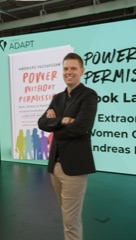
By Andreas Pettersson, Founder, Leaders ADAPT
A mid-size company paid a top consultancy about $500,000 for an AI strategy. Nobody in the building could do anything with it. The same company then paid about $100,000 for basic prompt training, and the invoice folder changed more than the work did.
That's the buying mistake an AI adoption consultant is supposed to prevent, and it's the mistake the wrong one causes.
I've worked with more than 30 companies on AI, and I ran it in production at my own company before ChatGPT existed. Below: what a good AI adoption consultant does for an owner-led company, what the market charges, the red flags, and when to rent an executive instead.
Quick answer: An AI adoption consultant is an outside specialist hired to move a company from experimenting with AI to using it in daily work. The work usually covers finding the workflows where AI saves real hours, running a first pilot, setting the rules for data and security, training the people who own those workflows, and handing the result to an internal owner. Fees run hourly, by project, or on a monthly retainer.
What does an AI adoption consultant do?
AI adoption consulting is project-based outside help that gets AI into a company's real workflows, as opposed to strategy advice that stops at a recommendation.
An AI adoption advisor is an outside expert who helps a leadership team decide where and how to use AI without building or running the work themselves.
The difference matters when you sign. A consultant is accountable for a deliverable, an advisor for advice. Neither is accountable for whether your company still uses any of it next year. That part is yours.
What the good ones do inside a company of 20 to 200 people:
- Sitting with the people who do the work, not the people who describe it, and mapping where the hours go.
- Picking one workflow with a clear before and after number and building the first version fast.
- Writing the one-page governance rules: what data can go where, what needs a human sign-off, what waits.
- Training the owner of that workflow, then getting out of the way.
Notice what's missing: the 60-slide strategy, the roadmap, the tool bake-off. Those fill a consultant's month, not your pipeline.
AI adoption consulting, AI advisory services, or a fractional AI executive?
Three kinds of help, three jobs. The longer comparison is in AI adoption consulting versus a fractional AI executive. The short version:
| Option | What you buy | Who owns the outcome after | Fits when |
|---|---|---|---|
| AI adoption consulting | A scoped build: pilot, integration, training | You, once the project closes | You already know which workflow to fix and have someone inside to run it |
| AI advisory services | Judgment and a sounding board on a retainer | You, throughout | You want to keep every decision but need someone who has done it before |
| Fractional AI executive | A part-time leader inside your leadership team | Shared with the executive until your team can carry it | The gap is ownership at the top, not a missing build |
Owner-led companies usually reach for the first option because it comes with a scope, a price, and an end date. That's fine when the target is already chosen. When it isn't, you're paying a firm to build toward a decision nobody has made.
What an AI adoption consultant should deliver in the first 30 days
Let me be direct. If a consultant's first month produces a document, you've hired a writer.
I've watched what stuck at client companies and what quietly died. The pattern fits in a table.
| Deliverable that decays | Deliverable that compounds |
|---|---|
| A company-wide AI strategy deck | A map of the five workflows where the most hours go, with a number on each |
| A tool comparison | One working automation in one of those workflows, used by the person who owns it |
| A generic AI policy copied from a template | A one-page rule set your team wrote with the consultant: what data goes where, what needs a human, what waits |
| An all-hands training session | Three people trained on the one workflow they run, measured by hours saved |
| A twelve-month roadmap | A named internal owner and the next single bet |
The number on the right-hand side is the whole point. One client organization submits about 200 bids every three months, and each bid took roughly 80 hours. The automation we built together cut that to about 10. Nobody needed a deck to see the value; they needed the first bid to go out.
My rule: "Every time you do change management, you have to start wicked small. Get the wins, convince people it's working, then expand. Big projects are dead instantly."
One more demand for month one: the consultant sits with your finance person, your operations lead, and one front-line employee before recommending anything. At one client of about 70 people, roughly 60 percent of my discovery report had nothing to do with AI. It was a leadership problem wearing an AI costume. A consultant who can't tell the difference will automate the mess.
How much does an AI adoption consultant cost?
Market ranges, not a rate card. According to Leanware's AI consultant cost guide (updated September 2026), independent AI consultants charge about $150 to $350 an hour, boutique AI firms $250 to $450, and strategy firms $350 to $500 and up. Monthly advisory retainers run $2,000 to $15,000 depending on hours. Small AI strategy assessments are priced at $5,000 to $25,000; enterprise-wide programs reach $100,000 to $500,000 and beyond.
For the executive option, the published rates on the fractional Chief AI Officer page put light advisory engagements near $4,000 to $8,000 a month and embedded ones at $15,000 to $30,000.
Price tells you less than the shape of the deal. A $20,000 project that ends with one automation your team runs is cheap. A $500,000 strategy nobody can execute is not.
Red flags when hiring AI adoption consulting
The strategy-only hire. A company of about 200 people spent roughly $400,000 on a senior AI strategy hire, plus the developers that person requested, before a single workflow changed. The fix was a CEO-level decision map: which decisions AI could support, which stayed human, and who owned each.
The lockdown policy. A regulated firm blocked AI tools over security and audit fears while leaving riskier things wide open, after employees had already automated roughly 80 percent of their own work. Restricting instead of enabling isn't a policy, it's the absence of one. The question I put to boards is a slider: security on one end, productivity on the other, and where do you draw the line?
The template rollout. "I'm not a person who sells you cookie cutter ready-made stuff, because every IT company does that, and it ends up in one department and no one uses it after six months." If the proposal could go to your competitor with the logo swapped, it will.
The consultant who never ran anything. "They have no credibility because they haven't run a company that actually implemented it. They learned it online." Ask what they shipped, where, and what broke.
The technology framing. "AI is a culture change; it's not a technology change." A consultant who talks only about models and integrations will hand your rollout to IT, and IT will do what it's built to do: contain it. AI strategy for CEOs explains why that delegation fails even when IT is excellent.
How to screen an AI adoption consultant for an owner-led company
Five questions. Listen for specifics.
- Which workflow would you fix first here, and what number would prove it? A good answer names something from your business, not theirs.
- What did you build at the last company, and is anyone still using it? Silence after the first half is the answer.
- Who inside my company will own this when you leave? If they haven't asked to meet that person, they don't plan to leave anything behind.
- Where would you tell me not to use AI yet? The restraint list is where experience shows.
- What happens in the first two weeks? You want to hear about sitting with your people and building something small, not a discovery phase that ends in a presentation.
And a screen for yourself: never hire an advisor where you feel you have the upper hand. If you can out-argue them in the first meeting, they can't move you.
Is your company ready for an AI adoption consultant?
Three conditions, and you need all three. You can name one workflow that eats hours. Your data for it is clean enough that a first version won't embarrass you. And someone inside the company, not you, will own the result.
If you can't name the workflow, take the free AI readiness assessment before you spend anything. If you can name it but nobody inside can own it, the gap isn't a consultant. It's an executive, and the honest move is to rent one for a while rather than buy a project that dies on delivery.
Frequently asked questions about hiring an AI adoption consultant
What does an AI adoption consultant do?
An AI adoption consultant helps a company move from experimenting with AI to using it in everyday work. Typical tasks include mapping workflows to find where AI saves time, running a first pilot with a measurable result, setting rules for data use and human review, training the employees who own those workflows, and handing the work to an internal owner.
What is the difference between an AI adoption consultant and an AI adoption advisor?
An AI adoption consultant delivers scoped work: a pilot, an integration, a training program, usually priced as a project. An AI adoption advisor provides judgment on a retainer, helping leaders decide where and how to use AI while the company's own people do the building. Consultants are accountable for deliverables; advisors are accountable for advice. Some practitioners offer both under the label AI advisory services.
How much does an AI adoption consultant cost?
Published 2026 market ranges from Leanware put independent AI consultants at about $150 to $350 an hour, boutique firms at $250 to $450, and large strategy firms at $350 to $500 and up. Advisory retainers commonly run $2,000 to $15,000 a month depending on hours. Project fees range from $5,000 to $25,000 for a small assessment to $100,000 and above for enterprise-wide programs.
Do small businesses need AI advisory services?
Not always. A small business with one clear, repetitive workflow and a capable operator can often start with off-the-shelf tools and no outside help. AI advisory services add the most value when a company has several possible uses, sensitive customer or financial data, or a leadership team that disagrees on where to start. A few hours of experienced judgment can then prevent a project aimed at the wrong problem.
Should the IT department own AI adoption?
Usually not on its own. IT departments are built to secure, integrate, and govern systems, so an IT-led AI program tends to produce policies and tooling plans rather than changed workflows. AI adoption changes how people work across sales, operations, and finance, which makes it a leadership decision. IT should own security and integration while a business leader owns where AI is used and what it must deliver.
When is a fractional AI executive better than an AI adoption consultant?
A fractional AI executive fits when the missing piece is ownership at the leadership level rather than a specific build. Signs include several stalled pilots, no single person accountable for AI results, and disagreement among executives about priorities. A consultant fits when the target workflow is already chosen and an internal owner exists. Some companies use both, in that order.
Buy the first workflow, not the deck
The companies that got value from an AI adoption consultant all did the same unglamorous thing. They picked one workflow, put a number on it, built the smallest version that worked, and gave it an owner. The deck came later, if at all.
So before you take a sales call, write down the workflow, the number, and the owner. Whichever one is blank is your real project.
When the blank is the owner, rent one
That's what my fractional AI executive work exists for. I sit inside your leadership team part-time, draw the workflow map with your people in the first weeks, ship the first automation with the person who'll run it, and write the rules with your team rather than for them. There's a fourth step in the first month that I don't put on the website, because it decides whether the whole thing sticks.
To see how that runs for a company your size, read the fractional AI executive page and book a discovery call from there. Bring the workflow, the number, and the name. Inside 30 minutes we'll know whether you need me or a good AI adoption consultant.
Andreas Pettersson built and sold an AI company before ChatGPT existed. One of Canon's youngest CEOs, he now works as a fractional AI executive and advisor to non-technical CEOs.