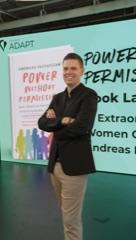

By Andreas Pettersson, Founder, Leaders ADAPT
You cut the bonus pool in March. You keep your own car allowance. Nobody says a word. In June two of your best people resign, and in the exit conversation one of them mentions March.
That is the whole book in one scene. A leaders eat last summary usually lists the Circle of Safety and the chemicals and stops there. The part an owner needs is the price tag. Every habit a CEO keeps or drops sends a signal about who is inside the circle, and people read those signals faster than any memo.
I lead a peer group of CEOs at Leaders ADAPT, virtual, capped at 14 members and with no revenue gate, and I read Sinek as someone who once had to pay for the kind of safety he describes. Below is the summary, a table that turns each idea into a Monday test, and a straight view of what works at $5M and what does not.
Quick answer: Leaders Eat Last, by Simon Sinek, argues that teams cooperate when people feel safe inside their group, a boundary he calls the Circle of Safety. Leaders build or break that safety through what they put first. He explains it with four chemicals, endorphins, dopamine, serotonin and oxytocin, plus cortisol under stress, and with examples from the Marines and from companies.
Leaders Eat Last summary in one paragraph
Leaders Eat Last is a book by Simon Sinek arguing that trust and cooperation inside an organization depend on whether its people feel protected by their leaders, and that leadership is a responsibility for the people in your care, not a rank. It was published by Portfolio/Penguin in 2014 and appeared on the bestseller lists of the Wall Street Journal and The New York Times. Sinek gave the argument a short form in his TED2014 talk, Why good leaders make you feel safe, which the TED page shows at more than 22 million plays.
The title comes from the Marine Corps habit of feeding the junior ranks first and the officers last. The author's own book page states the commercial claim plainly: leaders and organizations who prioritize the well being of their employees are more successful. The book spends most of its pages on why.
Read in one sitting, the leaders eat last book makes one argument from many angles. People who feel safe from each other spend their energy on the outside threat. People who do not, spend it on each other.
The core ideas, each with a Monday test
The book is long on stories and short on steps. Here are the six ideas that carry it, in my own words, each with the cost a CEO pays and a test you can run this week.
| Idea in the book | What Sinek argues | What it costs the CEO | Monday test |
|---|---|---|---|
| Circle of Safety | Inside the boundary people trust each other and face outward | The CEO has to absorb outside pressure instead of passing it down | Who on your team would tell you a bad number first? |
| Leaders eat last | Leadership is a cost accepted, not a perk collected | Status perks that look small from the top look large from below | Which perk did you keep the last time you asked others to cut? |
| Selfish chemicals | Endorphins and dopamine reward individual goals and hitting numbers | Bonus schemes that pay only individual targets pit people against each other | How much of your incentive plan rewards helping a colleague? |
| Selfless chemicals | Serotonin and oxytocin reward trust, status and belonging | Time. Trust is built in repeated contact, not in a speech | When did you last spend an hour with a team without an agenda? |
| Cortisol | Constant threat inside the group keeps people in self protection | Fear of the leader turns into hidden problems and slow decisions | What happened to the last person who brought you bad news? |
| Abstraction | Leaders who see people as numbers on a sheet make harsher calls | Distance grows with headcount, quietly | Can you name everyone affected by your last cost decision? |
The chemistry is a simplification, and Sinek presents it as a model rather than a lab report. The tests work anyway, because they look at behavior.
The Circle of Safety in an owner led company
In a corporation the circle is abstract. In an owner led company it is the owner's kitchen table. People can see who gets told first, who gets a second chance and who gets blamed in public.
The research world has a name for the same idea. Amy Edmondson defined psychological safety in 1999 as an environment where people feel safe to speak up, admit mistakes and take risks. Sinek's circle adds one thing to that definition. He puts the leader at the edge, holding the line between the people inside and the pressure outside.
Picture the circle as a roof. When it holds, the people under it work. When the CEO drills holes in it, by blaming a manager in front of the team or by passing every customer threat straight down, the rain gets in and everyone starts carrying an umbrella. Umbrellas are expensive. They are the cover emails, the extra approvals and the meeting before the meeting.
The best known business story in the book is Barry-Wehmiller. Sinek describes how its chief executive, Bob Chapman, chose a company wide furlough over layoffs during the financial crisis so that everyone shared a smaller loss rather than some losing their job. Barry-Wehmiller is a St. Louis manufacturing technology company that reports about 12,000 employees, so this is not a startup fable. It is a choice about who stays inside the roof.
The page on psychological safety in the workplace has the practical side of building that roof in a team.
What still works in a $5M company
Most of it. Some of it works better than in the large companies Sinek writes about, because the owner is close enough to be seen.
The perk test. Small companies are full of visible perks. The owner's parking spot, the owner's vacation that nobody else can take in the busy season, the owner's expenses. You do not have to give them up. You have to make sure they are never visible on the same day you ask others to give something up.
Absorbing pressure. A customer threatens to leave. The weak move is to forward the angry email to the account manager with a question mark. The strong move is to take the call, protect the person, and then fix the cause with them in private. That is Sinek's circle in one afternoon.
Bad news speed. If your team brings you bad news late, the circle has a leak. Not because your people are dishonest. Because the last messenger paid for it. Measure how many days a problem lives before it reaches you.
Abstraction at 50 people. At some point in growth the owner stops knowing every name. That is the moment cost decisions start being made on a spreadsheet. Keep one rule: no decision that removes a person's job or pay goes through without the CEO naming the people it touches.
What does not translate from a Marine platoon
Sinek's critics have a point, and an owner should hear it.
The chemical model is tidy and too neat. It is a way to talk about culture, not a dosage chart. Do not build an incentive plan on oxytocin.
The Marine example does not fully carry over. A platoon has a shared mission, shared risk and a chain of command that the law backs. A $5M company has customers who can leave, staff who can resign and an owner who has personally guaranteed the bank line. The owner eats last on status. The owner does not eat last on survival, because if the company dies, the circle dies with it.
The book also says little about the opposite failure. A CEO who protects everyone from everything builds a team that never meets the outside world. Safety does not mean comfort. It means people can say the hard thing without fearing the person they say it to. Some of them still have to hear hard things back.
Finally, "eat last" can turn into martyrdom. The owner who works every weekend so nobody else has to is not building a circle. They are building a dependency. Leadership is measured by how well the people inside the circle work when you are not in the room.
For the method the book does not give, the Extreme Ownership summary covers command and handovers, and the Start With Why summary covers Sinek's earlier book on purpose. The How to Win Friends and Influence People summary opens the full set of leadership book summaries.
The day safety cost me six months of runway
The book is a theory about trade offs. I had one.
While I was raising money for Arcules, one prospective investor commented on the women who sat on my leadership team. I walked away from that money. It cost us six months of runway. I slept fine.
I am not telling it as a badge. I am telling it because that is what the circle looks like in a real company. The cost was concrete and it landed on the company, not just on me. The signal was concrete too. My leadership team knew exactly where the edge of the circle was, and that I would hold it even when it hurt the plan. After that, I did not have to give speeches about values.
Most CEO tests are smaller. A rude customer. A sales star who is cruel to a junior colleague. A board member who wants a scapegoat. Each one asks the same question Sinek asks. Who is inside the circle, and what will you pay to keep them there?
A circle of operators for the decisions nobody inside your company can see
The decisions that test your circle are the ones you cannot discuss with the people inside it. The Leaders ADAPT CEO Mastermind is a virtual room of at most 14 owners, with no revenue gate, run by an operator who scaled a company to 150+ people and exited to Canon.
Each month there is one virtual session plus weekly office hours. Members check in with a score from 1 to 10, one member takes the hot seat with real numbers, and the room gives direct feedback on what the host is not seeing. Nobody logs off without one committed action, with an owner and a date beside it.
It is for owners who want the hard question asked before the decision, not after.
Leaders Eat Last summary FAQ
What is Leaders Eat Last about?
Leaders Eat Last is a 2014 book by Simon Sinek about why some teams trust each other and others do not. Its argument is that people cooperate when they feel safe inside their group, and that leaders create or destroy that safety by what they put first, the people in their care or the numbers and themselves.
What is the Circle of Safety in Leaders Eat Last?
The Circle of Safety is the boundary inside which people trust the colleagues around them and stop spending energy protecting themselves from each other. Threats still exist outside it, from competitors or markets. Sinek argues that the leader sets where the circle ends and who is inside, and that a wider circle produces more cooperation and fewer internal politics.
Where does the title Leaders Eat Last come from?
The title comes from a practice Sinek describes in the United States Marine Corps, where the most junior Marines eat first and the senior officers eat last. He uses it as a picture of leadership as a cost the leader accepts, putting the needs of the people in their care ahead of their own comfort and status.
What are the four chemicals in Leaders Eat Last?
Sinek groups four chemicals. Endorphins and dopamine reward individual effort and reaching goals, which he calls selfish chemicals. Serotonin and oxytocin reward status, trust and belonging, which he calls selfless. A fifth, cortisol, rises under stress and threat. The book uses this as a simplified model for how culture feels to the people inside it.
Is there a Leaders Eat Last summary PDF?
The publisher does not offer a free official summary PDF. A leaders eat last summary on a web page, such as this one, covers the main ideas in a few minutes of reading. For the full argument and the case studies, the book itself is available in print, ebook and audiobook formats through the usual retailers.
Is Leaders Eat Last worth reading for a business owner?
It is worth reading for an owner whose team hides problems or competes internally, because the book gives a clear model for why that happens. It is lighter on method. Readers looking for meeting structures, delegation steps or accountability scripts will need a more practical book alongside it to turn the ideas into weekly habits.
Eat last on one decision this month
This leaders eat last summary comes down to one habit. Pick the next decision where you could protect your own comfort or protect your people. Make the call in their favor, and do it in a way they can see. Then watch how fast the next piece of bad news reaches you.
Which perk, shortcut or silence of yours is your team reading right now?