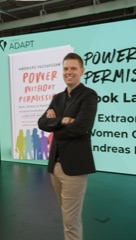

By Andreas Pettersson, Founder, Leaders ADAPT
After Arcules was sold to Canon, I sat inside two planning cultures at once. On one side, a startup that iterated fast, failed forward and learned by shipping. On the other, a global parent with mature, long range planning processes and big company policies.
The two contradicted each other constantly. We spent a lot of time extrapolating data that was not naturally caught in the daily business rhythm, just to please Canon.
Scaling Up sits between those two worlds. It gives a growing company more planning than a startup wants and far less than a conglomerate runs. Whether that is right for you depends on your stage, not on the framework.
Quick answer: Scaling Up is Verne Harnish's growth framework for companies that want to grow past the founder stage. It organises the business around four decisions (People, Strategy, Execution, Cash), a One Page Strategic Plan and the Rockefeller Habits meeting rhythm from daily huddles to annual planning. Its owner says it fits companies with 25 to 2,500 employees.
This page is part of our business operating system comparison, where this framework is scored against five other frameworks.
What is Scaling Up, and where did the Rockefeller Habits come from?
Scaling Up is a growth framework that makes a leadership team decide on people, strategy, execution and cash, then run those decisions through a fixed meeting rhythm.
Verne Harnish first set out the execution side in Mastering the Rockefeller Habits. His later book kept those habits and added the other three decisions. So when people search Rockefeller Habits, they are usually looking for the execution core of the same system.
The name borrows from John D. Rockefeller's practice of a small number of priorities, regular data and a disciplined meeting rhythm. The idea is old. The packaging is what Harnish added.
If you are comparing it with the Entrepreneurial Operating System, read the EOS head to head next. The short version: EOS is simpler, Harnish's system goes deeper.
Leaders ADAPT is an independent advisory firm. It has no affiliation, certification or endorsement from the owners of Scaling Up, EOS Worldwide, Pinnacle Business Guides, FranklinCovey or any framework owner. Names like Rockefeller Habits and One Page Strategic Plan are used here only to describe the frameworks, and none of their proprietary tools are reproduced.
What are the four decisions in Scaling Up?
The Four Decisions are the spine of the system. Each one is a question the leadership team has to answer before growth answers it for them.
Here is how I translate them for a CEO, with the failure I see most often at each stage.
| Decision | The question it asks | The failure I see most | First move at 30 people | First move at 150 people |
|---|---|---|---|---|
| People | Do we have the right people in the right roles, and do they want to be here? | Hiring fast, acting slowly on the wrong seat | Write down who owns each function, one name per function | Run a structured hiring process for every leader seat |
| Strategy | How do we win, and what do we say no to? | A plan that lists everything and chooses nothing | One sentence on where you win and one on where you will not play | A written strategy the whole leadership team can repeat |
| Execution | Are the priorities clear, measured and reviewed on rhythm? | Ten priorities, none finished | One to three quarterly priorities with one owner each | Priorities cascaded one level down with a weekly review |
| Cash | Will we have the cash to get where we are going? | Tracking revenue and ignoring cash position | A weekly view of revenue, cost and cash | Fixed and variable cost split, plus a cash conversion review |
Source: Leaders ADAPT operator translation of the Four Decisions, Andreas Pettersson, September 2026. The decisions are Harnish's. The questions, failures and first moves are ours.
The cash row is the one I push hardest. The numbers that matter are revenue, cost and cash position. Younger companies consistently miss the cash position. They also fail to separate fixed and variable cost, so their margins sway with staffing cost.
That is not an accounting problem. That is a leadership visibility problem.
What are the Rockefeller Habits?
The Rockefeller Habits are the execution discipline inside the framework. Harnish published them as a checklist. I will not reproduce it, but the habits group into three ideas.
Priorities. The leadership team is aligned and healthy, there is one clear top priority for the quarter, and every function has someone accountable for it.
Data. Every employee can tell, with a number, whether they had a good day or week. Customer and employee feedback is collected on a rhythm, not when someone complains.
Rhythm. Meetings run on a fixed cadence: a daily huddle, a weekly team meeting, a monthly review, a quarterly planning session and an annual one. Plans and progress are visible to everyone.
The daily huddle is the habit people underestimate. Fifteen minutes, same time every day, three items: what happened yesterday, what is on today, where anyone is stuck. It feels like overhead for the first month. Then it becomes the fastest way bad news reaches the leadership team.
The monthly review is the one people skip. It is where the numbers get a real look instead of a glance, and where cash gets its own line. Skip it and the quarterly session turns into an autopsy.
Painted. Framed. Laminated. Ignored. That is what happens to most habit checklists. The checklist only works if the leadership team scores itself against it every quarter and fixes the lowest score first.
What is the One Page Strategic Plan?
The One Page Strategic Plan is the framework's planning document, which fits long range direction, multi year targets, annual goals, quarterly priorities and individual accountabilities onto a single page.
Its value is the line of sight. A manager can trace their weekly work up to this quarter's priority, up to this year's goal, up to the long range direction. When that line breaks, people work hard on the wrong thing.
If I were installing it at a 100 person company, I would fill it in over two sessions, not one. The first session drafts the long range side and stops. The second, a week later, fills in the year and the quarter after the team has slept on the direction.
Then the page goes on the wall of every leadership meeting and gets a red, yellow or green mark each quarter. Two sessions, one page, four reviews a year.
Its risk is that it becomes a form. I have seen leadership teams fill every box in a day and never open the page again. A plan nobody reviews on rhythm is decoration.
EOS Worldwide describes it as more detailed than the two page EOS equivalent, and that matches my experience (EOS Worldwide, read September 2026). More detail is useful when the company has more moving parts. It is overhead when it does not.
How much does a Scaling Up coach cost?
The vendor's own comparison page says installation costs from $20 for the paperback to $40,000 to $200,000 or more per year for full coaching support (scalingup.com, read September 2026). The same page describes the install as ongoing rather than a fixed timeline.
Individual certified coaches quote their own fees. I have not found a public rate card, so I will not print a per day number I cannot source.
For comparison with EOS implementer fees, see our EOS implementer cost breakdown. For how external advisors price their time more broadly, see executive coaching cost.
Who is Scaling Up for, and who should wait?
The vendor says it fits firms with 25 to 2,500 employees (scalingup.com, read September 2026). My own rule is narrower.
Scaling Up from 100 to 250 people and beyond. EOS from 2 to 250. Beyond a few hundred people, its tools can be built on top of the EOS foundation.
Why the gap? Planning weight has to match the stage. Canon taught me that from the heavy end. A young company forced into mature planning spends its energy feeding the plan instead of learning from the market.
Harnish's system is lighter than Canon's. It is still heavier than a 30 person company needs.
Here is the test I use. Count the meetings your leadership team already runs well. If the weekly meeting still slips, adding a daily huddle and a monthly review will not rescue it. Get one rhythm right, then add the next.
It fits you if you have several product lines or markets, a management layer below the leadership team and cash that is getting harder to predict. It is premature if the founder still makes most decisions and the leadership team is four people. For that company, start simpler. Our EOS vs OKRs comparison and the independent EOS review are the better next reads.
Unsure which side of that line you sit on? That is a good use of a 1:1 advisory session.
Where does AI fit in Scaling Up?
The framework was designed before AI became a daily tool, and AI is a massive culture change. Every framework built before it needs to evolve so it does not miss that shift.
The rhythm gives AI obvious jobs. Summarise the daily huddles into a weekly digest.
Pull the KPIs for each quarterly priority. Draft a cash forecast for the monthly review. Produce a first draft of the one page plan from last year's version and this year's data.
The caution is real. Companies self implement, skip validation, never turn repeat work into reusable skills, and things go off the rails. I have walked into an organisation where a vibe coder had built the company CRM as a single HTML file with over 12 million lines of code. After about a month of proper training, with the right ontology, rules and framework, results come much quicker.
What the framework should never hand to AI:
- Who sits in which seat
- How an issue actually gets solved
- What happens after a missed priority
- The strategy and the annual commitments
- Reviews with your people
- Anything promised to a customer or a board
See what not to delegate to AI and our hub on AI for companies running EOS, which applies to teams on this framework too.
What Scaling Up does not fix
The People decision is strong on hiring. It is weak on the harder call: acting on the person already in the seat.
I learned this the slow way. Every time I stalled more than 30 days on a wrong seat, it was painful for the organisation and an unnecessary tax.
Sometimes it was the right person in the wrong seat, and we moved them. Sometimes there was a great company for that person, and it just was not ours. It took me a few years to learn the 30 day rule.
No framework makes that call for you. A better hiring process does not either.
The leadership work sits outside the tool. Our guide to leadership team development covers what every operating system surfaces and none of them solves.
Scaling Up is a serious framework for a company with serious complexity. Is yours there yet, or are you borrowing a bigger company's plan?
Common questions about scaling up
What is Scaling Up in simple terms?
Scaling Up is a growth framework created by Verne Harnish. It asks a leadership team to get four decisions right: people, strategy, execution and cash. It uses a one page strategic plan, a short list of quarterly priorities with measurable targets and a meeting rhythm that runs from a daily huddle to an annual planning session.
What are the Rockefeller Habits?
The Rockefeller Habits are a set of execution habits Verne Harnish first described in Mastering the Rockefeller Habits. They center on three ideas: a small number of clear priorities, data that shows daily and weekly progress, and a meeting rhythm that keeps the leadership team aligned. The later book updated and expanded them into its execution decision.
What is the One Page Strategic Plan (OPSP)?
The One Page Strategic Plan is the planning document in Verne Harnish's framework. It fits a company's long range direction, its three to five year targets, its one year goals, this quarter's priorities and individual accountabilities onto a single page. The aim is that every leader can see how a weekly task connects to the long term direction.
How much does a Scaling Up coach cost?
The vendor's own comparison page, read in September 2026, says installation costs from about $20 for the paperback book to $40,000 to $200,000 or more per year for full coaching support. Individual certified coaches set their own fees, so the actual price depends on the coach, the company size and the scope agreed.
What are the alternatives to Scaling Up?
The main alternatives are the Entrepreneurial Operating System, Pinnacle, System and Soul, the 4 Disciplines of Execution and OKRs. EOS is simpler and suits leadership teams under about 250 people. 4DX and OKRs are execution and goal methods rather than full operating systems. Pinnacle and System and Soul were built by former EOS practitioners.
Is Scaling Up the same as Mastering the Rockefeller Habits?
No. Mastering the Rockefeller Habits is Verne Harnish's earlier book, focused on priorities, data and meeting rhythm. The later Scaling Up book keeps those habits as its execution section and adds decisions on people, strategy and cash. Most practitioners treat the later book as the current version and the earlier one as its foundation.
Your next question
Three places to go from Scaling Up:
- EOS vs OKRs: which quarterly goal system fits
- The 4 Disciplines of Execution for CEOs
- 1:1 CEO advisory with Andreas
Or compare it with all five alternatives in the business operating system hub.
What it is: 1:1 advisory with Andreas Pettersson, a former CEO who has run Scaling Up, EOS and OKRs, on which operating system your company should run and how to install it. Who it is for: CEOs weighing a certified coach or an EOS implementer who want an independent view first. Talk to Andreas 1:1