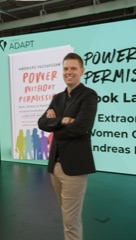

By Andreas Pettersson, Founder, Leaders ADAPT
Most CEOs frame EOS vs Scaling Up as a marriage. Pick one, forsake the other. EOS Worldwide's own comparison page says it plainly: do not mix the two systems.
I ran both. I ran EOS for years at Arcules, the company I founded and scaled to 150 people before it was sold to Canon. I have also run Scaling Up.
My answer is different. The real question is which one first, and what tells you it is time to add the second.
This page is one spoke of our business operating system comparison, which scores six frameworks on the same 12 criteria.
Quick answer: EOS vs Scaling Up comes down to company size and appetite for detail. The Entrepreneurial Operating System is simpler: a two page vision document, three to seven quarterly Rocks and one 90 minute weekly meeting, aimed at 10 to 250 employees. Scaling Up adds strategy and cash depth and a daily to annual meeting rhythm, aimed at 25 to 2,500 employees.
What is the difference between EOS and Scaling Up?
The Entrepreneurial Operating System is a set of simple tools from Gino Wickman's book Traction that aligns a leadership team on one vision, a few quarterly priorities and a weekly meeting.
Scaling Up is Verne Harnish's growth framework built on Four Decisions (People, Strategy, Execution, Cash) and the Rockefeller Habits meeting rhythm.
Both do the same basic job. They get a leadership team to agree on where it is going, what matters this quarter and who owns each number. The difference is how much they ask of you to get there.
EOS is built for simplicity. Six components, a handful of tools, one weekly meeting. Scaling Up is built for depth. More strategy, more cash discipline, more meetings.
People searching Traction vs Scaling Up are really asking the same thing: two books, two authors, two philosophies about how much structure a growing company can absorb.
| Dimension | EOS (Traction) | Scaling Up (Rockefeller Habits) |
|---|---|---|
| Owner's stated size | 10 to 250 employees | 25 to 2,500 employees |
| Planning document | Vision/Traction Organizer, two pages | One Page Strategic Plan, more detailed |
| Quarterly priorities | Rocks, 3 to 7 | Priorities with KPIs and a quarterly theme |
| Meeting rhythm | Level 10 Meeting, weekly, 90 minutes | Daily huddle, weekly, monthly, quarterly, annual |
| People tools | Core values, GWC, People Analyzer | Topgrading and core values |
| Cash | Tracked on the scorecard | A decision of its own |
| Owner's install stance | Pick one system and commit fully | Ongoing install, no fixed timeline |
Sources: EOS Worldwide, EOS vs. Scaling Up and Scaling Up's comparison page, both read September 2026. Each page is written by the side it describes.
What EOS does better
EOS is easier to start and easier to keep. A leadership team can learn the whole toolbox in a few sessions and run it without a consultant in the room every week.
It is also better at saying no. At Arcules, EOS gave us accountability, clearer roles and a framework to say no to a lot of things. The Rocks forced us to pick. If it was not for EOS, a lot of things would have become an issue.
And it surfaces issues without making them personal. The Nordic reflex is to pull the problem away from the person before anyone argues about it, and the weekly issues list does exactly that.
What Scaling Up does better
Scaling Up is better at strategy and cash. EOS asks where you are going. Scaling Up also asks how you will win there and whether you will have the cash to arrive.
It is also better at reaching the front line. A daily huddle in every operating team gets information up the organisation faster than a weekly leadership meeting ever will. Past a few hundred people, that matters.
The Rockefeller Habits vs EOS debate usually ignores this. The habits were written for companies with layers. EOS was written for one leadership table.
A note on where I stand: Leaders ADAPT is independent, not affiliated with, certified by or endorsed by EOS Worldwide, Scaling Up, Pinnacle Business Guides, FranklinCovey or any other framework owner. The framework names here describe the systems. No proprietary worksheet or tool is reproduced.
EOS vs Scaling Up: which is better for a small company?
For a small company, EOS wins almost every time. Not because Scaling Up is worse. Because a 30 person company cannot carry its weight yet.
My own stage rule is simple. EOS from 2 to 250 people. Scaling Up from 100 to 250 and beyond. Beyond a few hundred people, Scaling Up tools can be built on top of the EOS foundation.
Here is what happens when a 25 person company installs the full Scaling Up rhythm. The daily huddle becomes a status read. The strategic plan gets filled in once and never opened again. The CEO spends Friday writing KPIs for priorities nobody chose.
That is not a framework failure. That is a weight problem.
Here is how I sequence it, stage by stage.
| Headcount | Run this | Trigger to add more | What to borrow from Scaling Up |
|---|---|---|---|
| 2 to 20 | EOS basics: Rocks, an issues list, a weekly meeting | None yet | Nothing. Build the habit first |
| 20 to 100 | Full EOS, ideally with a professional implementer | Cash surprises the scorecard missed | A monthly cash review with fixed and variable cost split |
| 100 to 250 | EOS foundation, first Scaling Up tools | Several product lines or markets fighting for one quarter | Deeper strategy work and daily huddles in operating teams |
| 250 and above | Scaling Up or similar, on the EOS foundation | Management layers the weekly meeting cannot reach | The full meeting rhythm, level by level |
Source: Leaders ADAPT stage table, Andreas Pettersson's operating rule, September 2026. Headcounts are rounded working bands, not a vendor rule.
Want the independent read on EOS itself before you pick? Start with our independent EOS review.
How much does Scaling Up cost compared to EOS?
Both vendors publish something close to a range. Scaling Up's own page says installing Scaling Up costs from $20 for the paperback to $40,000 to $200,000 or more per year for full coaching support. The same page puts EOS at $14 for Traction up to $50,000 or more per year (Scaling Up, read September 2026).
EOS Worldwide does not print a fee. It says the cost varies by implementer, and that clients stay about two years on average (EOS Worldwide, updated July 2026). One implementer practice's public FAQ says to expect $20,000 to $45,000 per year for two years (published FAQ, read September 2026).
Read the Scaling Up page for what it is: one vendor pricing both sides. The full breakdown sits on our EOS implementer cost page.
My view on the implementer is short. It is always worth it, and use an external professional. Just make sure you are doing it to improve things, not to check a box.
If the implementer is outside your area, budget about $1,500 per trip for a two day session. That is my working figure, September 2026. If you want a second opinion before signing either kind of engagement, that is the conversation I have in 1:1 advisory.
Can you run EOS and Scaling Up together?
EOS Worldwide says no. I say yes, in sequence, with one vocabulary per meeting.
At Arcules our cadence was weekly Level 10 Meetings, quarterly Rock reviews, monthly performance reviews of the numbers and quarterly reporting to Canon. In the beginning we did not time those rhythms against each other. It created a lot of friction. It also created a lot of concern about whether EOS was the right model.
The fix was a calendar fix. We closed the last quarter and set the next quarter's Rocks before board preparation began. By the time anyone built a board slide, the leadership team was already aligned.
That was not an EOS problem. That was a sequencing problem.
Stacking works the same way. Keep one weekly meeting, one priority list and one scorecard. Borrow Scaling Up's strategy and cash tools for the quarterly and annual sessions. Never run two sets of names for the same thing in the same room.
Here is what that looks like in practice. If your team says Rocks, keep saying Rocks, even when the quarterly theme and the KPIs come from Scaling Up. If your scorecard lives in one tool, the Scaling Up dashboard feeds it, not the other way around. The moment a manager has to translate between two vocabularies before a meeting, you have added work without adding clarity.
When should a company move from EOS to Scaling Up? When complexity outgrows the two page plan. Several markets, a parent company or board pressing harder on strategy, cash that surprises you.
Frustration alone is not a trigger. If the weekly meeting feels stale, the fix is usually inside EOS: a sharper scorecard, fewer Rocks, an issues list that actually gets solved. Switching to Scaling Up vs EOS at that moment just gives a tired team a heavier rhythm.
Where does AI fit in EOS and Scaling Up?
Neither system was designed with AI in mind. Traction predates the current AI wave, and Scaling Up's rhythm predates it too. The culture change AI brings is bigger than either book anticipated, and both need to evolve so they do not miss it.
The good news: the meeting rhythm is exactly where AI earns its keep. In EOS, that means scorecard pulls with exception flags, Level 10 pre-reads, Rock status collection and to-do capture from the transcript. In Scaling Up, it means huddle notes rolled into a weekly summary, KPI dashboards and a draft cash forecast for the monthly review.
Who owns it? The CEO, the same way the CEO has to own the operating system. The Integrator or COO has to be fully bought in. Both, or it does not happen.
What stays human in either system:
- People decisions and seat changes
- The judgment inside every issue solved
- Consequences when a commitment is missed
- Strategic commitments and the annual plan
- Performance conversations
- Promises made to customers, boards and investors
More on the split in what not to delegate to AI, and the full map in AI for companies running EOS.
What a framework switch does not fix
At Arcules, one of my biggest mistakes had nothing to do with the framework. I gave up the Integrator role from a responsibility perspective, but not from an authority perspective.
Part of that came from the board and Canon, who expected me to be the authority. I held the power to fire the Integrator. That forced consensus decisions where the Integrator should have decided.
Scaling Up would not have fixed that. Neither would a better EOS implementer. Authority is a leadership decision, and no framework makes it for you.
That is why I tell CEOs to fix leadership first and pick the system second. Our guide to leadership team development covers the people problems both systems surface and neither solves.
The honest summary of EOS vs Scaling Up: start simple, add depth when complexity demands it, and never let a framework debate stand in for a leadership conversation.
Which one are you running today, and what made you choose it? Tell me.
Common questions about EOS vs scaling up
Is EOS or Scaling Up better for a company under 50 people?
For most companies under 50 people, EOS is the easier start. It uses fewer tools, one weekly leadership meeting and a short vision document. Scaling Up adds daily huddles, a more detailed strategic plan and a cash discipline that pays off more once the company has several layers of management. Small companies can still borrow its cash review.
Can you use EOS and Scaling Up at the same time?
EOS Worldwide advises against mixing the two and recommends committing to one. In practice, many larger companies keep EOS as the foundation, with Rocks, a weekly meeting and a scorecard, and add Scaling Up strategy and cash tools on top. The rule that keeps this workable is one vocabulary per meeting and one priority list per quarter.
How much does Scaling Up coaching cost compared to an EOS implementer?
Scaling Up's own comparison page, read in September 2026, puts Scaling Up at $20 for the book up to $40,000 to $200,000 or more per year with full coaching, and EOS at $14 for Traction up to $50,000 or more per year. EOS Worldwide says implementer fees vary by practice and clients stay about two years on average.
When should a company move from EOS to Scaling Up?
The usual trigger is complexity, not frustration. Signs include several product lines or markets competing for the same quarter, cash surprises the scorecard did not predict, a board or parent company pressing on strategy the vision document cannot hold, and managers two layers below the leadership team who need a daily rhythm. Headcount above 100 to 250 people is a common threshold.
What is the difference between Traction and Scaling Up?
Traction is Gino Wickman's book that describes the Entrepreneurial Operating System. Scaling Up is Verne Harnish's book that updates his earlier Mastering the Rockefeller Habits. Traction focuses on simple tools for a leadership team of up to about 250 people. Scaling Up goes deeper on strategy, cash and meeting rhythm, and is written for companies expecting to grow much larger.
What is the main difference in EOS vs Scaling Up?
The main difference in EOS vs Scaling Up is depth. EOS keeps a leadership team on a short vision document, three to seven quarterly Rocks and one 90 minute weekly meeting. Scaling Up asks for a more detailed one page strategic plan, priorities with KPIs, a daily to annual meeting rhythm and a separate decision on cash.
Your next question
Still weighing EOS vs Scaling Up? These three pages go deeper:
- Scaling Up explained: the Rockefeller Habits and the one page plan
- EOS vs OKRs: Rocks against key results
- How to choose an executive coach or advisor
Or go back to the business operating system comparison for all six frameworks side by side.
What it is: 1:1 advisory with Andreas Pettersson on how to run your company, including which operating system to install and in what order. Who it is for: founders and CEOs of 20 to 250 person companies who want an operator's view before signing an implementer or a coach. See 1:1 CEO advisory