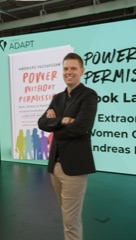

By Andreas Pettersson, Founder, Leaders ADAPT
Six frameworks. Networks of certified implementers, coaches and guides. Two year engagements. Fees that run from the price of a paperback to six figures a year.
And in my experience, the most common reason a company quits its business operating system has nothing to do with which one it picked.
I have run three of them: EOS, Scaling Up and OKRs. I ran EOS for years at Arcules, the company I founded and scaled to 150 people before it was sold to Canon, and I run EOS at Leaders ADAPT today. This page compares all six on the same 12 criteria, then tells you the part the vendors cannot.
Quick answer: A business operating system is the set of tools and meetings a leadership team uses to set direction, pick quarterly priorities, track a few numbers and hold people accountable. The main options are EOS, Scaling Up, Pinnacle and System & Soul, with 4DX and OKRs as execution layers. Company size, complexity and your leadership team's maturity decide which fits.
What is a business operating system?
A business operating system is the agreed set of tools, meetings and rules a leadership team uses to decide where the company is going, what matters this quarter, who owns each number and how issues get solved.
People also call it a company operating system, an operating system for business or a management operating system. The names differ. The job is the same.
Almost every system has the same six parts:
- A vision or strategy document, usually one or two pages
- A short list of quarterly priorities, each with one owner
- A scorecard of weekly numbers
- A meeting cadence, from weekly to annual
- An accountability structure, such as an accountability chart, that says who owns which function
- A way to surface and solve issues
What separates them is how much of each they ask for, how rigid they are and who installs them. A framework is not a leadership theory. If you want that distinction, our guide to leadership theories and models covers the other side.
One boundary matters. A CEO peer group is not an operating system. If you are weighing EOS against Vistage, that is a different question, answered in our CEO mastermind comparison.
Leaders ADAPT is independent of every framework on this page. We are not affiliated with, certified by or endorsed by EOS Worldwide, Scaling Up, Pinnacle Business Guides, System & Soul, FranklinCovey or any OKR vendor. We name their systems only to describe and compare them, and we reproduce none of their proprietary tools.
What are examples of business operating systems?
Here are the six, in one paragraph each. Every one has its own spoke in this guide.
EOS, the Entrepreneurial Operating System from the book Traction. Simple tools: a two page vision document, three to seven quarterly Rocks, a weekly 90 minute Level 10 Meeting and a scorecard. Its owner targets 10 to 250 employees (EOS Worldwide, read September 2026). Read our independent EOS review.
Scaling Up, Verne Harnish's framework built on the Rockefeller Habits. Four decisions (people, strategy, execution, cash), a One Page Strategic Plan and a daily to annual meeting rhythm, aimed at 25 to 2,500 employees (Scaling Up, read September 2026). See Scaling Up explained and EOS vs Scaling Up.
Pinnacle, from Pinnacle Business Guides, founded by one of the original EOS implementers. A customizable system shaped by a Business Guide, with fit claims for franchising, multi site operations and 250 to 1,500 employees (Pinnacle, read September 2026).
System & Soul, founded in 2021 by two former EOS coaches and a leadership organisation executive. Execution tools plus deliberate culture and team health work (System & Soul, read September 2026). Both are compared in EOS vs Pinnacle vs System & Soul.
4DX, the 4 Disciplines of Execution from FranklinCovey. Wildly Important Goals, lead measures, a scoreboard and a weekly cadence of accountability (FranklinCovey, read September 2026). An execution layer, not a full system. See the 4 Disciplines of Execution for CEOs.
OKRs, objectives and key results, developed by Andy Grove at Intel and brought to Google by John Doerr in 1999 (What Matters, read September 2026). A goal method, not a full system. See EOS vs OKRs.
Which business operating system is best? The six compared on 12 criteria
There is no best business operating system. There is the one that fits your company now. That is why we score all six on the same 12 criteria.
| Criterion | EOS | Scaling Up | Pinnacle | System & Soul | 4DX | OKRs |
|---|---|---|---|---|---|---|
| Stage | Early growth to mid market | Growth to large | Mid market, complex models | Growth, culture focused | Any, as a layer | Any, best with layers |
| Headcount (owner's claim) | 10 to 250 | 25 to 2,500 | Includes 250 to 1,500 | Not published | Any team | Any |
| Complexity it handles | Low to medium | High | Medium to high | Medium | One goal per team | Many teams |
| Cadence appetite | Weekly and quarterly | Daily to annual | Guide led | Weekly and quarterly | Weekly | Quarterly with check ins |
| Founder role | Visionary and Integrator split | CEO as strategist | Guide customises | Leader owns culture | Leader chooses the goal | Leaders set objectives |
| Capital to install | Book to implementer fees | Highest published ceiling | Quote based | $2,000 to $6,000 a month coach | Book to training | Method free |
| Industry fit (our view) | Most owner led SMBs | Scale ups, multi market | Franchise, multi site | People heavy services | Operations, service, sales | Product and tech |
| Growth rate | Steady | Fast | Varied | Steady | Any | Fast, stretch |
| Team maturity | New leadership teams | Experienced teams | Any, with a guide | Teams wanting health work | Teams with a rhythm | Teams at ease with stretch |
| Culture | Direct and simple | Data heavy | Flexible | Culture first | Disciplined | Ambitious, transparent |
| Geography | Implementer network | Coach network | Guide network | Coach network | Global trainer | Anywhere, self run |
| AI ambition | Pre AI, easy to add | Pre AI, rich data | Pre AI, customisable | Pre AI | Lead measures automate well | Measures automate well |
Source: Leaders ADAPT Framework Fit assessment, Andreas Pettersson, September 2026. Headcounts and costs are the owners' published claims, read September 2026 and linked above. Every other cell is our judgment, not a vendor statement.
The Framework Fit Scorecard is a Leaders ADAPT self assessment that scores your company on these 12 criteria to show which operating system fits your stage and leadership team.
Score yourself on the Framework Fit Scorecard. It takes a few minutes and tells you which column you are standing in.
How do I choose a business operating system?
My own stage rule is the starting point. EOS from 2 to 250 people. Scaling Up from 100 to 250 and beyond. Beyond a few hundred people, other frameworks like Scaling Up can be built on top of the EOS foundation.
Then walk these steps in order.
- Check the leadership team first. If the leaders at the top are not aligned, no system will hold.
- Count the layers. One leadership table suits EOS. Several management layers need more rhythm.
- Name your cadence appetite. A team that cannot keep a weekly meeting will not keep a daily huddle.
- Look at the founder's role. If the founder is both Visionary and operator, pick a system that forces the split.
- Pick one foundation and commit for many 90 day cycles.
- Hire an outside guide. It is always worth it, and use an external professional. The point is to improve things, never to check a box.
Here is what happens when a company skips step one. The leadership team picks a system in a single meeting, usually the one the CEO read about last. The first quarter goes well because everything is new.
By the third quarter the weekly meeting is where disagreements go to hide, and someone suggests trying a different framework. The framework was never the problem.
There are great things in all of these. I am not fixed on EOS. I recommend it most because it works for a lot of people, if the leadership is fixed first. If you want help walking these six steps, that is what my 1:1 CEO advisory is for.
Can you combine business operating systems?
Two full systems side by side fail. Two vocabularies, two priority lists, two sets of meetings. People spend the week translating.
One foundation with borrowed layers works. At Leaders ADAPT we run EOS and borrow OKR thinking for how we measure our 90 day targets. A company past a few hundred people can build Scaling Up strategy and cash tools on top of the EOS foundation. Any system can add 4DX lead measures to its scorecard.
The rule: one foundation, one vocabulary per meeting, layers only where they solve a named problem.
When does a company need a business operating system?
Earlier than most founders think. If you are more than three people, you need a framework, and you also need to work on your leadership.
That does not mean a two year implementer engagement at five people. It means a calendar.
A yearly planning session, a quarterly reset, a monthly look at the numbers, a weekly leadership meeting. Every business moves in cycles. The framework makes the cycles visible.
Establish the mindset early. Thinking in Rocks and keeping an issues list is a good habit when you are just a few people, and it makes the full system far easier to install later.
There is an opposite failure too. Too much system is its own tax. After Arcules was sold to Canon, I lived inside a big company planning machine: mature, long range processes that directly contradicted startup iteration. A lot of our time went into extrapolating data the daily rhythm never naturally caught, only to please Canon.
The right amount of system is the least that keeps the team aligned. When in doubt, subtract.
How much does a business operating system cost?
The methods are cheap. The installs are not. Every figure below is the owner's own published number, with the month we read it.
| System | Published cost | Source, read |
|---|---|---|
| EOS | Implementer fees vary, clients stay about two years on average | EOS Worldwide, September 2026 |
| EOS (per Scaling Up) | $14 for Traction up to $50,000 or more per year | Scaling Up, September 2026 |
| Scaling Up | $20 for the book up to $40,000 to $200,000 or more per year with full coaching | Scaling Up, September 2026 |
| Pinnacle | Not published, quote based | Pinnacle, September 2026 |
| System & Soul | Coach $2,000 to $6,000 a month, two year engagement recommended | System & Soul, September 2026 |
| 4DX | Program pricing not published on the page read | FranklinCovey, September 2026 |
| OKRs | The method is free, software and coaching optional | What Matters, September 2026 |
Add the hidden line: leadership team time. Every system asks for a weekly meeting, a quarterly day and an annual two days. That is the biggest cost on the list, and nobody invoices it.
If your guide travels, budget about $1,500 per trip for a two day session, my working figure from September 2026. The full EOS breakdown is on our EOS implementer cost page.
Where does AI fit in a business operating system?
Every system on this page was designed before AI. EOS predates AI entirely, and AI is now a massive culture change. EOS, and every framework like it, needs to evolve so it does not miss this.
Here is how I map AI onto the six parts of an operating system, using the EOS names.
| Component | Where AI helps | Where it stays out |
|---|---|---|
| Vision | Drafting help on the plan | The choices in it |
| People | Never | Every seat and every review |
| Data | Scorecard pulls and exception flags | Deciding what a red number means |
| Issues | Capture and triage | The solve |
| Process | Documentation and retrieval | Deciding the process |
| Traction | Rock status, meeting pre-reads, to-do capture | The commitments themselves |
The results are real when it is done properly. Clients have saved $200,000 to $300,000 per quarter in hours from email, calendar and reporting automation, with about 95 percent of that work automated and the decisions kept with the managers. A finance team that had open requisitions closed them once the AI processes were running. Those are my client figures, rounded, September 2026.
Who owns it? The CEO, the same way the CEO has to own the operating system, with the Integrator fully bought in. And one line for every Visionary who feels they do not understand operations: with help from AI, running inside a framework like EOS, you can absolutely expand your Integrator role.
What stays human in any system:
- Hiring, firing and seat changes
- The judgment in solving an issue
- Consequences for missed commitments
- The strategy and the annual plan
- Performance conversations
- What the company promises outside
The full map is in AI for companies running EOS, the boundaries in what not to delegate to AI, and the build in our guide to building the AI layer of your company.
What a business operating system does not fix
Back to the opening. The most common reason a company quits its system is not the system. It is the leadership underneath it.
Many companies start with EOS first in order to move ahead, but they are not able to do so if the leadership is poor. If people have implemented EOS and moved on, it is usually because leadership was never really established in the proper way to begin with. I have seen that many times.
I do not believe the system should mold the leader. The leader should be able to cope regardless of the system. Leadership first, then the system.
That is also where EOS is lacking. It lacks the how when it comes to leadership: how to delegate, how to hold people accountable, how to run 1:1s, how to give feedback. Our guide to leadership team development covers what every system surfaces and none of them solves, and the leadership style test is a quick way to see where your own habits sit.
Which system are you running today, and is the system really the thing holding you back? Tell me.
Common questions about business operating system
What is a business operating system?
A business operating system is the set of tools, meetings and rules a leadership team uses to set direction, choose quarterly priorities, track a few key numbers, solve issues and hold people accountable. Well known examples include EOS, Scaling Up, Pinnacle and System & Soul. Execution methods such as 4DX and OKRs cover only part of that job.
What are the most common business operating systems?
The most widely discussed are the Entrepreneurial Operating System (EOS), Scaling Up (the Rockefeller Habits), Pinnacle and System & Soul. Two execution methods, the 4 Disciplines of Execution and OKRs, are often compared with them but cover goals and weekly execution rather than the whole company. Many companies also build their own from these parts.
Which business operating system is best for a small business?
For most companies between about 3 and 250 people, EOS is the simplest full system to start with, because it uses few tools and one weekly leadership meeting. Scaling Up suits larger or more complex companies. Pinnacle and System & Soul suit teams wanting more flexibility or culture work. 4DX and OKRs work as layers on top.
How much does a business operating system cost?
The method itself can cost the price of a book. Guided installs cost more. Published figures read in September 2026 include System & Soul coaching at $2,000 to $6,000 a month and Scaling Up at up to $40,000 to $200,000 or more per year with full coaching. EOS and Pinnacle fees are set per implementer or guide.
Can a company run two business operating systems at once?
Running two full systems side by side usually fails, because the team ends up with two vocabularies, two priority lists and two sets of meetings. What works is one foundation, often EOS, with borrowed layers: lead measures from 4DX, key result style measurement from OKRs, or Scaling Up strategy and cash tools once the company grows larger.
Is a CEO peer group like Vistage a business operating system?
No. Peer groups such as Vistage, YPO and EO bring CEOs together for advice, perspective and accountability to peers. They do not give a company a vision document, a weekly meeting, quarterly priorities or a scorecard. Many CEOs use both: a peer group for their own development and an operating system to run the company.
Your next question: the whole guide
Every page in this business operating system guide:
- EOS vs Scaling Up: which fits your company
- Scaling Up explained: the Rockefeller Habits and the one page plan
- EOS vs OKRs: Rocks against key results
- The 4 Disciplines of Execution for CEOs
- EOS vs Pinnacle vs System & Soul
- The Framework Fit Scorecard
If you want a person rather than a page, see how to choose an executive coach or advisor.
What it is: 1:1 advisory with Andreas Pettersson, a former CEO who ran EOS, Scaling Up and OKRs, on which operating system to run and how to fix the leadership underneath it. Who it is for: founders and CEOs of 10 to 250 person companies choosing or rethinking their system. See 1:1 CEO advisory